
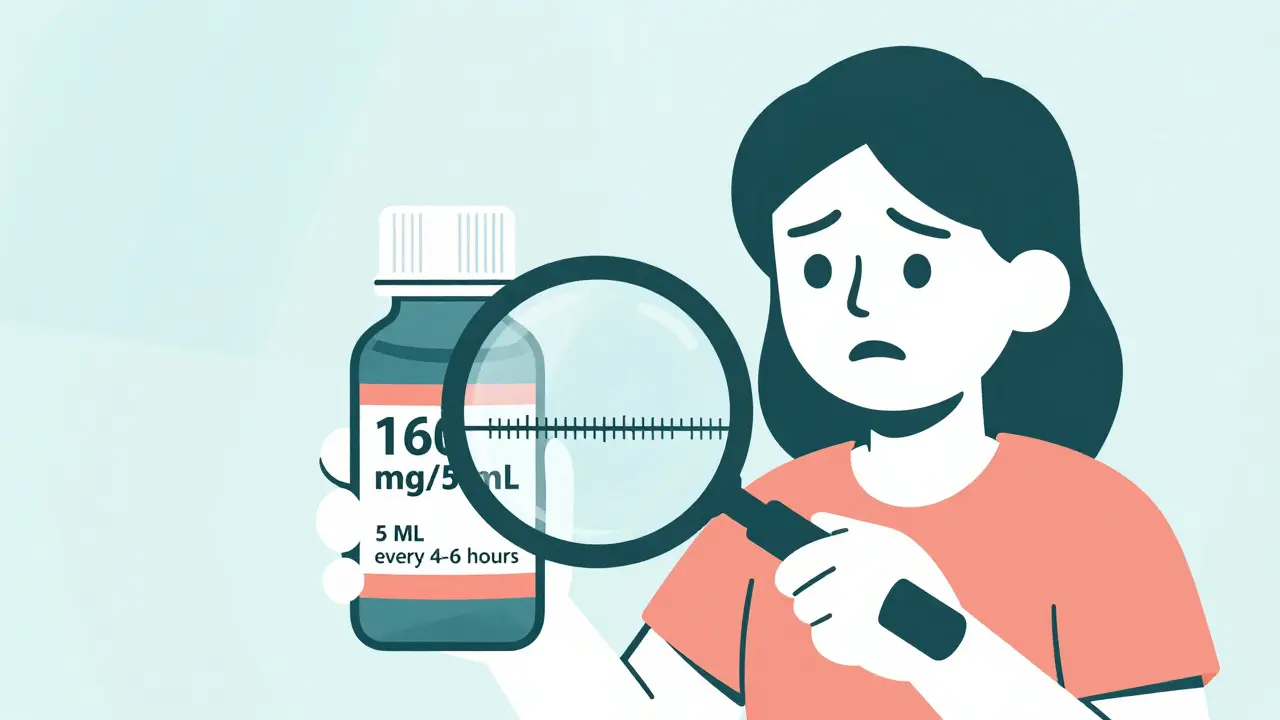
Reading a liquid prescription label might seem simple-until you’re holding a bottle with numbers and tiny lines and your child is sick and needs medicine now. One wrong measurement can mean too little medicine doesn’t work, or too much causes dangerous side effects. In the U.S., liquid medication errors cause over 1.3 million injuries every year, according to the FDA. Most of these mistakes happen because people misread the dose on the label. But it’s not your fault. The system has been confusing for decades. The good news? There’s a clear, simple way to read these labels correctly-and avoid serious mistakes.
What You’ll See on the Label: Three Key Parts
Every liquid prescription label has three essential pieces of information you must understand before giving any medicine:- Total container volume - This is how much liquid is in the whole bottle. You’ll see something like “118 mL” or “240 mL.” This number tells you the total amount of medicine in the bottle, not how much to give. Don’t confuse this with the dose.
- Concentration - This is the most important part. It tells you how much medicine is in each milliliter. It’s written like “125 mg/5 mL.” That means every 5 milliliters of liquid contains 125 milligrams of the active drug. If the label says “240 mg/5 mL,” then 5 mL has 240 mg of medicine. Always read this line carefully. Many errors happen when people think the number before the slash is the dose.
- Dosage instructions - This tells you how much to give and how often. It will say something like “Take 10 mL twice daily.” That means 10 milliliters, two times a day. Never guess. Never use a kitchen spoon.
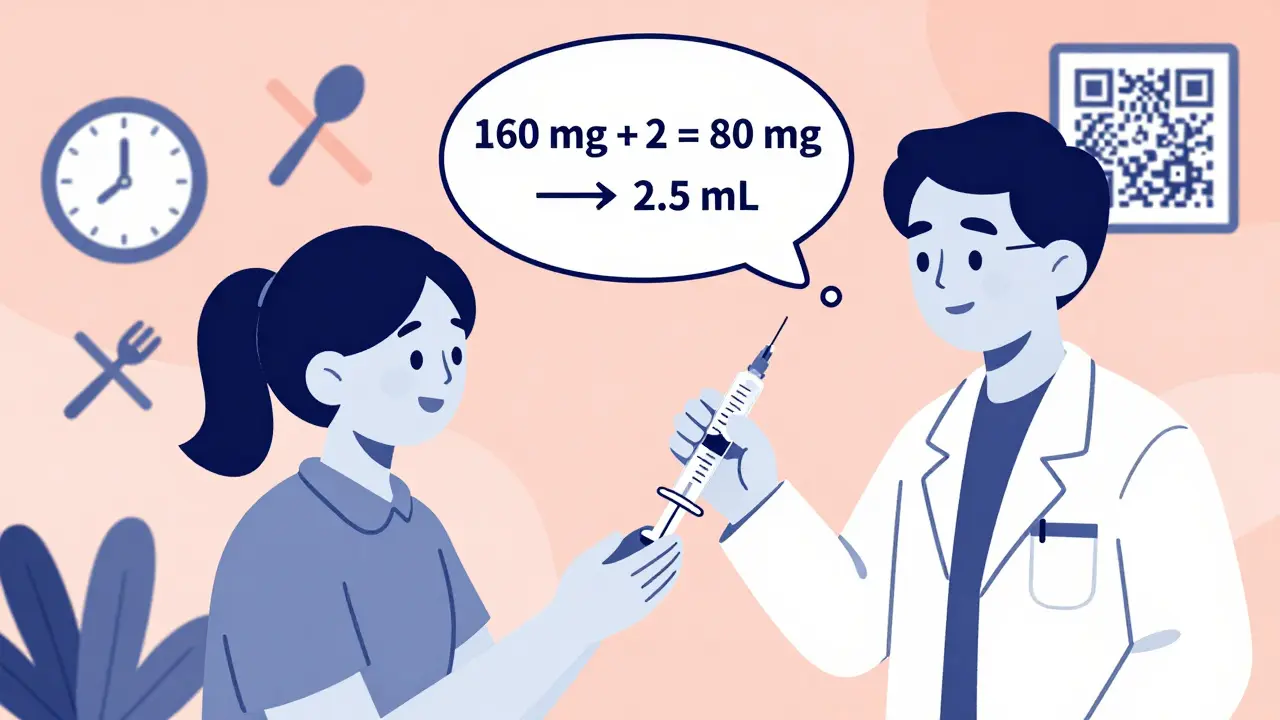
Here’s a real example: A bottle says “Concentration: 160 mg/5 mL. Dose: 5 mL every 4-6 hours.” That means each 5 mL dose contains 160 mg of medicine. If your child needs 80 mg, you give 2.5 mL-not half the bottle, not half a spoon. Always calculate based on the concentration, not the total volume.
Why Milliliters (mL) Are the Only Safe Unit
You might see old labels or over-the-counter bottles still using teaspoons (tsp) or tablespoons (tbsp). Don’t trust them. Household spoons vary wildly. A teaspoon you use for coffee might hold 4 mL one day and 7 mL the next. The FDA and the National Council for Prescription Drug Programs (NCPDP) banned these units on prescription labels in 2016 because of this.Here’s what’s actually true:
- 1 teaspoon = exactly 5 mL
- 1 tablespoon = exactly 15 mL
- 1/2 teaspoon = 2.5 mL
- 1/2 tablespoon = 7.5 mL
But your kitchen spoon? It could be anywhere from 2.5 mL to 20 mL. A 2018 Consumer Product Safety Commission study found household teaspoons held between 2.5 and 7.5 mL-way off from the 5 mL standard. That’s why parents using spoons are twice as likely to give the wrong dose, according to a 2016 study in the Journal of Pediatrics.
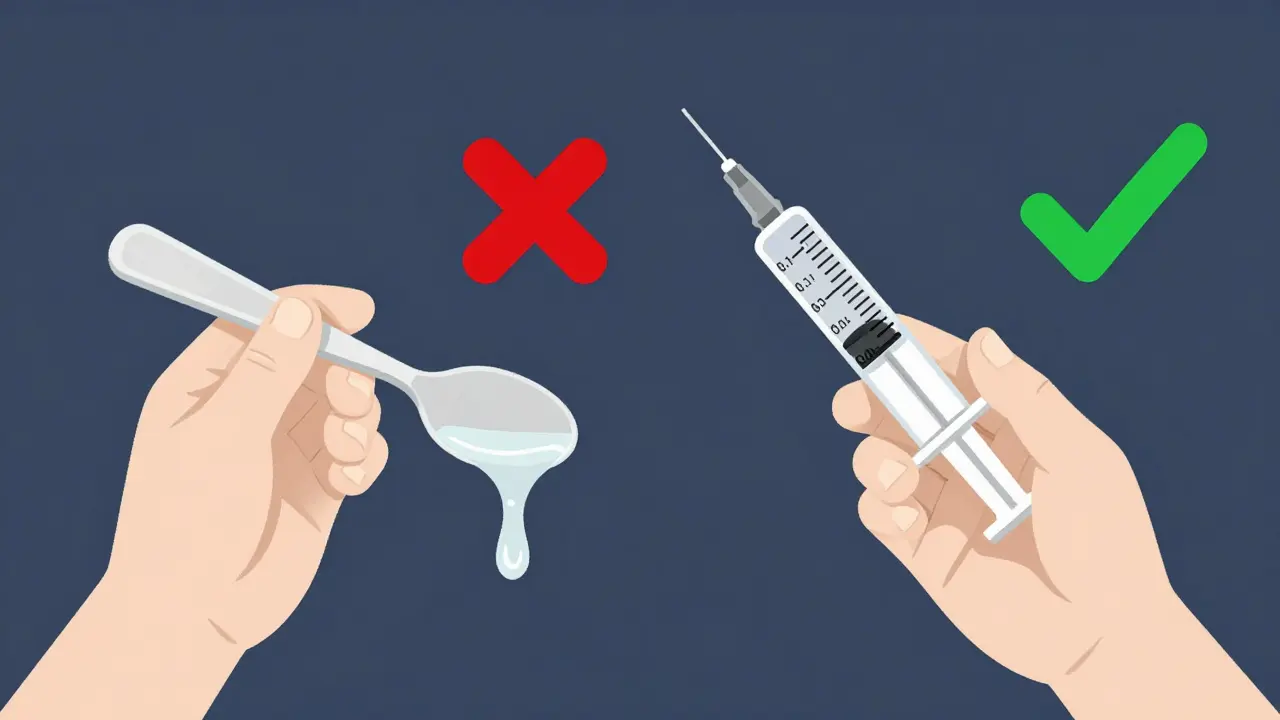
Always use the measuring device that came with the medicine. It’s marked in milliliters. If it didn’t come with one, ask the pharmacist for a syringe or cup. They’re free. Don’t use anything else.
How to Read Decimal Points Correctly
Decimal points on labels can be deadly if misread. The rules are strict for a reason:- Always write 0.5 mL-not .5 mL. The leading zero prevents misreading “.5” as “5.”
- Never write 5.0 mL-only 5 mL. The trailing zero can make someone think it’s more precise than it is, leading to overdosing.
A 2018 Johns Hopkins study showed that following these rules cut 10-fold dosing errors by 47%. That means if your child needs 0.8 mL, and you see “.8 mL,” you might accidentally give 8 mL-ten times too much. That could cause serious harm. Always look for the zero before the decimal.
What the Dosing Device Tells You
The syringe or cup that comes with the medicine isn’t just a tool-it’s your safety net. But not all devices are created equal. Some have markings every 0.1 mL. Others only every 1 mL. The key is to match the device to the dose.For doses under 5 mL, use a syringe. They’re more accurate. For doses over 5 mL, a dosing cup with clear lines works fine. But here’s the catch: always use the device that came with the bottle. Don’t swap it for another one. Different devices have different line placements. A line labeled “5 mL” on one cup might be 4.8 mL on another. That’s enough to cause a problem.
Also, check the maximum measurement. Some syringes only go up to 5 mL. If your dose is 10 mL, you’ll need to give two separate doses. Don’t try to fill a small syringe twice and guess the total. Use the right tool.
How to Avoid the Most Common Mistakes
Even with clear labels, people still mess up. Here are the top three mistakes-and how to stop them:- Confusing concentration with dose - You see “240 mg/5 mL” and think, “The dose is 240 mg.” No. The dose is whatever the doctor wrote: “Take 2.5 mL.” You have to calculate: 2.5 mL is half of 5 mL, so half of 240 mg = 120 mg. That’s your dose.
- Using kitchen utensils - Even if you think your teaspoon is “accurate,” it’s not. Pharmacists see this every day. It’s the #1 reason for errors in children under 12.
- Ignoring the expiration date - Liquid medicines lose strength over time. If the label says “Expires 03/2026,” don’t use it after March 31, 2026. Even if it looks fine, it might not work.
There’s one more thing: always double-check with the pharmacist. If you’re unsure, ask: “Can you show me how to measure this?” Most pharmacies now offer this for free. A 2021 study from Nationwide Children’s Hospital found that 78% of parents who got a live demonstration made zero errors. Without it, the error rate was 39.4%.
What to Do If You’re Still Confused
If the label feels overwhelming, you’re not alone. Only 12% of U.S. adults have strong health literacy, according to the National Assessment of Adult Literacy. You don’t need to be a doctor to get this right. Here’s what to do:- Ask the pharmacist to write the dose on a sticky note: “Give 3 mL, twice a day.”
- Take a photo of the label and the dosing device with your phone. Review it before giving the medicine.
- Use the “teach-back” method: After the pharmacist explains, say, “So I give 4 mL using this syringe, twice a day, right?” If they say yes, you got it.
Some pharmacies now include QR codes on labels that link to short videos showing how to measure the dose. Amazon Pharmacy and McKesson’s Medly are leading this trend. If your label has one, scan it. It’s faster than reading.
What’s Changing in 2025 and Beyond
The rules are getting stricter. The FDA proposed new rules in 2023 requiring pictograms on all liquid medication labels-simple images showing how to use the syringe or cup. By 2025, Medicare and Medicaid will start penalizing pharmacies that don’t follow the latest NCPDP standards. That means labels will be clearer, fonts bigger, and spacing tighter.The American Academy of Pediatrics is also rolling out a 2024 program to teach parents how to read these labels during well-child visits. Right now, 41% of parents get no counseling at all. That’s changing.
For now, your best tools are still simple: know the three parts of the label, use only the provided measuring device, never use a spoon, and ask questions. You’re not just giving medicine-you’re protecting your child’s health.
Can I use a kitchen teaspoon if I don’t have a dosing cup?
No. Kitchen teaspoons vary in size from 2.5 mL to 7.5 mL, and tablespoons can hold 5 mL to 20 mL. Even if you think yours is accurate, it’s not reliable. Always use the measuring device that came with the medicine. If you don’t have one, call your pharmacy-they’ll give you a free syringe or cup.
What does ‘125 mg/5 mL’ mean on the label?
It means that every 5 milliliters of liquid contains 125 milligrams of the active drug. If your dose is 10 mL, you’re getting 250 mg total. If your dose is 2.5 mL, you’re getting 62.5 mg. Always calculate based on the concentration, not the total volume in the bottle.
Why do some labels say ‘0.5 mL’ and others say ‘.5 mL’?
Only ‘0.5 mL’ is correct. The leading zero prevents confusion. ‘.5 mL’ can be misread as ‘5 mL’-that’s a tenfold overdose. FDA and NCPDP require the leading zero. If you see a label without it, ask the pharmacist to double-check the dose.
Is it safe to use an old dosing cup from a previous prescription?
No. Each medicine has a different concentration, and dosing devices are designed for specific volumes. A cup marked for one medicine may not match the lines for another. Always use the device that came with the current prescription. If it’s missing, ask for a new one.
What should I do if I think I gave the wrong dose?
Call your pharmacist or poison control immediately at 1-800-222-1222. Don’t wait for symptoms. Even if you think it’s a small mistake, it’s better to be safe. Keep the bottle and dosing device with you when you call-they’ll need to know the concentration and how much you gave.
Next Steps for Safe Medication Use
- Always read the label before each dose. Don’t assume it’s the same as last time. - Keep all liquid medicines out of reach of children, even if they’re empty. - Write down the dose, time, and amount each time you give it. This helps avoid double-dosing. - If you’re ever unsure, stop. Call the pharmacy. No question is too small. - Ask for a free measuring device if one wasn’t included. - Teach other caregivers how to read the label. Grandparents, babysitters, and partners need to know too.Medication safety isn’t about being perfect. It’s about being careful. One extra minute reading the label can prevent a trip to the ER. You’ve got this.

Meghan O'Shaughnessy
December 18, 2025 at 03:12My kid had a fever last week and I almost gave him the wrong dose because I misread the concentration. I thought 125 mg/5 mL meant the dose was 125 mg, not that each 5 mL had that much. Scary stuff. I’m so glad this post exists. 🙏
Kaylee Esdale
December 19, 2025 at 15:43Just use the syringe. No spoons. No guessing. No drama. I used to wing it until my niece got sick from a double dose. Now I measure like my life depends on it-because it does.
0.5 mL. Not .5. Always.
Pharmacies give free ones. Ask. Done.
Jody Patrick
December 20, 2025 at 17:01USA got this right. Other countries still use teaspoons. That’s why their kids end up in the ER. We’re ahead. Don’t let the world drag us back.
Radhika M
December 21, 2025 at 20:22I work in a pharmacy in India and we see this every day. Parents use spoons because they don’t have syringes. We always give them free ones. Please ask. No shame. Safety first.
Jonathan Morris
December 23, 2025 at 19:20Let’s be real-this whole system is a corporate scam. The FDA doesn’t care about you. They just want you to buy their branded syringes so pharmacies make more profit. The real solution? Liquid meds should come in pills. But they won’t tell you that because Big Pharma owns the FDA.
Donna Packard
December 25, 2025 at 09:20I used to panic every time I had to give medicine. Now I take a breath, read the label three times, and use the syringe. It’s not hard. You’ve got this. And if you’re unsure? Call the pharmacy. They’re happy to help.
Patrick A. Ck. Trip
December 27, 2025 at 05:50i just wanted to say thank you for sharing this. it means a lot to me as a parent. i’ve made mistakes before and i’ve learned. i always double check now. even if its 2am and my baby is crying. i still read the label. because safety matters. 🙏
Virginia Seitz
December 28, 2025 at 20:570.5 mL. Not .5. I’m telling my whole family this. 🚨💉
Peter Ronai
December 28, 2025 at 23:13Oh please. You think this is the first time someone’s tried to ‘simplify’ medicine? They did the same thing with insulin in the 90s. Now we have 30 different types. This is just the next step in making parents feel dumb so they’ll keep coming back. The real problem? Doctors who write illegible scripts. But nobody talks about that.
Joe Bartlett
December 29, 2025 at 08:33Brilliant post. UK’s still using tsp on some OTC meds. Madness. We need to follow the US lead. No more spoons. Syringes only. Simple.
Marie Mee
December 30, 2025 at 14:18they’re lying about the syringes being safe you know that right? the plastic leaches chemicals into the medicine and then your kid gets autism. i read it on a blog. my cousin’s friend’s neighbor’s doctor said it too. they don’t want you to know
Naomi Lopez
December 30, 2025 at 21:21While the intent of this article is commendable, the structure lacks a rigorous citation framework. For instance, the claim that ‘1.3 million injuries annually’ is attributed to the FDA, yet no source link or publication date is provided. This undermines the credibility of an otherwise well-intentioned piece. Please cite your data properly.