
Every pill bottle, every prescription box, every OTC medicine you pick up has a label. But most people skip right past the fine print-especially the contraindications and warnings. That’s a mistake. These sections aren’t legal jargon. They’re life-or-death instructions written by the FDA to keep you safe. If you don’t understand them, you’re flying blind when it comes to your own health.
What’s the Difference Between a Contraindication and a Warning?
It’s simple: a contraindication means don’t take this drug at all. A warning means proceed with extreme caution.
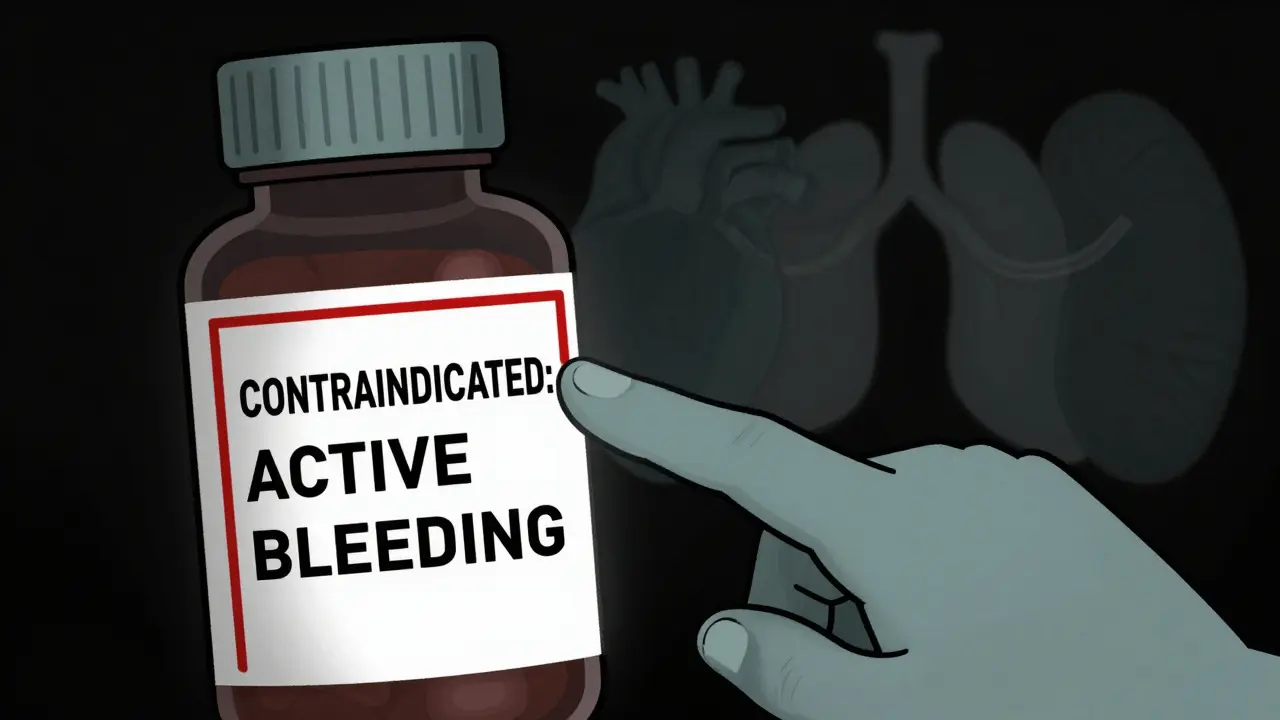
Contraindications are absolute. If your medical history matches one listed in Section 4 of the prescription label, the drug is off-limits. For example, the blood thinner Xarelto has a contraindication for patients with active bleeding. If you’re currently bleeding from an ulcer or had a recent brain hemorrhage, taking Xarelto could kill you. No exceptions. No "maybe."
Warnings, on the other hand, are about risk. They tell you what could go wrong-and how to watch for it. Take Humira, used for rheumatoid arthritis. Its warning says serious infections like tuberculosis can happen. That doesn’t mean you can’t take it. It means you need a TB test before starting, and you need to call your doctor if you develop a fever or cough that won’t go away.
Boxed Warnings: The Red Flag You Can’t Ignore
At the very top of every prescription drug label, if there’s a boxed warning, it’s the FDA’s highest alert. It’s surrounded by a thick black box. That’s not decoration. It’s a scream.
Warfarin (Coumadin) has a boxed warning for major or fatal bleeding. Bupropion (Wellbutrin) has one for increased suicide risk in young adults. These aren’t rare side effects. They’re serious enough that the FDA requires them to be front and center.
Here’s the truth: 40% of drugs approved between 2008 and 2012 got a boxed warning within their first five years on the market. That’s not a fluke. It’s the system working. These warnings are added after real patients get hurt. If your drug has one, don’t panic-but don’t ignore it either. Ask your doctor: "What’s the actual risk for me? How do I spot it early?"
How Prescription Drug Labels Are Structured
Prescription labels follow a strict 16-section format set by the FDA since 2006. You don’t need to read all of them. But you must read these three in order:
- Boxed Warning (if present)-top priority
- Section 4: Contraindications-what you must avoid
- Section 5: Warnings and Precautions-what to watch for
Why this order? Because risk goes from absolute to relative. A contraindication overrides everything else. If you have a contraindication, the warning doesn’t matter-you shouldn’t be taking the drug at all.
For example, the diabetes drug metformin has a contraindication for severe kidney disease. But its warning says lactic acidosis is rare. If your kidneys are failing, the warning is irrelevant. The contraindication already told you: don’t take it.
What About Over-the-Counter Drugs?
OTC labels look different. No sections. No numbers. Just "Drug Facts." But the same rules apply.
Look for the Warnings section. Inside, you’ll find two key phrases:
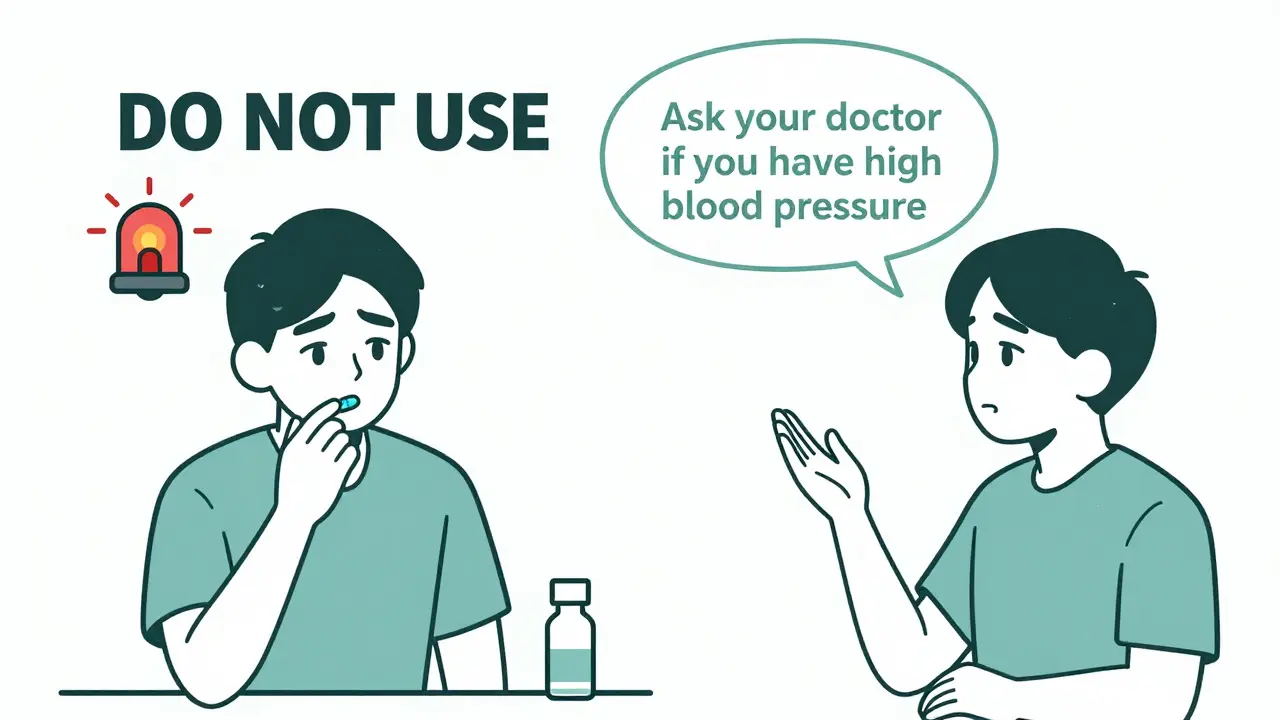
- "Do not use" = contraindication. If you have asthma and the label says "Do not use if you have asthma," don’t take it.
- "Ask a doctor before use if..." = precaution. This is where relative risks live. "Ask a doctor if you have high blood pressure" means your BP might make this drug riskier-but it doesn’t mean it’s banned.
A 2022 FDA study found only 52% of people could correctly identify a "Do not use" statement as a hard stop. That’s scary. People think "ask a doctor" means "it’s probably fine." It doesn’t. It means: "This could hurt you. Get professional advice first."
Relative vs. Absolute: The Most Confusing Part
Here’s where most people get tripped up. Not all contraindications are the same.
An absolute contraindication is a flat-out no. Example: penicillin if you’ve had anaphylaxis. No exceptions.
A relative contraindication is a maybe. Example: ibuprofen if you have mild kidney disease. It’s not banned, but your doctor needs to adjust the dose or monitor you closely.
One Reddit user shared how their cardiologist prescribed amiodarone for an irregular heartbeat-even though they had mild lung disease. The pharmacist refused to fill it, thinking the contraindication applied. But the label said "severe" pulmonary disease. The doctor knew the difference. The pharmacist didn’t.
That’s why you need to read the exact wording. "Severe" isn’t the same as "mild." "Active bleeding" isn’t the same as "history of bleeding." Precision matters.
Why Labels Get Updated-and What That Means for You
Drug labels aren’t static. The FDA updates them constantly. Between 2020 and 2023, they changed 147 labels based on real-world data from the Sentinel Initiative. That’s the FDA’s system for tracking what happens to real people after they take a drug.
For example, in 2023, the FDA added a new warning to some statins after data showed higher diabetes risk in older adults. That warning didn’t exist five years ago.
So if you’ve been on a drug for years, don’t assume the label hasn’t changed. Ask your pharmacist or doctor: "Has this drug’s warning been updated recently?"
How to Use This Information in Real Life
Here’s how to turn labels from confusing text into actionable safety steps:
- Before taking any new drug, ask for the full prescribing information. Most pharmacies can print it or email it.
- Go straight to the Boxed Warning, then Section 4, then Section 5.
- Highlight any "Do not use" or "contraindicated" phrases that match your health history.
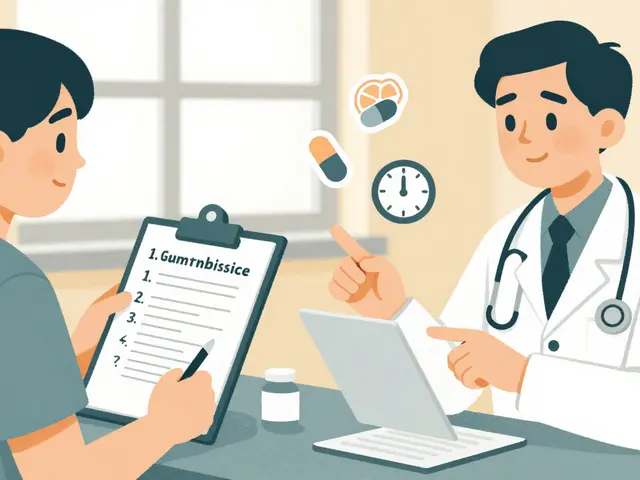
- Write down any warnings that apply to you: "Ask doctor if I have liver disease," "Watch for swelling in legs," etc.
- Ask your doctor: "Is this warning relevant to me? What signs should I look for? What should I do if I see them?"
- Keep a list of your contraindications and warnings. Bring it to every appointment.
Don’t rely on memory. Don’t trust the pharmacy’s one-sentence summary. Read the label yourself. You’re the one who has to live with the consequences.
What If You Don’t Understand It?
It’s not your fault. The FDA admits only 30% of critical safety info is effectively understood by patients. The language is dense. The risks are complex.
But you have rights. You can ask for help:
- Ask your pharmacist to explain the warning in plain language.
- Call the FDA’s MedWatcher hotline (1-800-FDA-1088) to report confusion or ask questions.
- Visit the FDA’s website and search for the drug name + "label." They post the full document.
- Use patient advocacy groups like the National Psoriasis Foundation-they’ve created plain-language guides for common drugs.
There’s no shame in asking. The goal isn’t to be a medical expert. The goal is to stay alive.
What’s Changing in the Future
The FDA is trying to fix this. In 2024, they required all new drugs to include a "Highlights" section that summarizes the most important warnings in plain language. Some companies are testing color-coded risk levels-red for high, yellow for medium, green for low.
And AI is starting to help. Mayo Clinic and Kaiser Permanente are testing tools that scan your medical record and flag which warnings apply to you personally. Imagine opening your app and seeing: "Your history of kidney disease means you should avoid this drug. Here’s why."
But until that’s everywhere, you’re still the last line of defense. Don’t skip the fine print. It’s not there to scare you. It’s there to save you.


lisa Bajram
January 10, 2026 at 19:16Y’all need to stop treating drug labels like they’re written in ancient Latin. I used to skip ‘em too-until my mom ended up in the ER because she took ibuprofen with her blood pressure med and her kidneys freaked out. The label said ‘ask your doctor if you have hypertension’-she thought that meant ‘maybe ask if you’re curious.’ Nope. That’s a red flag. Now I print every label and highlight the scary parts. It’s not paranoia, it’s survival.
Ted Conerly
January 11, 2026 at 19:06Exactly. I work in a pharmacy and people come in asking why their new med ‘feels weird’-and half the time, the warning was right there in plain sight. ‘Do not use if you have kidney disease.’ They had stage 3. Didn’t read it. I’ve stopped just handing out pills. Now I say ‘read this like your life depends on it’-because it does.
Ashlee Montgomery
January 13, 2026 at 13:15There’s a difference between ‘contraindicated’ and ‘caution advised’ that most people miss. I once had a pharmacist refuse to fill my amiodarone because I had mild asthma. The label said ‘severe pulmonary disease.’ I had to show him the actual text. He apologized. But how many people just accept ‘no’ without digging deeper?
Saumya Roy Chaudhuri
January 13, 2026 at 15:52Let me guess-you think the FDA actually cares about you? They only update labels after enough people die. That’s not safety, that’s damage control. They approve drugs fast, then panic when the bodies pile up. Your ‘life-saving label’ is just a postmortem memo.
Ian Cheung
January 13, 2026 at 17:10My grandma takes 12 pills a day and she reads every single label. She circles the warnings in pen, writes notes in the margin like ‘watch for dizziness after 3pm’ or ‘don’t take with grapefruit.’ She’s 84 and still hiking. I’m 32 and just googling side effects. Maybe I’m the one who needs to grow up.
Lisa Cozad
January 14, 2026 at 02:36My dad had a stroke last year. He was on a blood thinner. The label said ‘avoid NSAIDs.’ He didn’t know ibuprofen was an NSAID. He took it for his back pain. That’s how you end up in the ER. Now I print labels for my whole family and we have a weekly ‘med check’ at dinner. No jokes. No distractions. Just read it out loud.
Michael Marchio
January 15, 2026 at 04:20It’s not just about reading the label-it’s about understanding the hierarchy. Boxed warning first, then contraindications, then warnings. Most people read the whole thing like a novel. That’s why they miss the part that could kill them. The FDA structured it for a reason. Skip the fluff. Go straight to the kill switch.
neeraj maor
January 15, 2026 at 17:29And who writes these labels? Big Pharma lawyers. They bury the real risks in legalese so you don’t sue them. The ‘contraindications’ are just the tip of the iceberg. The real dangers? The ones they don’t list. The ones that show up years later in the ‘Post-Marketing Surveillance’ section that nobody reads. You think you’re safe? You’re just a data point.
Jay Amparo
January 16, 2026 at 21:23I’m from India and we don’t have the same access to detailed labels. But I’ve learned to ask: ‘Is this safe for someone with my history?’ My uncle took a diabetes drug and didn’t know it could cause pancreatitis. He didn’t ask. He just trusted the pharmacist. He’s fine now, but I’ll never stop asking questions. Knowledge isn’t power-it’s oxygen.
Mario Bros
January 17, 2026 at 15:14Just read the damn label. I used to roll my eyes at this stuff too. Then I got prescribed Adderall and saw the warning about heart issues. I got an EKG. Turned out I had a minor arrhythmia they missed. Saved my life. Labels aren’t boring-they’re your body’s emergency manual.
Jake Nunez
January 18, 2026 at 11:30My sister took melatonin for sleep. The label said ‘do not use if you have autoimmune disease.’ She has lupus. Didn’t read it. Woke up in the hospital with a flare-up. Now she has a sticky note on her medicine cabinet that says ‘READ FIRST.’ I made it for her. She cries every time she sees it. Good. Let her cry. It’s better than crying in the ICU.
Faith Edwards
January 19, 2026 at 22:53It is a profound societal failure that the average citizen must act as their own pharmacologist. The burden of comprehension has been externalized onto the layperson, who, by virtue of not possessing a medical degree, is inherently ill-equipped to parse the nuanced semantic distinctions between ‘absolute contraindication’ and ‘relative caution.’ This is not empowerment-it is institutional negligence dressed in the hollow rhetoric of ‘personal responsibility.’
Christine Milne
January 21, 2026 at 12:30Of course you’re supposed to read the labels. But why? Because the government can’t be trusted to regulate properly? Because the drug companies lie? Because your doctor is overworked and doesn’t care? This isn’t about being responsible-it’s about surviving a broken system. And if you’re not angry about that, you’re not paying attention.
Ritwik Bose
January 22, 2026 at 22:34🙏 I’m so glad someone finally said this. My cousin died last year from a drug interaction nobody warned her about. The label had it. She didn’t read it. We all assumed the doctor told her. He didn’t. Please, if you take one thing from this-ask your pharmacist to explain it in your language. Not just the words. The meaning. We’re all just trying to live. Let’s not make it harder.
Ashlee Montgomery
January 23, 2026 at 20:44And that’s why the ‘Ask your doctor’ line is the most dangerous phrase in medicine. It’s not a suggestion. It’s a trap. People think it means ‘it’s probably fine.’ No. It means ‘this could kill you if you ignore it.’ I wish they just wrote ‘DO NOT USE IF YOU HAVE X’ or ‘CALL YOUR DOCTOR NOW.’
Ian Cheung
January 24, 2026 at 21:37That’s the exact phrase that got my uncle hospitalized. He saw ‘ask your doctor’ and thought ‘I’ll get to it tomorrow.’ He never did. He had liver disease. The drug was metabolized by his liver. He didn’t know. The label didn’t scream. It whispered. And he died because of the whisper.
Ashlee Montgomery
January 25, 2026 at 16:04Exactly. The system is designed to make you feel like you’re in control. But the language is deliberately vague. They want you to feel responsible… so they don’t have to be.
Ian Cheung
January 27, 2026 at 02:04My grandma’s got a notebook. Every drug. Every warning. Every doctor’s note. She says it’s her ‘survival journal.’ I’m stealing it.
Ted Conerly
January 28, 2026 at 00:13Just one sentence: Read the label like your life depends on it-because it does.