
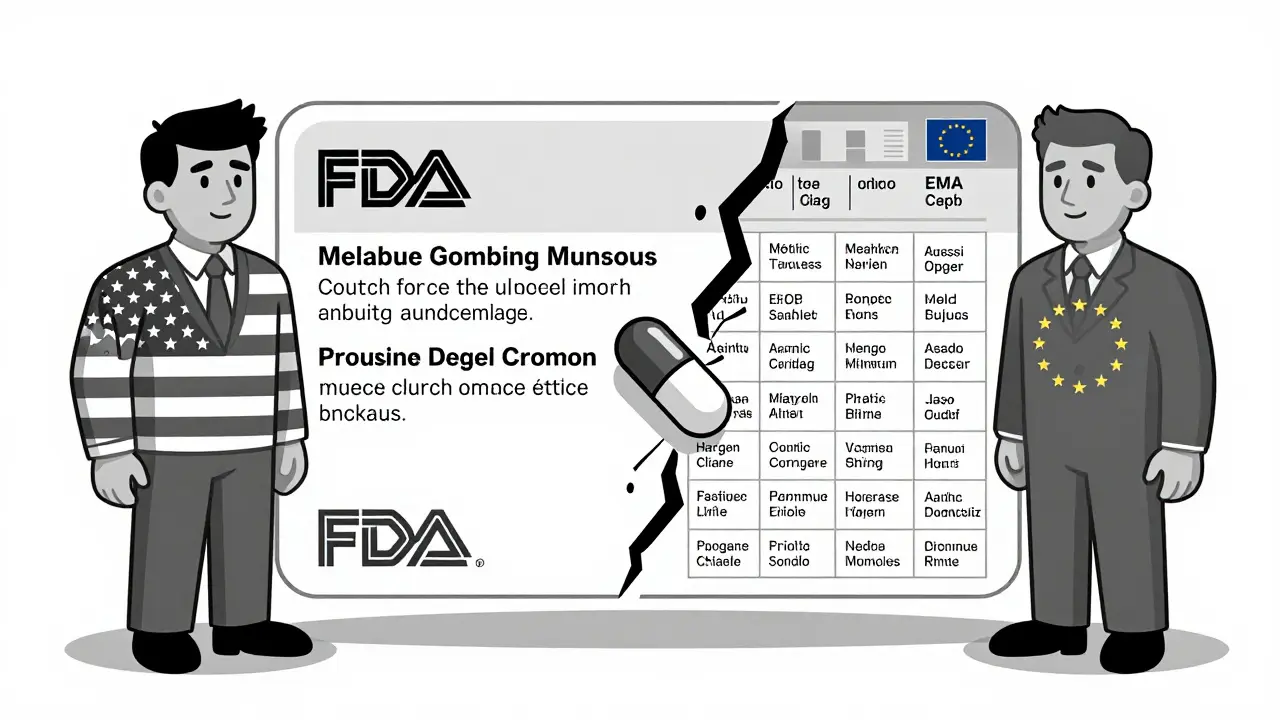
FDA vs EMA Drug Labeling Comparison Tool
Understand Key Labeling Differences
This tool compares how the FDA and EMA might label the same drug based on critical factors like evidence strength, disease type, and risk tolerance.
Labeling Comparison Results
Approved Indications
FDA typically requires strong clinical evidence of benefit before approving new indications. For rare diseases, they may accept earlier evidence but still demand clear survival or functional improvements.
EMA is more likely to approve based on earlier evidence (like tumor shrinkage in oncology), especially for serious or rare conditions where no alternatives exist. They often use the "exceptional circumstances" pathway.
Patient-Reported Outcomes (PROs)
FDA generally rarely includes PROs in drug labels unless evidence is exceptionally strong. They view PROs as "soft" data that supplements but doesn't replace clinical endpoints.
EMA routinely includes PRO claims (e.g., "improved ability to walk" or "reduced fatigue") when patients consistently report benefit. PROs are considered valid evidence for approval.
Risk Management
FDA requires legally binding REMS with specific requirements: mandatory training, restricted distribution, or patient monitoring. These systems create significant infrastructure requirements.
EMA requires Risk Management Plans (RMPs) but with less rigidity. They emphasize monitoring and reporting rather than mandated systems, giving more flexibility to healthcare providers.
Pregnancy/Lactation Warnings
FDA typically uses unambiguous warnings like "Avoid use in pregnancy" when risks exist. They prioritize clear guidance over nuanced interpretation.
EMA often uses nuanced statements like "Use only if benefit outweighs risk." They trust healthcare providers to make clinical judgments based on individual patient circumstances.
Time and Cost Impact
U.S. labeling is single-language (English) which allows faster market entry. However, FDA's higher evidence standards can lead to longer development times for some indications.
Multilingual labeling (24 languages) adds 15-20% to costs and delays EU market entry by 18 months on average. However, EMA has a higher first-cycle approval rate (92% vs FDA's 85%).
This tool provides a general comparison based on the article's content. Actual labeling decisions depend on specific regulatory requirements, clinical evidence, and individual case assessments.
When a new drug is developed, the paperwork doesn’t end when the clinical trials are done. The real challenge begins when it’s time to write the drug label - the document that tells doctors how to use it, what risks to watch for, and who should avoid it. But here’s the catch: if you’re trying to sell that drug in both the United States and the European Union, you’re not just writing one label. You’re writing two - and they’re not the same.
The U.S. Food and Drug Administration (FDA) and the European Medicines Agency (EMA) are the two biggest drug regulators in the world. Together, they cover over 70% of the global pharmaceutical market. But despite decades of talks, joint meetings, and shared guidelines, their labeling rules still look like they came from different planets. And for drug companies, that means double the work, double the cost, and double the confusion.
Legal Frameworks: Why the Rules Don’t Match
The FDA operates as a single, centralized federal agency. It answers to U.S. law - mainly the Federal Food, Drug, and Cosmetic Act, last updated in 2007. Everything it does flows from that one legal structure. The EMA, on the other hand, isn’t even really a single agency. It’s a network of 27 national regulators across the EU. The EMA coordinates, but the final approval and translation of labels happen in each country. This isn’t just bureaucratic detail - it changes how labels are written.
Because the FDA works alone, it can move fast on one language: English. The EMA has to work in 24 official languages. That means every label, every warning, every dosage instruction must be translated, reviewed, and approved in each language. This isn’t a translation job - it’s a legal and clinical audit in every EU country. A single error in French or Polish can delay approval across the whole bloc.
Approved Indications: The Same Data, Different Conclusions
Here’s where things get strange. Two drugs, identical clinical trial data, submitted at the same time - and they get different approved uses.
A 2019 study looked at 21 cases where both agencies reviewed the same drug. In more than half - 11 cases - they reached different conclusions on whether the drug worked for a specific condition. Why? Because they interpreted the evidence differently. The FDA tends to demand stronger proof of benefit before approving a new use. The EMA is more willing to approve based on early signs of effectiveness, especially for serious or rare diseases.
Take oncology drugs. The FDA often waits for proof that a drug extends life. The EMA sometimes approves based on tumor shrinkage alone - even if it’s not clear if patients live longer. That’s not a mistake. It’s a different philosophy. The EMA says: if a cancer patient has no other options, and the drug shrinks tumors, we’ll approve it and keep watching. The FDA says: we need to know it saves lives before we tell doctors to prescribe it.
Patient-Reported Outcomes: What Patients Say Matters More in Europe
Let’s say a drug helps people with chronic pain feel less discomfort. That’s a patient-reported outcome (PRO) - something the patient feels, not something a lab test measures.
In a 2011 review of 75 drugs approved by both agencies, 47% of EMA-labeled drugs included PRO claims. Only 19% of FDA-labeled drugs did. That’s a huge gap. The EMA routinely accepts statements like “patients reported improved ability to walk” or “reduced fatigue during daily activities.” The FDA rarely does.
Why? The FDA still sees PROs as “soft” data - useful for research, but not strong enough for a label. The EMA treats them as real evidence. If a large group of patients consistently say they feel better, the EMA will put that on the label. For patients and doctors, that matters. It means a drug approved in Europe might list benefits the U.S. label ignores.
Risk Management: REMS vs RMPs - One Is a System, the Other Is a Plan
Both agencies require drug makers to manage risks - especially for drugs that can cause serious side effects. But how they do it couldn’t be more different.
The FDA uses something called Risk Evaluation and Mitigation Strategies (REMS). These are strict, legally binding systems. For some drugs, that means only one pharmacy can dispense it. Or doctors must complete training. Or patients must sign forms. Think of REMS like a security checkpoint for every prescription.
The EMA uses Risk Management Plans (RMPs). These are more flexible. They require companies to identify risks and describe how they’ll monitor them - but they don’t force specific systems. No mandatory training. No single pharmacy rules. Just ongoing reporting. It’s less rigid, but also less visible to doctors and patients.
For drug companies, this means: if you’re selling in the U.S., you’re building a whole new infrastructure. If you’re selling in Europe, you’re writing a report and updating it every year. One is a project. The other is paperwork.
Pregnancy and Lactation: How Risk Is Communicated
When a drug is used during pregnancy or breastfeeding, the label needs to be clear. But clarity doesn’t mean the same thing everywhere.
A 2023 study looked at three drugs with pregnancy data. In two of them, the FDA and EMA used completely different wording to describe the risks. One drug’s U.S. label said: “Avoid use in pregnancy.” The European label said: “Use only if benefit outweighs risk.” Same data. Different message.
The FDA tends to be more cautious - sometimes overly so. It prefers clear warnings like “not recommended.” The EMA prefers nuance. It trusts doctors to weigh the risk. This isn’t about safety - it’s about trust. The FDA assumes doctors need strong direction. The EMA assumes they can make judgments.
Language, Cost, and Time: The Hidden Burden
Let’s talk numbers. A drug company submitting to the FDA only needs to prepare documents in English. For the EMA? It needs 24 translations. Each one must be reviewed by local regulators. That’s not just expensive - it’s slow.
One study found multilingual labeling adds 15-20% to development costs. Another found it delays EU market entry by an average of 18 months compared to the U.S. That’s not a glitch - it’s the system. And it’s why many small biotech firms skip Europe entirely. The cost of compliance can be higher than the potential revenue.
Even the format is different. Both accept electronic submissions (eCTD), but the EMA requires extra files for each language. The FDA doesn’t. So a single submission package for the EMA can be 50% larger than for the FDA.

Approval Rates: Who Approves More, and Why?
Here’s a surprising fact: the EMA approves more drugs on the first try. Its first-cycle approval rate is 92%. The FDA’s is 85%. Why? Because the FDA turns down more applications upfront - not because the drugs are unsafe, but because they don’t meet the FDA’s bar for proof.
The EMA is more likely to approve drugs under “exceptional circumstances” - like for ultra-rare diseases where full data isn’t possible. The FDA doesn’t have a direct equivalent. So a drug that gets approved in Europe might be stuck in limbo in the U.S., waiting for more studies.
What This Means for Patients and Doctors
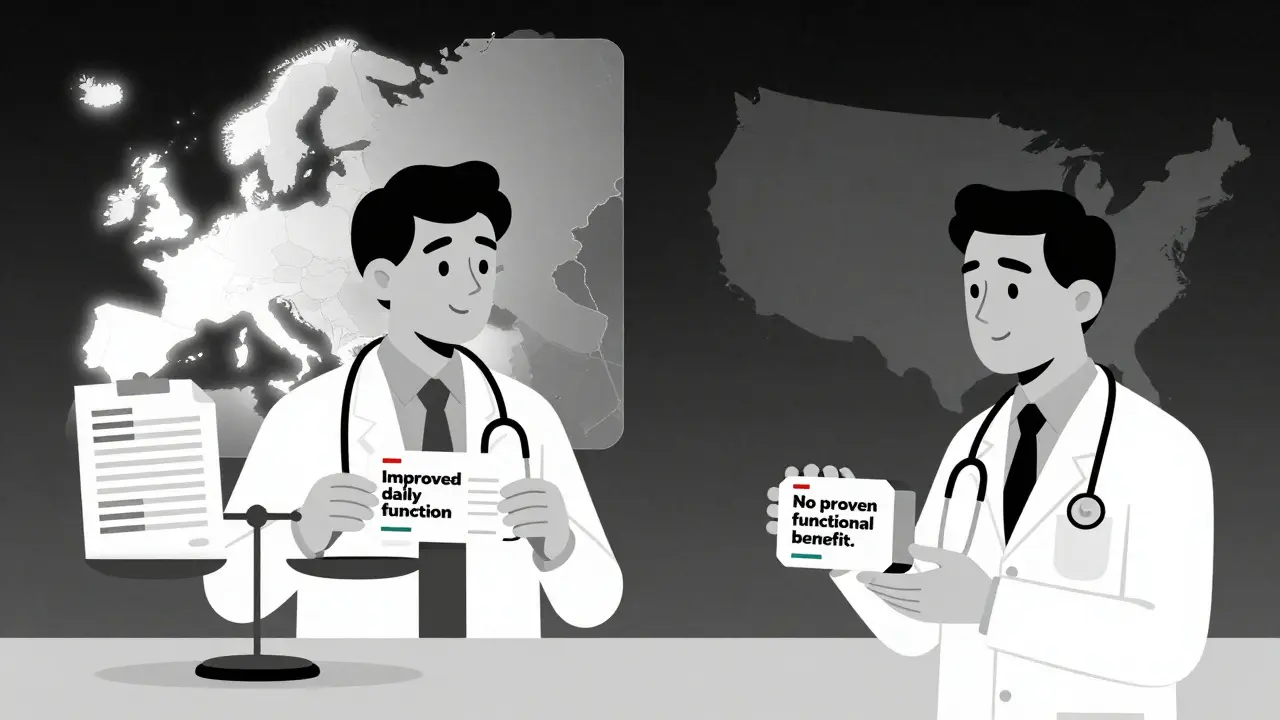
Most patients don’t realize their drug label might be different depending on where they live. A doctor in Berlin might prescribe a medication with a label that says it improves daily function. A doctor in Chicago might see no such claim - even though it’s the exact same pill.
This isn’t just confusing. It affects treatment choices. If a patient’s symptoms aren’t listed as an approved use in the U.S., insurance might refuse to pay. In Europe, it might be covered.
And for travelers? Bringing medication across borders becomes riskier. A drug approved in the EU might not be legal in the U.S., even if it’s the same chemical. The label tells the story - and the story is different.
The Future: More Alignment, But Not Harmony
Both agencies are trying to get closer. They share data. They hold joint meetings. The ICH guidelines have helped standardize clinical trials. But labeling? That’s the last frontier.
Why? Because it’s not about science. It’s about law, culture, and trust. The U.S. wants clear, strict rules. Europe wants flexibility and trust in professionals. Neither side is likely to give up its approach.
For now, the gap is narrowing - but it’s still wide. Companies that succeed globally are the ones who treat FDA and EMA labeling as two separate products. Not one product with two labels. Two entirely different documents.
And until that changes, doctors and patients will keep seeing two versions of the same drug - and wondering why.
Why do EMA and FDA labels differ even when the drug is the same?
They use different legal frameworks, risk tolerance levels, and evidence standards. The FDA demands stronger proof of benefit before approving new uses, while the EMA accepts earlier or less complete data, especially for serious conditions. Language requirements, cultural views on risk, and regulatory philosophy all contribute to different wording - even with identical clinical data.
Can a drug approved in the EU be sold in the U.S. without changes?
No. Even if a drug is approved by both agencies, the labeling must be rewritten to meet FDA requirements. The active ingredient may be the same, but the approved uses, warnings, dosing instructions, and risk management details often differ. A drug’s EU label cannot be used in the U.S. without full FDA review and approval of the U.S. version.
Do patients in Europe get access to drugs faster than in the U.S.?
Often, yes. The EMA has a higher first-cycle approval rate (92% vs. 85%) and allows approval under exceptional circumstances for rare diseases. However, because of the 24-language translation requirement, the actual time to market in all EU countries can be longer than in the U.S., where English-only labeling allows faster nationwide rollout.
Why does the EMA include patient-reported outcomes on labels and the FDA doesn’t?
The EMA considers patient-reported outcomes - like reduced fatigue or improved daily function - as valid evidence of a drug’s benefit. The FDA has historically viewed them as supplementary, requiring stronger clinical endpoints like survival or lab results. While the FDA is slowly accepting more PRO data, it still rarely includes them on labels unless the evidence is exceptionally strong.
How do language requirements affect drug pricing and availability?
Multilingual labeling increases development costs by 15-20% and can delay EU market entry by up to 18 months. This makes it harder for smaller companies to enter the EU market, reducing competition and potentially keeping prices higher. It also means some drugs are never launched in Europe at all - even if they’re available in the U.S.
Are there any drugs that have identical labels in both the U.S. and EU?
Very few. Even drugs approved at the same time with the same data typically have differences in wording, approved uses, risk warnings, or dosing details. Studies show that only about 11% of drugs approved by both agencies have identical patient-reported outcome claims. Full label alignment is rare and usually only happens after years of back-and-forth revisions.


Tim Schulz
March 12, 2026 at 02:36Oh honey, let me grab my monocle and my espresso 🥶 The FDA and EMA aren't just different-they're from different dimensions. One's a stern dad who says 'no snacks before dinner' and the other's the cool aunt who whispers 'here, take an extra cookie, I'll cover for you.' 🍪🇺🇸🇪🇺 The fact that we're still debating whether 'improved daily function' counts as a real outcome? Please. My cat has more clinical evidence than some FDA labels. 😭
Jinesh Jain
March 13, 2026 at 23:59Interesting read. I've seen this first-hand working with pharma clients in India. The language barrier isn't just about translation-it's about cultural interpretation of risk. A warning that's clear in English might sound overly alarming in Hindi or Bengali. It's not just paperwork-it's psychology.
douglas martinez
March 14, 2026 at 15:55The structural divergence between the FDA and EMA reflects deeper philosophical commitments to regulatory authority and professional autonomy. While the FDA's centralized model ensures consistency, the EMA's distributed framework enables contextual adaptation. Both systems are valid within their respective legal and cultural paradigms.
Sabrina Sanches
March 16, 2026 at 13:50I love how Europe just says 'hey, patients know how they feel' and puts that on the label 🙌 Like... duh? Why are we still treating patient experience like it's a suggestion? The FDA's clinging to lab results like they're the Ten Commandments. Meanwhile, real people are out here living with chronic pain and fatigue and just want to know if this pill helps them get through the day. Come onnnnnnnnn
Katherine Rodriguez
March 16, 2026 at 20:34Europe is just too soft. We have the best science, the best trials, the best standards. Why are we letting them dictate how we label drugs? If they can't prove it works, it shouldn't be on the shelf. Full stop. And why do we even need 24 languages? English is the global language. We should just make them all use it. America leads. Period.
Devin Ersoy
March 17, 2026 at 07:52Let’s be real-the FDA is basically a bureaucratic IKEA manual written by a committee of accountants who think ‘survival’ is the only metric that matters. Meanwhile, the EMA is like a jazz musician: improvising, listening to the patient’s vibe, and letting the data swing. One’s a PowerPoint. The other’s a live performance. Guess which one feels more human? 🎺💊
Adam M
March 19, 2026 at 03:54FDA demands proof. EMA accepts hope. That’s the whole thing.
Rosemary Chude-Sokei
March 20, 2026 at 12:10The linguistic and administrative burden placed on pharmaceutical companies by the EMA’s multilingual requirements is not trivial. It introduces systemic inefficiencies that disproportionately impact smaller biotech firms with limited resources. While the intent behind linguistic inclusivity is commendable, the current implementation may inadvertently restrict market access and innovation. A more harmonized, digitally adaptive approach could yield significant gains without sacrificing patient safety or regulatory rigor.
Noluthando Devour Mamabolo
March 21, 2026 at 10:23The EMA's RMP framework is a masterclass in risk governance architecture. By leveraging decentralized pharmacovigilance networks and adaptive signal detection, it enables dynamic risk-benefit recalibration without the rigid infrastructure overhead of FDA REMS. The 24-language requirement? Not a bottleneck-it's a fidelity layer. Each linguistic iteration serves as a validation checkpoint for cultural-linguistic construct equivalence. This isn't bureaucracy. It's epistemic sovereignty.