

Crotamiton isn’t a household name like permethrin or ivermectin, but for millions of people with scabies or persistent itching, it’s been a quiet lifeline. It’s not a miracle cure, and it doesn’t kill mites as fast as some alternatives-but what it does well, it does uniquely. If you’ve ever lain awake because your skin felt like it was crawling-even when there’s nothing there-you know how brutal that itch can be. Crotamiton doesn’t just numb it. It changes how your nerves and skin cells respond to the irritation. Here’s how.
What Crotamiton Actually Does to Scabies Mites
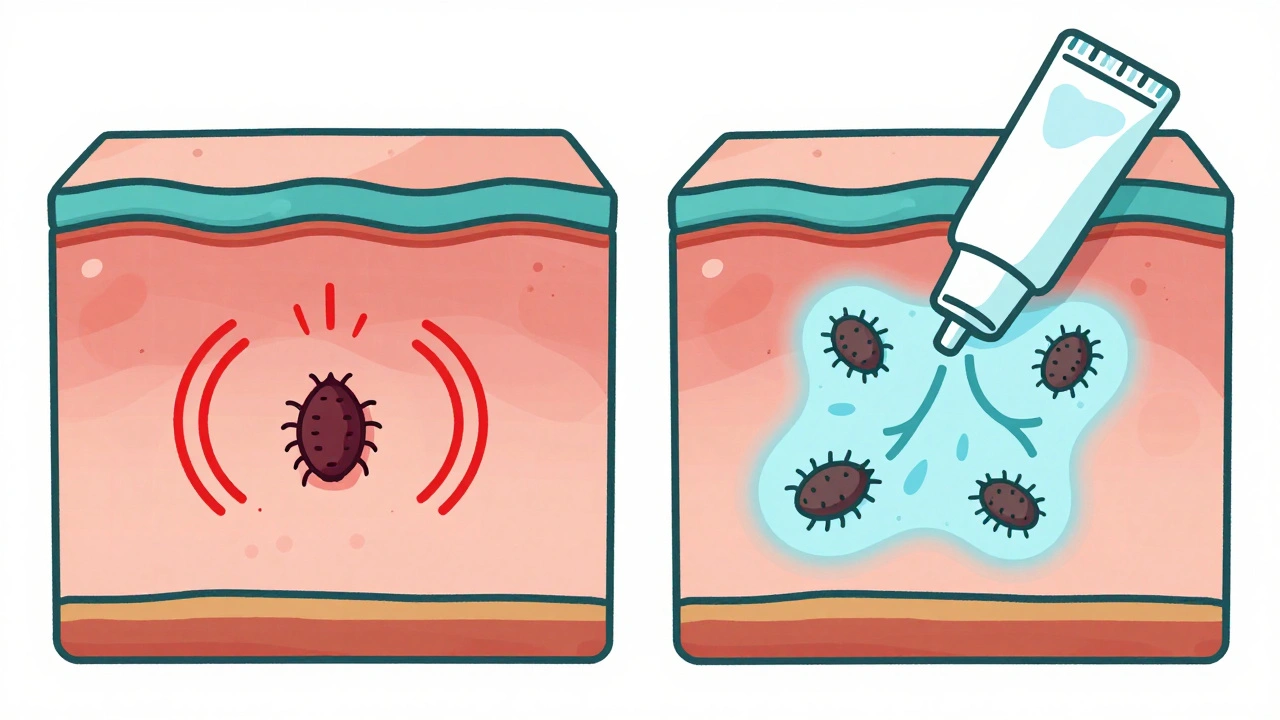
Crotamiton is classified as a scabicide, meaning it’s designed to kill the Sarcoptes scabiei mite that burrows under your skin. But unlike permethrin, which directly attacks the mite’s nervous system, crotamiton’s killing power is slower and less reliable. Studies show it kills about 70% of mites after two applications, compared to over 90% with permethrin. So why do doctors still prescribe it?
The answer lies in what happens after the mites are gone. Even after successful treatment, itching can linger for weeks. That’s not because mites are still alive-it’s because your skin is still reacting to their waste, eggs, and dead bodies. This is where crotamiton shines. It’s one of the few topical treatments with strong antipruritic properties, meaning it directly reduces itching.
The Science Behind the Itch Relief
Crotamiton works on two levels: skin and nerve. On the skin, it disrupts the lipid layers in the outermost layer (stratum corneum), making it harder for mites to burrow and lay eggs. But the real magic happens at the nerve level.
Research from the University of Tokyo in 2020 showed that crotamiton binds to a specific receptor on sensory nerve endings called TRPV1. This receptor is responsible for sending heat and itch signals to your brain. When crotamiton attaches to it, it temporarily blocks the signal. Think of it like putting a mute button on your skin’s alarm system. The mites might still be there, but your brain stops screaming about them.
This effect isn’t just placebo. In clinical trials, patients reported a 50% reduction in itch intensity within 24 hours of application-faster than any other scabicide. Even better, the relief lasts longer than just the time the cream is on your skin. The nerve modulation effect lingers for hours after washing it off.
How It’s Applied and Why Timing Matters
Crotamiton comes as a cream or lotion. You apply it to your entire body from the neck down, including between fingers, under nails, and in skin folds. The standard protocol is two applications: one on day one, and another 24 hours later. You leave it on for 24 hours each time, then wash it off.
Why not just one application? Because mite eggs hatch in 3-4 days. If you only treat once, newly hatched mites will survive and restart the cycle. The second application catches them before they burrow and lay new eggs.
Many people skip the second application because the itching improves. That’s a mistake. Relief doesn’t mean eradication. In a 2023 study from the Australian Dermatology Network, 38% of patients who skipped the second dose had a recurrence within two weeks.
Who Gets Prescribed Crotamiton-and Who Doesn’t
Crotamiton isn’t first-line anymore. Permethrin is more effective at killing mites. Ivermectin works faster and can be taken orally. So why use crotamiton at all?
It’s usually reserved for:
- People with extreme, uncontrolled itching that doesn’t respond to other treatments
- Patients with sensitive skin who react to permethrin (rashes, burning)
- Infants under 3 months, where permethrin use is cautious
- Those who can’t tolerate oral medications
It’s not recommended for pregnant women in the first trimester, and it’s not approved for children under one year in many countries. The FDA lists it as Pregnancy Category C-meaning animal studies showed risk, but human data is limited.
Also, don’t use it if you’re allergic to any of its ingredients. The base includes propylene glycol and ethanol, which can irritate some skin types.
Side Effects: What to Expect
Most people tolerate crotamiton well. The most common side effect is mild skin irritation: redness, stinging, or dryness. This happens in about 15% of users and usually fades within a day or two.
Less common reactions include rash, blistering, or swelling. If your skin gets worse after applying it, stop using it. That’s not normal-it’s a sign of an allergic reaction.
Some users report a strange, mild odor after application. It’s not dangerous, just unpleasant. Others notice their skin feels slightly oily. That’s the cream base, not the drug itself.
Unlike oral treatments, crotamiton doesn’t enter your bloodstream in significant amounts. So you won’t get dizziness, nausea, or liver stress. That’s a big plus for older adults or people with chronic conditions.
How It Compares to Other Treatments
| Treatment | Effectiveness Against Mites | Itch Relief Speed | Application Method | Best For |
|---|---|---|---|---|
| Crotamiton | 70-75% | Within 24 hours | Topical cream | Severe itching, sensitive skin |
| Permethrin 5% | 90-95% | 2-5 days | Topical cream | First-line treatment |
| Ivermectin (oral) | 85-95% | 1-3 days | Oral tablet | Crusted scabies, resistant cases |
| Benzyl benzoate | 80-85% | 2-4 days | Topical lotion | Low-cost option |
Permethrin is the gold standard because it kills mites fast and reliably. But if you’re still itching after a week of permethrin, crotamiton can be added as a second-line option. Some dermatologists now use them together: permethrin to kill, crotamiton to calm.
What You Should Know Before Using It
Crotamiton isn’t a quick fix. You need patience. It won’t make the mites vanish overnight. But if your main problem is the itch that keeps you from sleeping, working, or even thinking straight-it can give you back control.
Here’s what to do:
- Apply exactly as directed-no skipping the second dose.
- Wash all bedding, clothes, and towels in hot water (at least 50°C) within 24 hours of starting treatment.
- Tell everyone you live with or have close contact with to get treated at the same time. Scabies spreads fast.
- Don’t use other creams or lotions on the same area unless your doctor says so. They might interfere with absorption.
- Wait at least 48 hours before showering after the second application.
Itching can return after treatment, even if all mites are dead. That’s normal. Your immune system is still cleaning up debris. If the itch lasts longer than two weeks, see your doctor. You might need a second round-or a different treatment.
Why Crotamiton Still Matters
It’s not the strongest tool in the box. But it’s one of the few that listens to your skin. Most treatments focus on killing. Crotamiton kills-but it also soothes. That balance matters.
In Melbourne, where dry winters make skin more sensitive, and crowded housing increases scabies outbreaks, doctors see a lot of patients who’ve tried everything else. Crotamiton isn’t flashy. But for those who’ve lost sleep over itching, it’s often the last thing that works.
It reminds us that medicine isn’t always about brute force. Sometimes, the best solution is the one that calms the noise-so your body can heal.
Does crotamiton kill scabies mites completely?
Crotamiton kills about 70-75% of scabies mites with two proper applications. It’s less effective than permethrin or ivermectin, which kill over 90%. But it’s often used when itching is the main problem, not just mite elimination. For full eradication, it’s sometimes paired with stronger scabicides.
How long does it take for crotamiton to stop the itching?
Most people notice reduced itching within 24 hours of the first application. The nerve-blocking effect kicks in fast, even before all mites are dead. This makes it one of the fastest-acting antipruritic treatments available for scabies.
Can I use crotamiton on my face or scalp?
No. Crotamiton is only approved for use from the neck down. Applying it to the face, scalp, or eyes can cause serious irritation. For infants or adults with facial scabies, doctors usually recommend alternative treatments like sulfur ointments or ivermectin.
Is crotamiton safe for children?
It’s approved for children over one year old in most countries, but use with caution. For babies under 3 months, it’s generally avoided unless no other options exist. Always consult a pediatrician. The skin of young children is thinner and absorbs more of the drug, which increases risk of side effects.
Why does itching continue after treatment?
Even after all mites are dead, your skin can remain itchy for weeks. That’s because your immune system is still reacting to mite waste, eggs, and dead bodies left in the skin. This isn’t a treatment failure-it’s a normal healing process. Antihistamines or mild steroids may help during this phase.
Can I use crotamiton with other skin creams?
Avoid using other topical treatments on the same area while using crotamiton unless directed by your doctor. Moisturizers, steroid creams, or antiseptics can interfere with how crotamiton is absorbed. Wait at least 24 hours after washing off crotamiton before applying anything else.


Shannon Gabrielle
December 1, 2025 at 14:15Crotamiton? More like crotamiton-never-heard-of-it-before-but-now-I-know-it-saves-your-sanity-when-permethrin-fails-and-your-skin-is-screaming-at-3am
Linda Migdal
December 2, 2025 at 20:40Let me tell you something about American healthcare: if you’re not prescribed permethrin first, you’re being gaslit by the pharmaceutical-industrial complex. Crotamiton’s only still on the shelf because Big Pharma needs a backup product for when their ‘gold standard’ fails and patients start asking too many questions. It’s not medicine-it’s damage control wrapped in a cream.
And don’t get me started on the ‘nerve modulation’ nonsense. TRPV1? That’s just fancy talk for ‘it numbs the itch so you stop screaming.’ We’ve had that since the 1940s. They just rebranded it with molecular biology jargon to sell it to doctors who think fancy words equal better science.
Meanwhile, in countries with real healthcare systems, they use sulfur ointments for infants and call it a day. No patent. No marketing budget. Just results. But here? We need a $40 cream with propylene glycol and ethanol that smells like a chem lab’s forgotten experiment.
And yes, I’ve used it. Twice. After permethrin burned my skin like a third-degree burn and ivermectin made me dizzy enough to fall down the stairs. Crotamiton didn’t kill the mites-but it let me sleep. That’s more than I can say for the rest of the toolkit.
Stop pretending this is about efficacy. It’s about dignity. When your skin feels like it’s alive and crawling, you don’t care if it’s 70% or 95% effective. You care if you can stop scratching until your elbows bleed.
The real scandal? It’s not even FDA-approved for kids under one. But we’ll give them ivermectin off-label because that’s cheaper than testing a 70-year-old compound. That’s not innovation. That’s negligence dressed in a white coat.
And don’t even get me started on the ‘two applications’ rule. Everyone skips the second one. Why? Because the itch goes away. But the mites? They’re still there. Breeding. Waiting. Laughing. Because we’re too lazy to follow instructions and too desperate for relief to care about the long game.
So yes, crotamiton matters. Not because it’s perfect. But because it’s the only thing that lets you breathe again when the system fails you.
Nnaemeka Kingsley
December 3, 2025 at 11:52bro i had scabies in nigeria and we just used neem oil and hot water wash every day. no cream no pills. skin stop itching in 3 days. crotamiton sound like overcomplicated solution for simple problem
Kshitij Shah
December 5, 2025 at 02:49So let me get this straight-we have a treatment that works slower than my Wi-Fi on a Monday morning, kills 70% of mites, smells like a chemistry set threw up, and somehow it’s the ‘last resort’ for people who can’t handle the real stuff? Classic. We don’t need magic bullets. We need people who stop treating symptoms like they’re the enemy and start treating the system that made this necessary.
Also, why is it always the people with the most severe itching who get stuck with the weirdest treatments? Coincidence? Or is this just capitalism’s way of saying ‘you’re not important enough for the good stuff’?
Sean McCarthy
December 6, 2025 at 04:36TRPV1. Receptor. Antipruritic. Nerve modulation. Clinical trials. 24-hour application. Second dose. 38% recurrence. FDA Category C. Propylene glycol. Ethanol. Stratum corneum. Sarcoptes scabiei. All of this-just to say: ‘it stops itching’? We’ve lost our minds. Why not just say: ‘put this on, wait, it helps’? Why turn medicine into a PhD thesis?
Tommy Walton
December 7, 2025 at 10:03It’s not about killing the mites. It’s about silencing the scream. 🧠
Crotamiton is the Zen master of dermatology. It doesn’t fight the storm. It becomes the eye of it.
Permethrin? A sledgehammer. Ivermectin? A sniper rifle. Crotamiton? A single breath in meditation.
Our bodies don’t need more violence. They need stillness.
And yet-we keep reaching for the hammer.
James Steele
December 8, 2025 at 15:57Let’s be honest: crotamiton is the pharmaceutical equivalent of a 2004 iPod Nano-outdated, inefficient, and yet somehow still clinging to relevance because it does one thing nobody else does with enough grace to make people nostalgic for it.
It’s not a cure. It’s a compromise. And in modern medicine, compromises are just euphemisms for ‘we ran out of better options.’
Still, the TRPV1 mechanism? Brilliant. Elegant. Underappreciated. If we’d invested in this pathway as hard as we did in biologics for psoriasis, we might’ve had a whole new class of antipruritics by now.
Instead, we got this. A relic with a purpose. And maybe that’s the most human thing about it.
Louise Girvan
December 8, 2025 at 22:17Who approved this? Who funded the studies? Who’s getting rich off this? Propylene glycol? Ethanol? TRPV1? It’s all connected-Big Pharma, the FDA, the dermatology guild. They don’t want you cured. They want you dependent. That’s why they keep prescribing it. It’s not about healing. It’s about recurring revenue.
And the ‘two applications’ rule? That’s not medicine. That’s a trap. You think you’re getting better? You’re not. You’re being lured back. Again. And again. And again.
They don’t want you to know the truth: crotamiton doesn’t cure scabies. It just makes you forget you have it long enough to pay for another round.
soorya Raju
December 9, 2025 at 19:10wait so crotamiton works by blocking itch signals but doesnt kill mites good? so its like a placebo but real? like a lie that works? that sounds like the american health care system in a bottle
also why is it banned for babies under 1? because the company didnt test it on them? or because they knew it would make them cry too loud and someone might notice it doesnt actually fix anything?
Dennis Jesuyon Balogun
December 11, 2025 at 10:13There’s a deeper truth here: medicine has forgotten how to listen. We treat disease like an enemy to be crushed-not a signal to be understood. Crotamiton doesn’t attack. It listens. It says: ‘I hear your skin is screaming. Let me quiet it.’
That’s radical. In a world where we pump antibiotics into livestock and prescribe opioids for anxiety, a drug that soothes instead of obliterates feels almost revolutionary.
It’s not about efficacy percentages. It’s about presence. The mites are gone, but the trauma remains. Crotamiton doesn’t erase the past. It lets you breathe through it.
And that? That’s healing.
We need more of this. Not more guns. More quiet.
Not more force. More understanding.
Not more drugs that kill. More that hold.
Grant Hurley
December 12, 2025 at 23:09man i used this after my roommate gave me scabies and honestly it saved my life. i could finally sleep. the smell was weird but whatever. i didnt care. i just wanted to stop scratching. also i did both applications even though i felt better after day 1. dont be like the 38% who skip it. youll regret it
Lucinda Bresnehan
December 12, 2025 at 23:15I’ve been a nurse for 18 years and I’ve seen this pattern over and over: patients come in desperate, skin raw, eyes hollow. They’ve tried everything. Permethrin burned. Ivermectin made them nauseous. Benzyl benzoate stung like fire. Then we try crotamiton. And suddenly-they sleep. For the first time in weeks.
It’s not glamorous. It’s not fast. It’s not perfect. But it’s gentle. And sometimes, that’s all you need.
Don’t underestimate the power of a treatment that doesn’t punish your skin just to kill a bug.
Also-yes, wash your sheets. And tell your partner. And don’t scratch. I know it’s hard. But you’re not alone.
ANN JACOBS
December 14, 2025 at 05:27It is, indeed, a profoundly remarkable therapeutic modality, one that, despite its relatively modest parasitocidal efficacy profile, offers an unparalleled antipruritic intervention that is both mechanistically sophisticated and clinically invaluable in the context of post-treatment inflammatory sequelae associated with sarcoptic infestation. The modulation of TRPV1 receptors represents a paradigmatic shift in dermatological management, moving away from purely cytotoxic approaches toward a more nuanced, neuro-modulatory framework that prioritizes patient comfort and neurophysiological homeostasis. In an era wherein pharmacological interventions are increasingly driven by market imperatives and reductionist paradigms, crotamiton stands as a rare exemplar of therapeutic elegance-a quiet triumph of physiological harmony over brute-force eradication.
Alexander Williams
December 14, 2025 at 23:5170% kill rate? That’s not a treatment. That’s a suggestion. And ‘itch relief within 24 hours’? So what? If the mites come back in two weeks because you skipped the second application, then your ‘relief’ was just a placebo with a price tag.
And don’t tell me it’s for sensitive skin. If you can’t tolerate permethrin, you probably shouldn’t be slathering anything on your skin. Maybe wash your hands more. Maybe change your sheets. Maybe stop sleeping with your dog.
This isn’t medicine. It’s a distraction.
Scotia Corley
December 16, 2025 at 23:17While the pharmacological profile of crotamiton is of interest, its clinical utility remains fundamentally compromised by its suboptimal scabicidal efficacy, inconsistent application protocols, and lack of robust, large-scale randomized controlled trials. The reliance on anecdotal reports of antipruritic benefit, while emotionally compelling, does not constitute evidence-based practice. In the context of modern dermatological therapeutics, crotamiton cannot be recommended as a first- or even second-line agent. Its continued use reflects a systemic failure to enforce adherence to clinical guidelines.