
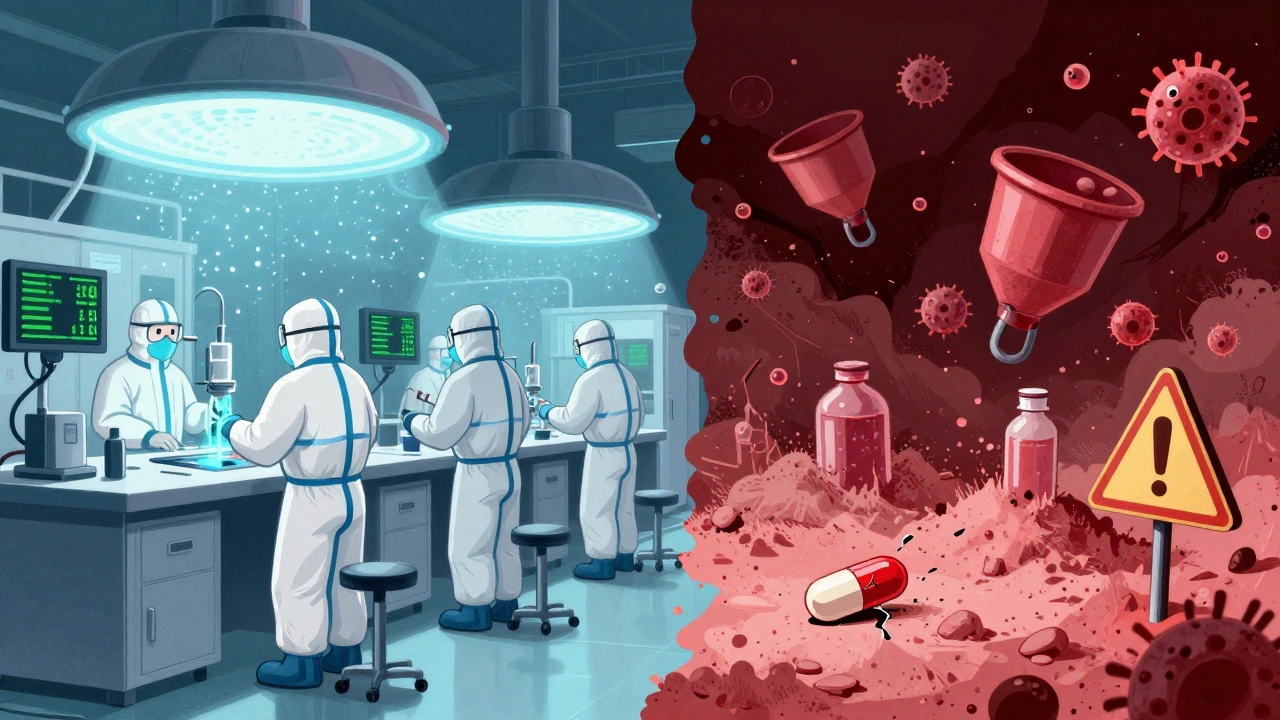
When you pick up a generic pill at the pharmacy, you expect it to work just like the brand-name version. But behind that simple promise is a high-stakes battle against invisible threats-dust, microbes, chemical residues-that can turn a safe medicine into a dangerous one. In generic drug manufacturing, contamination control isn’t just a checklist item. It’s the line between a life-saving treatment and a public health crisis.
Why Contamination Matters More in Generics
Generic drug makers don’t have the luxury of brand trust or big R&D budgets. They compete on price, which means tight margins and pressure to cut costs. But when it comes to contamination, cutting corners isn’t an option. A single batch of contaminated medicine can trigger recalls, lawsuits, and loss of FDA approval. In 2022, nearly 4 out of 10 FDA warning letters to pharmaceutical companies cited contamination issues. That’s not a glitch-it’s a pattern. Take the 2020 Valsartan recall. Nitrosamine contaminants slipped into blood pressure meds made by 22 different generic manufacturers. The result? Over $1.2 billion in lost product, global supply shortages, and a shattered reputation for an entire industry. The problem wasn’t one bad factory. It was a system that relied too much on testing finished pills instead of stopping contamination at the source.How Contamination Happens in Generic Factories
Contamination doesn’t come from one big spill. It sneaks in through small failures:- Human error: A worker skips a gowning step, tracks in particles, or mislabels a hopper.
- Cleaning failures: Residue from a previous drug lingers on equipment-sometimes at levels as low as 1 nanogram per square centimeter.
- Raw materials: Impurities in active ingredients from overseas suppliers can carry microbes or chemicals.
- Airflow issues: Poorly maintained HVAC systems let particles drift between production zones.
The Rules: CGMP, ISO, and Health-Based Limits
The foundation of contamination control is Current Good Manufacturing Practices (CGMP). These aren’t suggestions-they’re federal law. Under 21 CFR 210.3(b)(3), a drug is adulterated if it’s made under unsanitary conditions that could make it harmful. Factories must follow strict environmental standards:- ISO Class 5 (Grade A): For filling sterile products. Max 3,520 particles per cubic meter at 0.5μm or larger.
- ISO Class 7 (Grade C): General manufacturing areas. Must maintain 20-60 air changes per hour.
- ISO Class 8 (Grade D): Less critical zones like packaging.
Technology Is Changing the Game
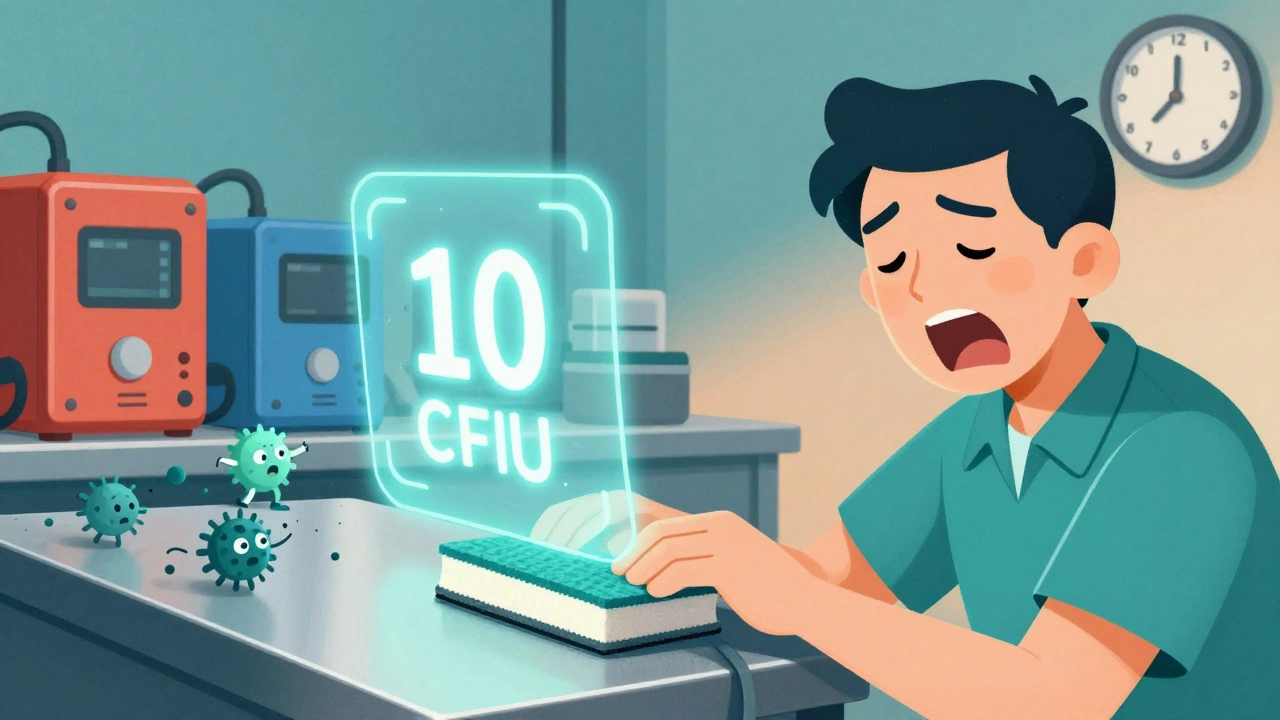
Old-school contamination control meant swabbing surfaces, sending samples to a lab, and waiting 5-7 days for results. By then, the batch was already shipped. Today, real-time monitoring is the norm for top-tier manufacturers:- MetOne 3400+ particle counters track airborne particles continuously. Facilities using them saw a 63% drop in contamination incidents.
- ATP bioluminescence systems give results in 5 minutes-95% accurate compared to traditional cultures.
- Dycem CleanZone mats trap dirt from shoes, reducing foot-borne contamination by 72% in some facilities.
- AI tools like Honeywell’s Forge Pharma cut false alarms by 68%, helping teams focus on real risks.
Human Factors: The Biggest Risk
Here’s the uncomfortable truth: most contamination comes from people. Dr. Michael Gamlen, a leading industry consultant, found that 83% of contamination events trace back to human behavior. Not because workers are careless-but because systems don’t account for fatigue, pressure, or poor training. A 2021 study at an AstraZeneca generics plant showed gowning compliance dropped 40% after 8 hours of shift work. Workers get tired. They skip steps. They don’t realize they’ve breached a clean zone. Solutions? Simple but effective:- Color-coded equipment: Red for Drug A, blue for Drug B. One facility cut mix-ups by 65%.
- Staggered shift changes: Reduces traffic in clean areas during handovers.
- One batch at a time: No switching between products without full cleaning. Facilities using this model saw 53% fewer cross-contamination events.

The Cost of Getting It Wrong
Contamination control isn’t an expense-it’s insurance. A single recall can cost millions. But the hidden cost is worse: loss of trust. The FDA is cracking down. In 2023, they announced a 27% increase in inspections for facilities with past contamination violations. The EMA found that 41% of generic drug applications got deficiency letters due to contamination controls. For small manufacturers, the pressure is crushing. The Generic Pharmaceutical Association estimates that meeting the 2025 HBEL requirements will cost $1.2 million per facility. Many won’t survive.What’s Next?
The future of contamination control is integrated, predictive, and smarter:- ICH Q13 guidelines (2023) are pushing continuous manufacturing, where contamination controls are built into the process, not added on.
- Waterless cleaning tech is cutting utility costs by 22%, as seen in a GSK generics case study.
- AI will soon predict contamination risks before they happen-based on equipment history, environmental data, and even worker movement patterns.
How to Know If a Generic Drug Maker Has Good Controls
You won’t see it on the bottle. But if you’re a buyer, regulator, or just a concerned patient, here’s what to ask:- Do they use real-time particle and microbial monitoring?
- Are cleaning validation results available in under 24 hours?
- Do they have HBELs for all products?
- Are equipment and zones color-coded?
- Do they use the ‘one batch at a time’ model?
What is considered adulteration in generic drug manufacturing?
Adulteration occurs when a drug is prepared, packed, or held under unsanitary conditions that could cause contamination with filth, harmful substances, or unintended chemicals. Under 21 CFR 210.3(b)(3), even trace amounts of cross-contamination-like 1 nanogram per square centimeter of another drug residue-can make a product adulterated if it poses a health risk.
Why are contamination controls stricter for generics than for brand-name drugs?
They’re not stricter by regulation-but generics face higher risk. Brand-name companies usually make one product per line. Generics often switch between 10-20 different drugs on the same equipment. That means more cleaning, more chances for error, and more pressure to cut costs. So their controls have to be tighter by design, not just by rule.
Can you test your way out of contamination?
No. The FDA has made it clear: relying on end-product testing is a violation of CGMP (21 CFR 211.110(a)). You can’t test every pill. Contamination must be prevented at the source through clean design, proper procedures, and real-time monitoring. Testing only tells you it’s already too late.
What’s the biggest mistake generic manufacturers make?
Trying to cut costs on contamination controls. Many assume that since generics are cheaper, they don’t need the same level of investment. But a single recall costs more than a decade of cleanroom upgrades. The smartest manufacturers invest early in real-time monitoring, training, and risk-based cleaning protocols-not because they’re required, but because it’s cheaper than failing.
How do I know if my generic drug is safe?
You can’t know for sure just by looking at the label. But you can check if the manufacturer is FDA-approved and has no recent warning letters. Look for companies that publish quality statements or partner with third-party auditors. If a generic is priced far below others, ask why-sometimes, low cost comes from cutting corners on contamination controls.

Michaux Hyatt
December 9, 2025 at 23:38Really appreciate this breakdown-contamination control in generics is such an underrated topic. I’ve worked in pharma QA for 12 years, and the pressure to cut corners is real, but the consequences? Devastating. One lab tech skipping a gowning step can sink a whole facility. The key isn’t just tech-it’s culture. When people feel heard and trained properly, compliance isn’t a chore, it’s pride.
Nikki Smellie
December 11, 2025 at 12:17Let’s be honest: the FDA is being manipulated by Big Pharma to keep generics off the market. They’re using ‘contamination’ as an excuse to shut down small labs so brand-name drugs can keep their monopoly. You think those $1M HBEL systems are about safety? No-they’re about control. And those ‘real-time monitors’? Mostly just expensive placebo tech to make executives feel better. Wake up, people.
David Palmer
December 13, 2025 at 04:28bro. i work at a small generic plant. we don’t have no fancy particle counters. we just clean real good and hope for the best. sometimes the machines beep weird and we just ignore it. i mean, who’s gonna check? nobody. and the pills still work, right? 😅
Regan Mears
December 15, 2025 at 04:12This is so important-and so under-discussed. I’ve seen firsthand how fatigue breaks protocols. One night shift, a worker missed a cleaning log because they’d been up 18 hours. No one yelled. No one fired them. We just sat down, adjusted the schedule, and added a buddy-check system. That’s how you fix human error: with compassion, not punishment. We cut contamination events by 60% in six months. It’s not magic-it’s mindfulness.
Queenie Chan
December 15, 2025 at 20:47It’s wild how we treat medicine like a commodity, but the moment you scratch the surface, it’s this delicate, almost poetic ballet of sterility-nanograms of residue, air currents whispering through HEPA filters, workers in bunny suits like astronauts landing on a planet made of pills. We’re not just making drugs-we’re engineering trust. And when that trust cracks? It doesn’t just cost money-it costs sleep, dignity, hope. We need to stop treating patients like data points and start treating their lives like the sacred, fragile things they are.
Stephanie Maillet
December 16, 2025 at 10:23Isn’t it ironic? We demand purity in our medicine, yet we live in a world that glorifies speed, profit, and convenience. We want our pills cheap, fast, and effective-but we don’t want to pay for the invisible labor, the silent machines, the exhausted technicians who keep it all from collapsing. Maybe the real contamination isn’t in the vials… it’s in our collective indifference.
Sarah Clifford
December 16, 2025 at 18:39OMG I just found out my blood pressure med was made in a factory where they use the same machine for 17 different drugs?? I’m literally terrified to take it now. I think I’m gonna start buying only brand-name even if it costs $300 a bottle. My life is more important than a few bucks!! 😱
Ben Greening
December 18, 2025 at 18:23The 2020 Valsartan recall remains one of the most instructive case studies in pharmaceutical manufacturing. The systemic failure wasn’t technical-it was cultural. Organizations prioritized throughput over traceability. The industry has improved since, but the underlying tension between cost and control persists. Vigilance must be institutionalized, not incentivized.
Raj Rsvpraj
December 19, 2025 at 06:32India makes 40% of the world’s generic drugs-and we do it with precision, discipline, and zero foreign interference. You think your fancy American particle counters matter? We’ve been making life-saving meds for decades with manual checks, trained workers, and national pride. Your ‘HBELs’ and ‘AI systems’? Just Western overengineering. We don’t need your expensive gadgets-we need your respect.
Frank Nouwens
December 19, 2025 at 19:43Thank you for this comprehensive and thoughtful overview. It’s refreshing to see a piece that doesn’t sensationalize but instead illuminates. The shift toward predictive analytics and continuous manufacturing represents not just technological progress, but a philosophical evolution in quality assurance-from reactive inspection to proactive resilience. The future of generics lies not in lower cost, but in higher integrity.