
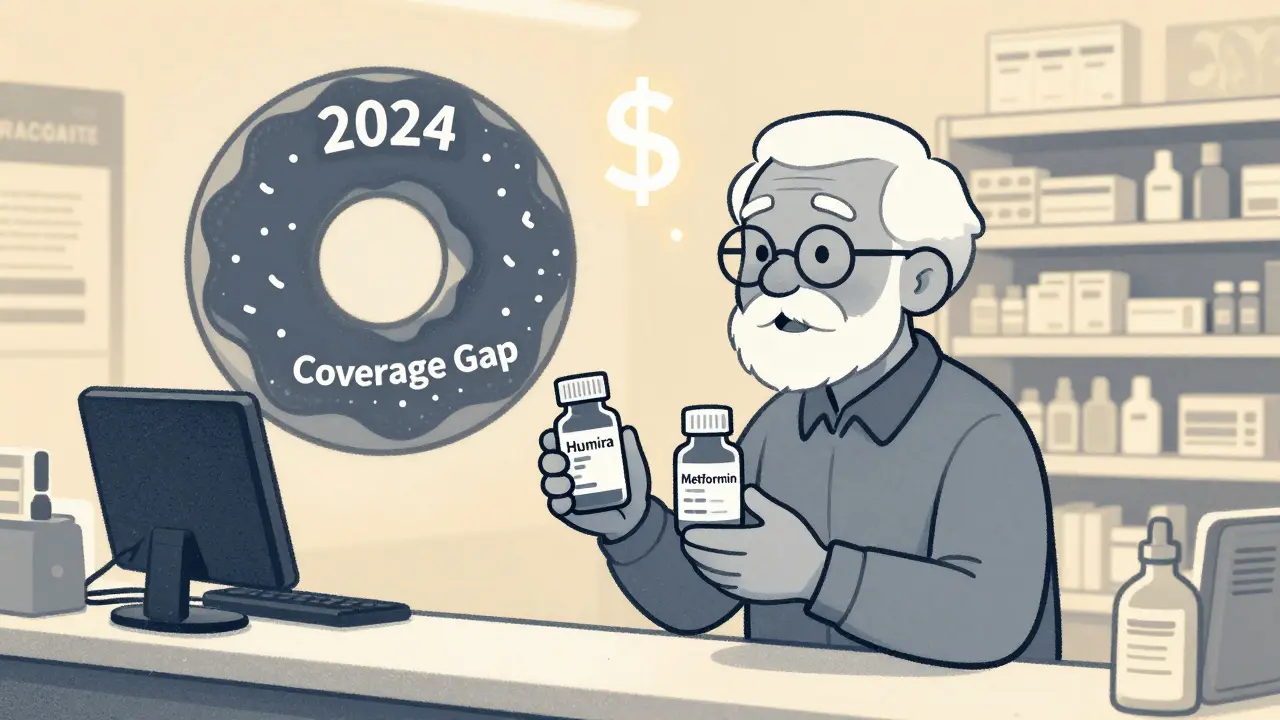
Starting January 1, 2025, the Medicare Part D donut hole is gone. That’s not a rumor-it’s law. The Inflation Reduction Act finally ends the coverage gap that forced millions of seniors to choose between paying for insulin or groceries. But if you’re still in the gap in 2024, or you’re preparing for 2025, you need to know how to protect yourself now-and how the new rules will change everything next year.
What the Donut Hole Actually Means in 2024
The donut hole isn’t a hole you fall into randomly. It’s a phase in your Medicare Part D drug plan that kicks in after you and your plan have spent $5,030 on covered drugs in 2024. At that point, you’re no longer getting the full help from your plan. You start paying 25% of the cost for both brand-name and generic drugs. Sounds manageable? It’s not. Here’s the catch: that 25% is only part of the story. For brand-name drugs, the manufacturer gives you a 70% discount, but that discount doesn’t count toward your out-of-pocket spending limit. Only what you actually pay out of your pocket counts. So if your Humira costs $1,200 a month, you pay $300, and the manufacturer covers $840. But only the $300 counts toward getting you out of the gap. That means you’re stuck paying hundreds every month for months on end, even though the drug is technically discounted. For generics, there’s no manufacturer discount. You pay 25% of the full price, and that’s it. No help from the drug company. So if your generic metformin costs $40 a month, you pay $10. That adds up fast when you’re on multiple meds.Why the Donut Hole Hits Some People Harder Than Others
Not everyone feels the donut hole the same way. If you take mostly brand-name drugs-like Humira, Repatha, or Enbrel-you’ll hit the catastrophic coverage phase faster. Why? Because the 70% manufacturer discount counts toward your total drug spending, even though you don’t get to keep it. So even though you’re paying $300 a month for Humira, the $840 discount pushes your total drug spending up faster. That means you might reach the $8,000 threshold (where catastrophic coverage kicks in) after spending only $3,300 out of pocket. But if you’re on generics-like lisinopril, atorvastatin, or levothyroxine-you’re stuck. No manufacturer help. You pay 25% of the full price, and that’s all that counts. You could spend $6,000 out of pocket before you get out of the gap. That’s a lot of money for someone on a fixed income. A 2023 survey by the Medicare Rights Center found that 68% of people who entered the donut hole had to change how they took their meds. Some skipped doses. Some split pills. Some stopped filling prescriptions entirely. That’s not just inconvenient-it’s dangerous.How to Save Money Before the Donut Hole Hits
You don’t have to wait until you’re in the gap to act. Here’s what works right now:- Check your plan’s formulary. Not all drugs are created equal. Your plan might list your medication in Tier 3 (higher cost) instead of Tier 2. Ask your pharmacist or log into your plan’s website. If a cheaper alternative exists and your doctor agrees, switch. A switch from brand to generic can save you $1,200 to $2,500 a year.
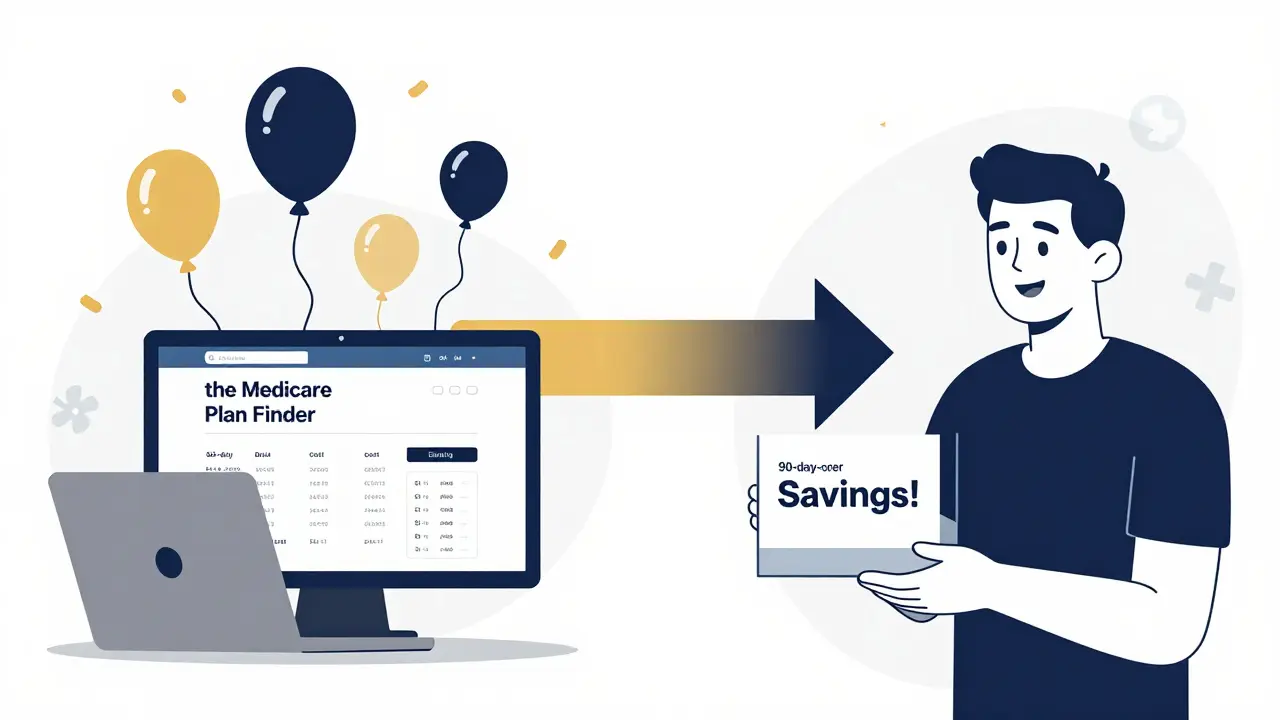
- Use 90-day mail-order prescriptions. Most Part D plans charge less for a 90-day supply than three separate 30-day fills. You might save 15-25% per prescription. That’s $20-$50 a month on a $200 drug.
- Use the Medicare Plan Finder. This tool lets you enter your exact medications and see which plans cost the least. In 2023, people who switched plans based on their drugs saved an average of $1,047 a year. Don’t assume your current plan is still the best.
- Apply for Extra Help. If your income is below $21,870 (single) or $29,580 (married), you qualify for the Low-Income Subsidy. It covers your premiums, deductibles, and eliminates the donut hole entirely. About 12.6 million people qualified in 2023-many didn’t even know it.
Manufacturer Assistance Programs Are Your Secret Weapon
Big drug companies have patient assistance programs-and they’re not hard to get. If you’re on a brand-name drug like Humira, Enbrel, or Repatha, the manufacturer likely offers a copay card or free drug program. One woman on Reddit, u/SeniorCareAdvocate, shared how her Repatha cost $560 a month until she enrolled in Amgen’s program. It dropped to $5. That’s not a fluke. A 2023 study in the Journal of Managed Care & Specialty Pharmacy found these programs cut out-of-pocket costs by 63% to 92% for brand-name drugs. How to find them:- Search “[Drug Name] patient assistance program”
- Visit NeedyMeds.org or RxAssist.org-both are free, nonprofit databases
- Ask your pharmacist. They often have printed brochures or direct links
What Changes in 2025 (And How to Prepare)
On January 1, 2025, the donut hole disappears. Instead of four phases, Medicare Part D will have three:- Deductible phase (up to $590)
- Initial coverage phase (until you’ve paid $2,000 out of pocket)
- Catastrophic coverage (you pay $0 for covered drugs)
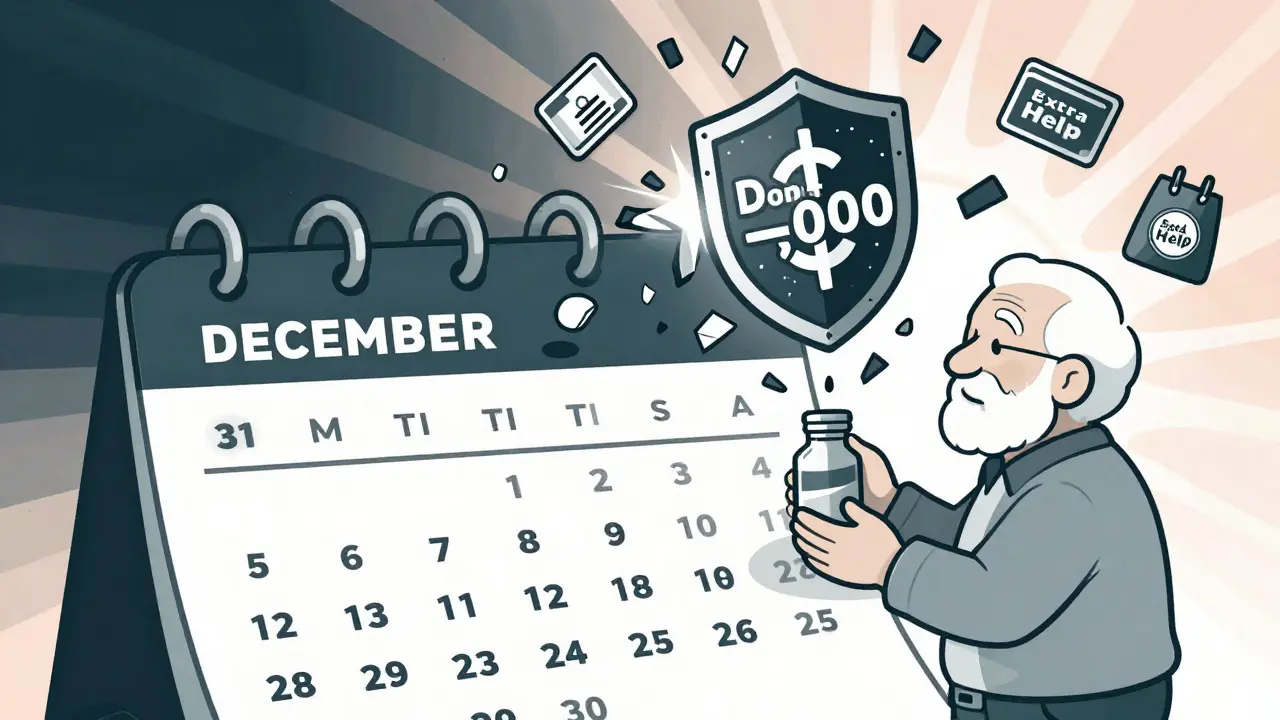
What to Do Before December 31, 2024
You still have time to act. Here’s your checklist:- Review your Annual Notice of Change. Your plan mailed this in September 2024. It tells you how your costs, coverage, and formulary are changing for 2025. Compare it to last year’s.
- Call your pharmacy. Ask if your drugs are changing tiers or prices in 2025. Some plans will shift drugs to higher tiers to offset the $2,000 cap.
- Reapply for Extra Help. Even if you got it last year, you must reapply every year. Don’t assume you’re still covered.
- Use the Medicare Plan Finder again. New plans are launching in 2025. The cheapest plan last year might not be the cheapest next year.
Real Stories: What Happens When You Don’t Act
One man in Ohio, 72, took two brand-name drugs for rheumatoid arthritis. In 2023, he hit the donut hole in May. By October, he’d spent $4,200 out of pocket. He skipped doses. His pain got worse. He ended up in the ER with a flare-up. His hospital bill: $8,700. He could’ve avoided it all with a generic switch and a manufacturer program. A woman in Florida, 68, took a generic blood pressure med. She didn’t realize the donut hole didn’t help her. She paid $120 a month for 8 months straight. By December, she’d paid $960-and still wasn’t out of the gap. She didn’t know about mail-order or Extra Help until a community health worker visited her home. These aren’t rare cases. They’re the norm.What’s Next After 2025
The $2,000 cap is a big win, but it’s not the end. Experts predict more changes: lower premiums, expanded Extra Help, and possibly even price negotiation for top-cost drugs. For now, focus on what you can control:- Know your drugs
- Know your plan
- Know your options
Is the donut hole still active in 2025?
No. The Medicare Part D coverage gap, or donut hole, was eliminated effective January 1, 2025. Instead of a gap, there’s now a $2,000 annual out-of-pocket spending cap on prescription drugs. Once you hit that cap, you pay $0 for covered medications for the rest of the year.
How much do I pay during the coverage gap in 2024?
In 2024, once you and your plan have spent $5,030 on covered drugs, you enter the coverage gap. You pay 25% of the cost for both brand-name and generic drugs. For brand-name drugs, the manufacturer provides a 70% discount, but only your 25% payment counts toward getting you out of the gap. For generics, there’s no manufacturer discount-you pay 25% of the full price.
Can I avoid the donut hole by switching plans?
Yes. Not all Medicare Part D plans have the same cost structure. Some have lower deductibles, better formularies, or lower copays for your specific drugs. Using the Medicare Plan Finder tool and comparing plans based on your exact medications can help you avoid or delay entering the coverage gap. People who optimize their plan selection save an average of $1,047 a year.
What if I can’t afford my meds even with the $2,000 cap?
If you’re still struggling, you may qualify for Extra Help (Low-Income Subsidy). This federal program reduces or eliminates premiums, deductibles, and copays. In 2023, over 12.6 million people qualified. You can apply through Social Security or your state Medicaid office. Even if you think your income is too high, check-it’s not as strict as people think.
Do manufacturer discounts still help after 2025?
Yes, but differently. After 2025, manufacturer discounts no longer count toward your $2,000 out-of-pocket cap. However, you still get the discount at the pharmacy counter-meaning you pay less upfront. For example, if your brand-name drug costs $1,000 and the manufacturer gives a 70% discount, you pay $300, not $1,000. That $300 counts toward your $2,000 limit. The discount still helps, but it doesn’t speed up your exit from the initial coverage phase like it used to.
Are generic drugs always cheaper than brand-name drugs in Medicare Part D?
Usually, yes-but not always. Some brand-name drugs have high manufacturer discounts that make them cheaper than their generic equivalents in certain plans. Always compare the final out-of-pocket cost using the Medicare Plan Finder. For example, a brand-name drug with a 70% discount might cost you $10, while a generic without discounts could cost $25. Don’t assume generics are always cheaper-check your plan’s pricing.

Joy F
January 1, 2026 at 16:54The donut hole was always a scam dressed up as policy. They let you think you’re getting help, but the math was rigged-manufacturer discounts don’t count toward your out-of-pocket? That’s not a discount, that’s a psychological trick. They’re giving you the illusion of relief while keeping you trapped in the same cage. And now they’re changing the rules again? Of course they are. The system doesn’t want you free-it wants you compliant.
Haley Parizo
January 3, 2026 at 10:51This isn’t just about drugs-it’s about dignity. People are choosing between insulin and rent. That’s not healthcare, that’s extortion wrapped in bureaucracy. The $2,000 cap? It’s a start. But why did it take 20 years of people dying in the gap for Congress to act? The real question isn’t how to navigate the system-it’s why the system was designed to break people in the first place.
Ian Detrick
January 3, 2026 at 14:09Look, I’ve been on Medicare Part D since 2018, and I’ve used every trick in the book. Mail-order? Lifesaver. Extra Help? Got it. Manufacturer coupons? Applied to all five of my meds. The key isn’t waiting until you’re in the donut hole-you’ve got to be proactive. I checked my plan every single year, switched when it made sense, and I’ve paid under $1,200 out of pocket for the last three years. It’s not magic. It’s just doing the homework. Most people don’t want to do that. They just hope it’ll get better. It won’t. You have to fight for it.
Angela Fisher
January 5, 2026 at 11:57EVERYTHING IS A LIE. 😭 The government says the donut hole is gone… but did you know the drug companies are now charging MORE for generics because they know you’ll be stuck at $2,000? They’re adjusting prices so you hit the cap FASTER so they can raise premiums next year. I saw the memo from Express Scripts. They’re already prepping for 2026. The $2,000 cap? It’s a trap. They want you to spend it all so they can say ‘see, they need more money!’ Then they’ll hike premiums again. I’m not falling for it. I’m stockpiling my meds before January. 😈
Lori Jackson
January 6, 2026 at 12:52It’s fascinating how the discourse around this issue has been co-opted by performative empathy. The real issue isn’t the donut hole-it’s the commodification of pharmaceuticals under a neoliberal healthcare framework. The $2,000 cap is a neoliberal Band-Aid on a systemic arterial bleed. The absence of universal price negotiation, the structural reliance on private insurers, and the absence of single-payer infrastructure render even this ‘reform’ a hollow gesture. The real victory would be abolishing the entire Part D architecture and replacing it with a public option. But no-let’s celebrate crumbs while the corporations keep their margins.
Wren Hamley
January 7, 2026 at 12:53Okay, real talk-I didn’t know about NeedyMeds until last year. Found a $1,400/month drug for $12 after I applied. My pharmacist didn’t even mention it. Why? Because they get paid per script, not per savings. Same with mail-order-my pharmacy tried to upsell me on 30-day fills because they make more money off it. The system is designed to keep you confused, overwhelmed, and spending. Don’t trust the people who sell you meds. Trust the free tools. Medicare Plan Finder, NeedyMeds, RxAssist-those are your real allies. And yeah, you have to spend an hour doing it. But that hour could save you $10,000. Worth it.
Ian Ring
January 8, 2026 at 10:43Excellent summary-thank you for the clarity. I’ve been managing my father’s medications since his diagnosis, and the complexity is staggering. I’ve used the Plan Finder, applied for Extra Help, and switched to mail-order. The real challenge? Ensuring he understands what’s happening. Many seniors are overwhelmed. I’ve printed out a one-page cheat sheet with the key steps: check formulary, apply for help, use coupons, call pharmacy. Simple. No jargon. He’s been saving $400/month since. The system isn’t broken-it’s just not designed for people. We have to design it for them.
Tru Vista
January 10, 2026 at 01:39lol the donut hole is gone? sure. and my cat can fly. just wait till 2026 when they raise premiums 20% and ‘adjust’ your formulary to make your meds tier 5. you think they’re helping? they’re just moving the goalposts. #medicarelies
Vincent Sunio
January 10, 2026 at 20:28The notion that the $2,000 cap represents a substantive reform is a dangerous illusion. The Inflation Reduction Act’s provisions are merely cosmetic adjustments to a fundamentally predatory system. The manufacturer discounts, while beneficial at point-of-sale, are deliberately excluded from the out-of-pocket threshold precisely to preserve the financial architecture of the pharmaceutical-industrial complex. One must question whether such policy changes are genuinely intended to alleviate burden-or merely to manufacture the appearance of progress while entrenching the status quo. The true measure of reform lies not in caps, but in price controls.
JUNE OHM
January 11, 2026 at 22:16THEY’RE LYING TO US AGAIN!! 🚨 The donut hole is gone… but the REAL reason? The government is secretly partnering with Big Pharma to push MORE expensive drugs so you hit the $2k cap FASTER and then they can say ‘look how much we saved!’ Then next year, premiums go up 15% and they say ‘we had to because you used so much!’ It’s a trap! I’m switching to natural remedies. Turmeric. Apple cider vinegar. No more pills. 🌿💊 #MedicareScam #SaveOurSeniors
Philip Leth
January 12, 2026 at 18:30Man, I just wish more people knew about those manufacturer programs. My mom was on Enbrel-$1,800 a month. She got it down to $10 after 3 weeks of paperwork. No one told her. Not her doctor, not her pharmacist. Just some random Reddit post. That’s the problem. We’ve got all the tools. We just don’t know how to use them. And nobody’s teaching us. We’re supposed to just… figure it out? On a fixed income? With arthritis in our hands? Come on.
Angela Goree
January 14, 2026 at 04:26And yet… they still won’t let us import cheaper drugs from Canada. They say it’s ‘unsafe.’ But if it’s unsafe, why do they let the drug companies sell the SAME EXACT DRUG here for 5x the price? This isn’t about safety. It’s about profits. And if you’re not angry about that, you’re not paying attention. #FixMedicare #NoMoreDonutHole