
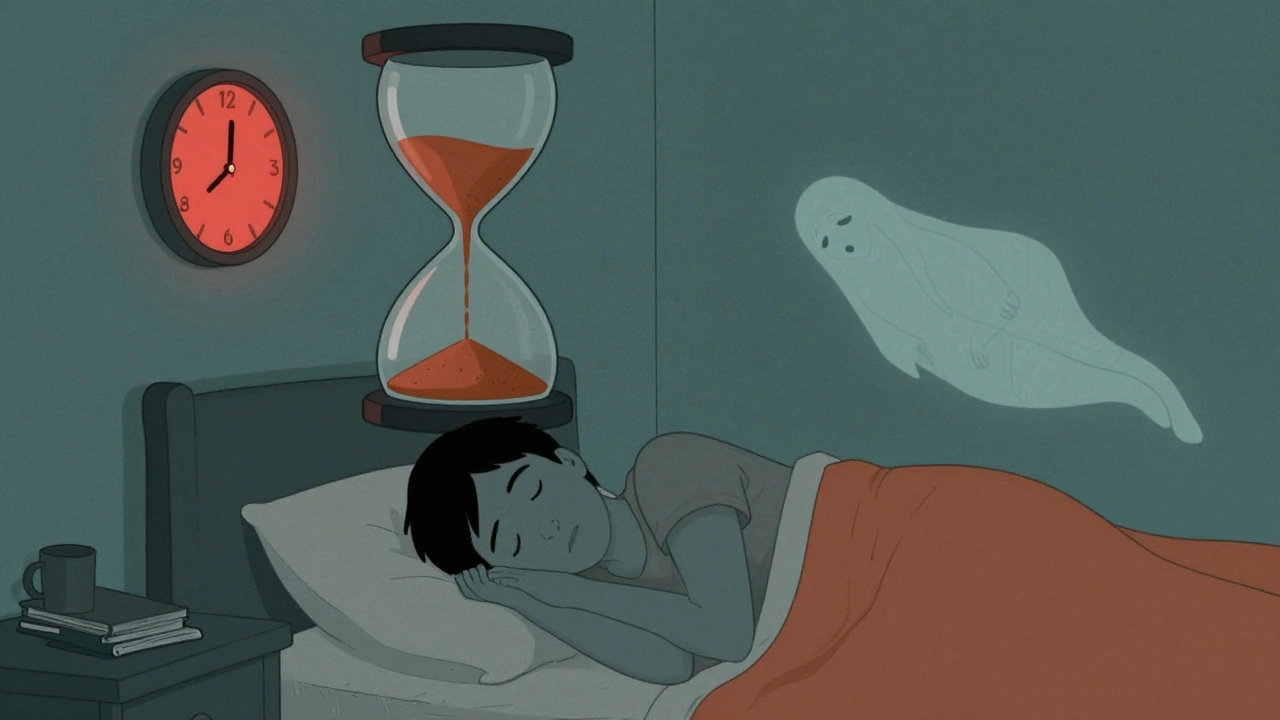
For years, people with chronic insomnia have been told to sleep more-to stay in bed longer, take naps, avoid caffeine, and follow strict sleep hygiene rules. But if you’ve been lying awake for hours night after night, you know that sleep restriction therapy isn’t about doing more. It’s about doing less. And that’s exactly what makes it work.
Why Staying in Bed Longer Makes Insomnia Worse
Most people with insomnia spend way too much time in bed. If you’re only sleeping five hours but spending eight hours in bed, your brain starts to associate your bed with wakefulness. You lie there worrying. You check the clock. You toss and turn. Over time, your body stops seeing the bed as a place for sleep-and that’s when insomnia becomes a habit. Sleep restriction therapy flips that script. Instead of trying to force more sleep, it limits your time in bed to match how much you’re actually sleeping. If you’re averaging 5.5 hours of sleep per night, you’re only allowed to be in bed for 5.5 hours. At first, this sounds impossible. You’ll feel exhausted. But that’s the point. By reducing time in bed, you build up sleep pressure-the biological drive to sleep that accumulates the longer you’re awake. When you finally get into bed, your body is so tired that falling asleep becomes easier. Waking up less often during the night becomes more likely. And over time, your sleep becomes more consolidated, more efficient, and more predictable.How Sleep Restriction Therapy Works: A Step-by-Step Breakdown
This isn’t a DIY hack. It’s a structured, evidence-based process backed by decades of research and endorsed by the American Academy of Sleep Medicine as a first-line treatment for chronic insomnia. Here’s how it actually works:- Track your sleep for 7 days. Use a sleep diary to record exactly when you get into bed, when you fall asleep, when you wake up, and any time you’re awake during the night. Don’t guess. Don’t estimate. Write it down. This gives you your baseline.
- Calculate your average total sleep time. Add up all the hours you slept over the week and divide by seven. If you slept 5 hours, 6 hours, 5.5 hours, 4.5 hours, 6 hours, 5 hours, and 5.5 hours, your average is about 5.3 hours.
- Set your initial time-in-bed limit. Your time in bed starts at your average sleep time. If you slept 5.3 hours on average, you get 5.3 hours in bed. That means if you need to wake up at 6 a.m., you can only get into bed at 12:42 a.m. No exceptions.
- Stick to a fixed wake time. No matter how little you slept, you wake up at the same time every day-even on weekends. This anchors your circadian rhythm and prevents your internal clock from drifting.
- Wait for sleep efficiency to improve. Sleep efficiency is the percentage of time in bed that you’re actually asleep. If you’re in bed for 5.3 hours and sleep 4.8 hours, your efficiency is 90%. When your efficiency stays at 85-90% for three nights in a row, you add 15 minutes to your time in bed.
- Gradually increase time in bed. Keep adding 15-30 minutes every few weeks as your sleep improves. The goal isn’t to sleep more-it’s to sleep better. Most people reach 7-7.5 hours of time in bed within 6-8 weeks.
What Happens in the First Few Weeks
Let’s be honest: the first two weeks are rough. You’ll be tired. You might feel foggy at work. You might snap at your kids. You’ll want to nap. You’ll want to get into bed earlier. You’ll think it’s not working. That’s normal. A 2023 study from Sleepstation.org.uk found that 68% of people using sleep restriction therapy reported significant daytime sleepiness in the first 1-2 weeks. But here’s the key: that fatigue isn’t a sign it’s failing-it’s proof it’s working. Your body is recalibrating. The sleep pressure is building. The brain is unlearning its association between bed and wakefulness. The people who quit? They usually quit because they didn’t stick to the wake time. Or they napped. Or they extended their time in bed on Friday night because they “deserved it.” That’s the biggest reason SRT fails-not because it doesn’t work, but because people break the rules. One Reddit user, SleepSeeker89, posted in January 2024: “After three weeks of strict SRT, my sleep efficiency jumped from 68% to 89%. I fall asleep in 15 minutes instead of lying awake for hours.” That didn’t happen because they slept more. It happened because they slept less-on purpose.Why Sleep Restriction Therapy Beats Medication
Sleeping pills might help you fall asleep faster tonight. But tomorrow night? You’ll need another pill. And the next night? Maybe two. And then you’re dependent. And then you have rebound insomnia when you stop. A 2023 meta-analysis showed that sleep restriction therapy improves sleep efficiency by 47% more than sleep hygiene alone. Benzodiazepines? They help 60-70% of people-but only while you’re taking them. Once you stop, sleep problems return. SRT? The improvements stick. A 2023 Sleepstation.org.uk follow-up found that 78% of people who completed SRT still had better sleep six months later. Compare that to only 32% for people who used medication. And it’s not just about falling asleep faster. People who do SRT report fewer nighttime awakenings, less anxiety about sleep, and more confidence in their ability to sleep naturally. That’s the real win.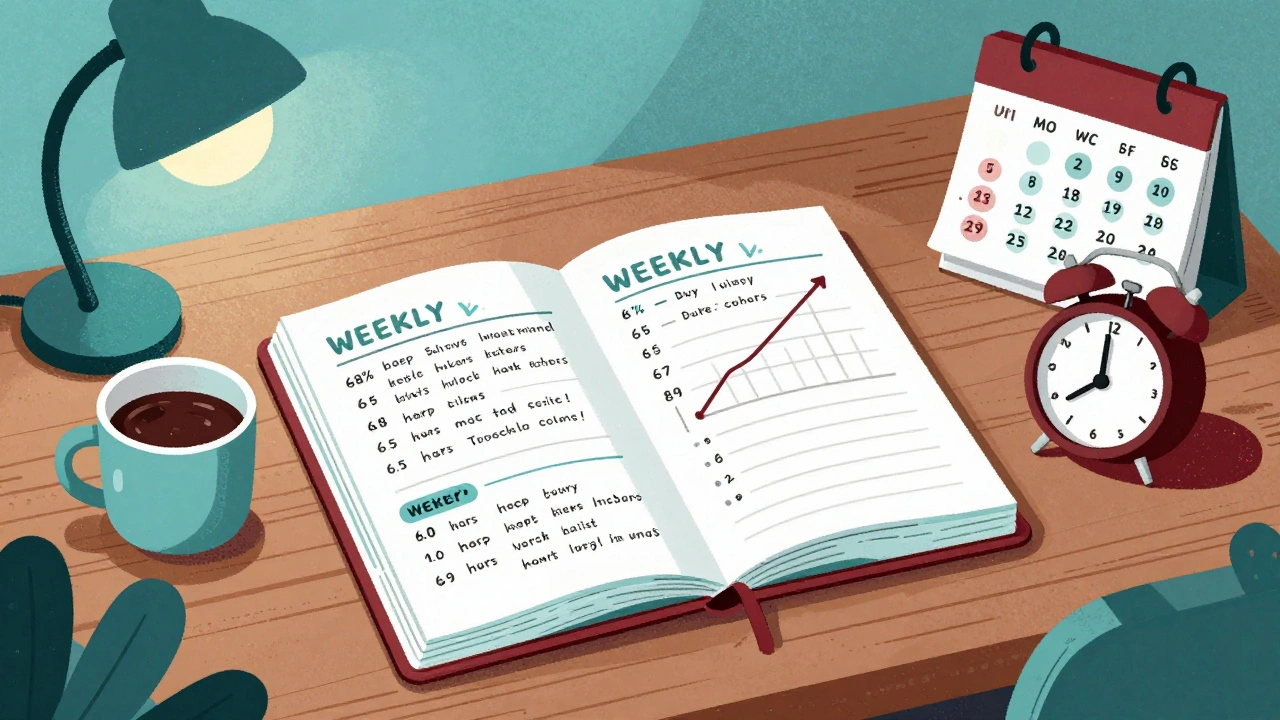
Who Shouldn’t Try Sleep Restriction Therapy
This isn’t for everyone. If you have severe depression, bipolar disorder, or untreated anxiety, SRT can make things worse. The sleep deprivation in the early phase can trigger mood crashes. The American College of Physicians recommends combining SRT with cognitive therapy for people with these conditions. Shift workers? It’s risky. Your schedule is already unstable. Adding strict wake times and sleep restriction can throw your circadian rhythm into chaos. Some people manage it-but only with expert guidance. And if you drive for a living, operate heavy machinery, or work in safety-critical roles, the first two weeks of SRT could be dangerous. You’ll be sleep-deprived. You’ll be slower. You’ll be more prone to errors. Talk to your doctor before starting.What Works Best Alongside SRT
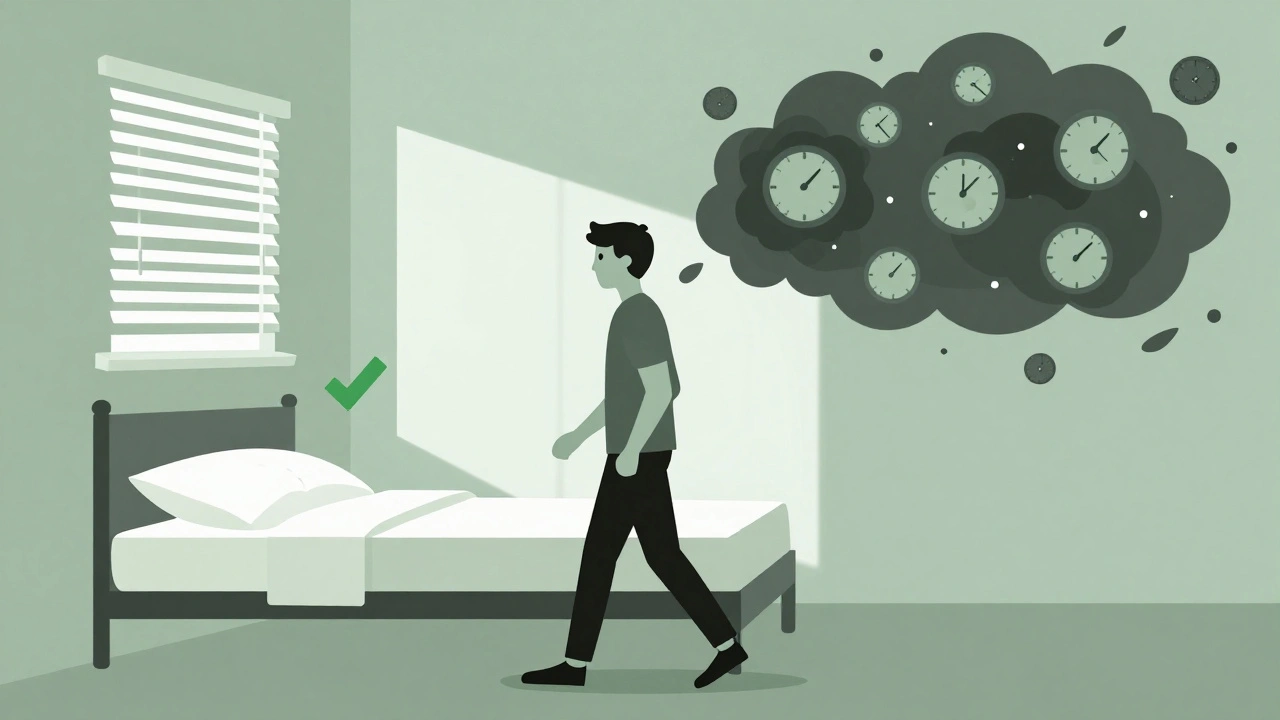
Sleep restriction therapy doesn’t work alone. It’s part of Cognitive Behavioral Therapy for Insomnia (CBT-I), which includes two other core components: Stimulus Control Therapy and Cognitive Therapy. Stimulus Control Therapy teaches you to use your bed only for sleep and sex. No reading. No scrolling. No watching TV. If you’re awake for more than 20 minutes, you get out of bed and go to another room until you feel sleepy. Then you go back. This rebuilds the bed-sleep connection. Cognitive Therapy helps you challenge the thoughts that keep you awake: “I’ll never sleep,” “If I don’t sleep tonight, tomorrow will be ruined,” “I need 8 hours to function.” These thoughts create anxiety-and anxiety keeps you awake. Sleep hygiene-avoiding caffeine, keeping the room dark, not exercising before bed-is helpful, but it’s not enough on its own. Studies show it’s the weakest part of CBT-I. SRT and stimulus control? Those are the heavy lifters.Tools and Support to Help You Succeed
You don’t need to do this alone. There are about 1,200 CBT-I-certified clinicians in the U.S. according to the Society of Behavioral Sleep Medicine. But they’re hard to find. Many insurance plans don’t cover them. That’s why digital tools are growing fast. Apps like CBT-i Coach (developed by the VA) and Sleepio have helped tens of thousands of people. A 2023 VA evaluation found CBT-i Coach had 72% user satisfaction. Somryst, an FDA-cleared app approved in October 2023, delivers full CBT-I-including SRT-with 64% efficacy in clinical trials. If you’re going the app route, make sure it includes:- A sleep diary tracker
- Automatic calculation of sleep efficiency
- Guided adjustments to time-in-bed
- Stimulus control prompts
- Cognitive restructuring exercises
How Long Until You See Results?
Most people start seeing changes in 2-3 weeks. Sleep efficiency improves. Time to fall asleep drops. Nighttime awakenings decrease. But real transformation? That takes 6-8 weeks. Some people take longer-up to 3 months. That’s normal. This isn’t a quick fix. It’s a reset. The people who stick with it? They don’t just sleep better. They stop fearing sleep. They stop checking the clock. They stop worrying about tomorrow. And that mental shift? That’s what makes the difference long-term.What Happens After You Finish
Once you reach 7-7.5 hours of time in bed and your sleep efficiency stays above 85%, you’re done with the active phase. But you’re not done with the habits. Keep your wake time consistent. No weekend oversleeping. No naps. Keep using the bed only for sleep. If you slip, go back to your last successful time-in-bed limit for a few nights. Most people who complete SRT maintain their results for years. A 2023 study in the Journal of Clinical Sleep Medicine found that 68% of people still had better sleep at the 12-month mark. Only 29% of medication users did. This isn’t a treatment you finish. It’s a way of sleeping you rebuild.Final Thoughts: It’s Hard, But It’s Worth It
Sleep restriction therapy isn’t gentle. It’s not comfortable. It doesn’t promise a magic cure. But it’s one of the few insomnia treatments that actually rewires your brain’s relationship with sleep. If you’ve tried everything-melatonin, valerian, white noise machines, weighted blankets-and you’re still lying awake-this might be what you’ve been missing. Not more sleep. Less time in bed. It’s counterintuitive. It’s hard. But for thousands of people, it’s the only thing that worked. Start with a sleep diary. Track your nights. Be honest. Stick to the wake time. Don’t nap. And give it six weeks. Your body is capable of resetting itself-if you give it the right conditions. You don’t need more sleep. You need better sleep. And sometimes, that means spending less time in bed.
Vivian Amadi
December 11, 2025 at 11:46This is the dumbest thing I’ve ever read. You think limiting sleep is the answer? My grandma slept 10 hours and lived to 92. You’re just sleep-deprived and desperate for a fix.
Jimmy Kärnfeldt
December 13, 2025 at 03:46I get where you're coming from, but I’ve been through this. The first two weeks felt like hell-zombie mode, caffeine addiction, snapping at my cat. But by week four? I fell asleep before my head hit the pillow. No pills. No magic. Just discipline. It’s not easy, but it’s real.
Ariel Nichole
December 14, 2025 at 09:56Really appreciate this breakdown. I tried SRT last year and quit after a week because I was too tired. But reading this made me think maybe I just didn’t stick with it. I’m going to try again this month-no naps, fixed wake time. Fingers crossed.
Monica Evan
December 16, 2025 at 04:15OMG YES this is life changing i did this last year after 8 years of insomnia and now i sleep like a baby like literally i dont even think about it anymore the wake time thing is everything dont even think about bed until your time its not about quantity its about quality and your brain is smarter than you think
Jim Irish
December 16, 2025 at 17:23Scientifically sound approach. The evidence is clear. Sleep efficiency is a measurable metric and behavioral conditioning is more effective than pharmacological intervention for long-term outcomes. The key is consistency.
Mia Kingsley
December 17, 2025 at 02:25Wait so you’re telling me I’m supposed to be awake 18 hours a day just to sleep 6? That’s not therapy that’s punishment. And who even tracks sleep to the minute? My dog sleeps better than me and she doesn’t use a diary
Katherine Liu-Bevan
December 18, 2025 at 21:35One thing this post doesn’t emphasize enough: the cognitive component. The anxiety around sleep is what keeps you awake. SRT works because it breaks the cycle-but only if you also challenge the thoughts like 'I’ll die if I don’t sleep' or 'I need 8 hours.' Those thoughts are lies your brain tells you. Therapy isn’t just about time in bed. It’s about rewiring the narrative.
Lisa Stringfellow
December 19, 2025 at 06:19So you’re saying I should be more tired so I can sleep better? That sounds like a cult. Also, why is everyone here acting like this is some revolutionary discovery? My therapist told me this 10 years ago and I didn’t believe her. Now you’re all acting like you found the cure for cancer.
Aman deep
December 19, 2025 at 11:53Bro I’m from India and we don’t have this kind of sleep culture here. People sleep when they’re tired, wake when the sun rises. But I tried this after reading your post and honestly? It worked. I used to lie awake till 3am. Now I’m out by 12:30. No apps. Just a notebook and a stubborn heart. You don’t need fancy tools. Just grit.
Eddie Bennett
December 21, 2025 at 02:55My wife did this last year. She cried the first week. We almost broke up. But now? She’s the calmest person I know. Doesn’t stress about sleep. Doesn’t check the clock. Doesn’t even talk about it anymore. That’s the real win. Not the hours. The peace.
Sylvia Frenzel
December 21, 2025 at 05:34Why are Americans so obsessed with optimizing sleep? In my country, people sleep when they can. No trackers. No apps. No guilt. Maybe the problem isn’t your bed. Maybe it’s your mindset.