
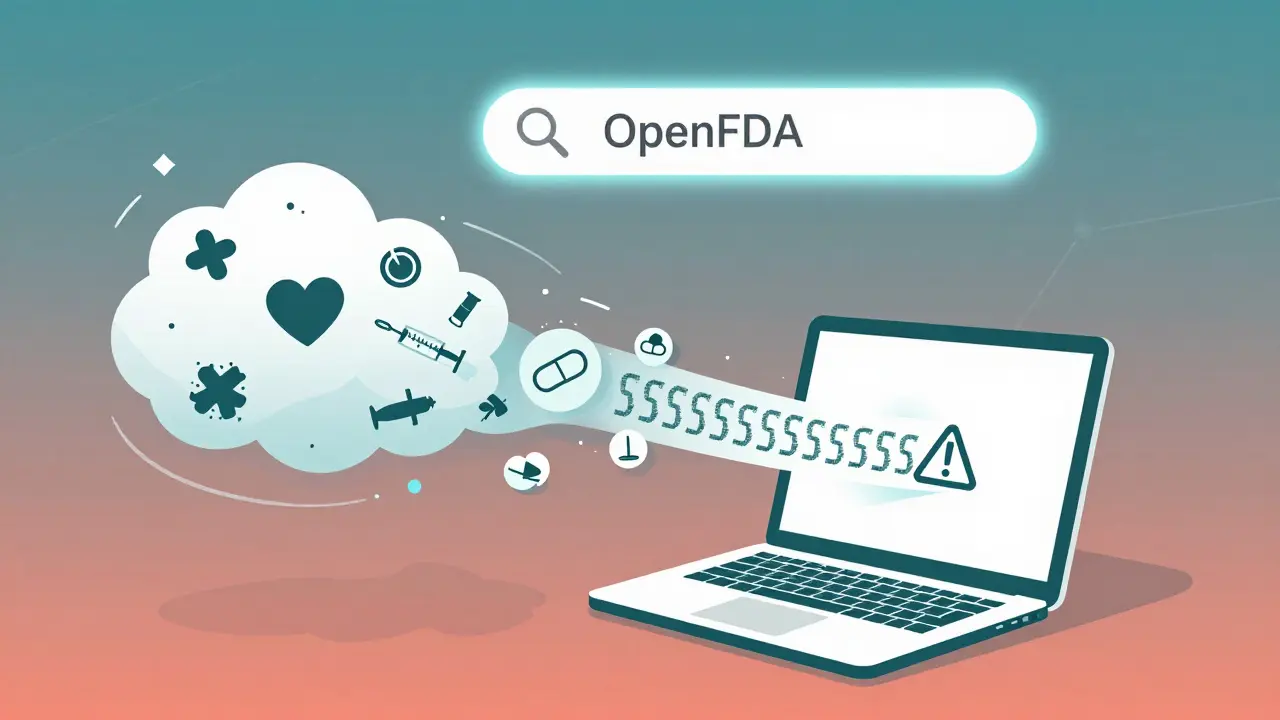
Drug Side Effect Search Simulator
Enter search criteria and click "Search OpenFDA" to see simulated results.
NOTE: This is a simulation. Real OpenFDA API requires an API key and follows rate limits.
When using the real OpenFDA API, you would use:
Where:
- [DRUG] = generic or brand name
- [GENDER] = 1 (male) or 2 (female)
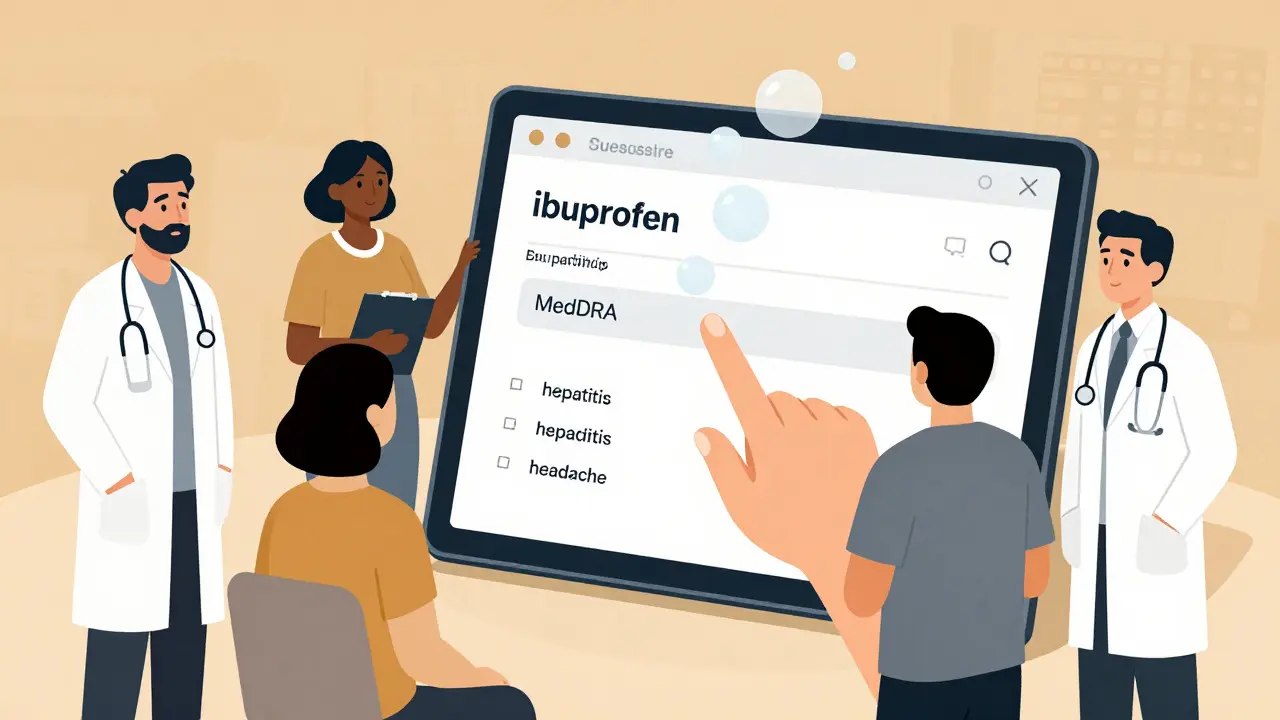
- [SYMPTOM] = MedDRA term
Important Notes:
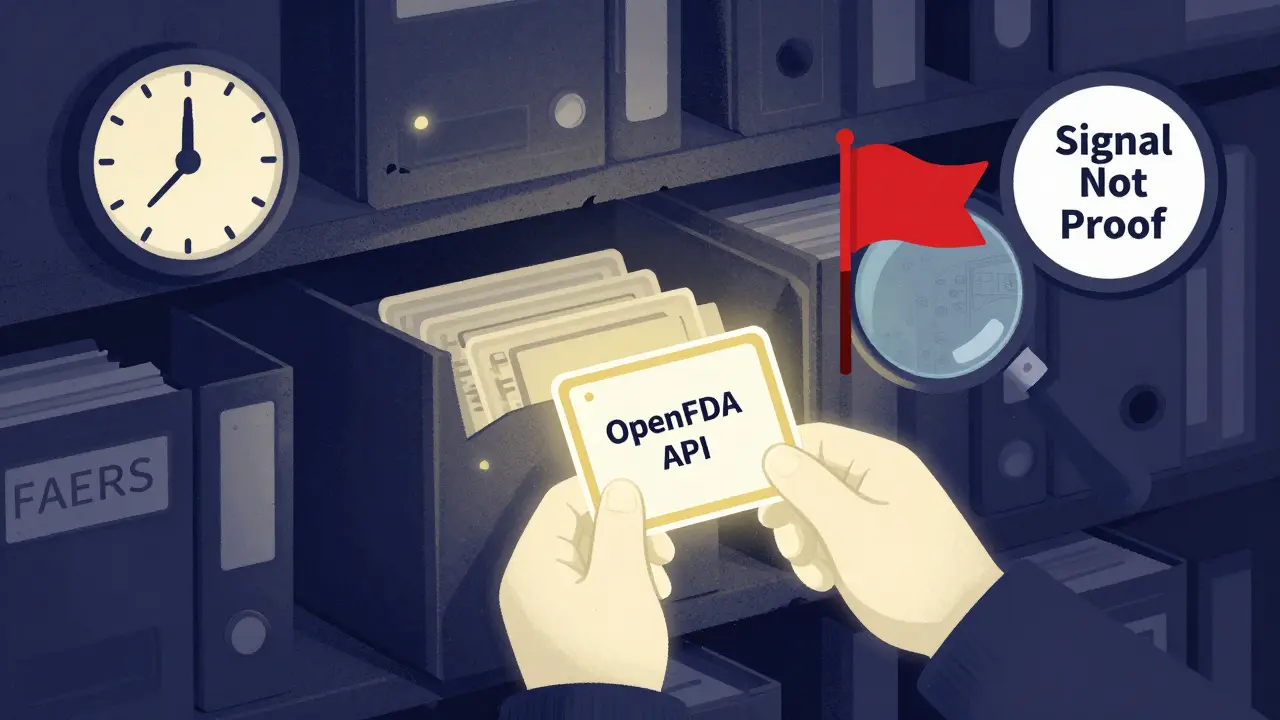
1. Data has up to 3-month delay - reports are not real-time
2. Reports are signals, not proof of causation
3. For research, compare to background rates
4. Always include your API key for full access
Every year, millions of people take prescription drugs. Most are safe. But some cause unexpected side effects - sometimes serious ones. If you’ve ever wondered how regulators track these reactions, the answer lies in the FAERS database and its public gateway: OpenFDA. This isn’t science fiction. It’s real data, freely available, and it’s changing how researchers, developers, and even curious patients understand drug safety.
What Exactly Is OpenFDA and How Does It Relate to FAERS?
OpenFDA is not a database you download. It’s an API - a digital doorway - that lets you search through public FDA data without needing a PhD in data engineering. The core dataset behind it? FAERS, the FDA Adverse Event Reporting System. FAERS collects voluntary reports from doctors, pharmacists, patients, and drug makers about harmful reactions after taking medications, vaccines, or medical devices. Before OpenFDA launched in 2014, getting this data meant downloading massive XML files, wrestling with outdated formats, and spending weeks cleaning up messy records. Now, you can type a simple query likeopenfda.generic_name:"ibuprofen" and get back clean, structured JSON with details on who reported the reaction, what drug was involved, what symptoms occurred, and the outcome - all in seconds.
The FDA built OpenFDA to fix a broken system. If you wanted to know how many people reported nausea after taking a specific drug, you used to need to hire a data analyst. Now, a developer with basic coding skills can do it in a day.
How the OpenFDA API Works: Endpoints, Queries, and Limits
OpenFDA doesn’t give you one big data dump. It gives you targeted endpoints - like separate doors for drugs, devices, and food recalls. For side effect reports, you use thedrug/events endpoint. Every request must go through one of these doors.
Queries use Elasticsearch syntax. That means you can search by:
- Drug name:
openfda.generic_name:"lisinopril" - Brand name:
openfda.brand_name:"Zestril" - Adverse event term:
patient.reaction.reactionmeddrapt:"hepatitis" - Patient age or sex:
patient.patientsex:"1"(male) or"2"(female)
skip parameter to paginate through more.
What Data You Actually Get - And What’s Missing
Each side effect report includes:- Drug information (generic name, brand name, dose, route)
- Reaction terms coded in MedDRA (a global medical terminology standard)
- Outcome: recovered, recovered with sequelae, hospitalized, life-threatening, death
- Demographics: age, sex, and approximate location (no names or exact addresses)
- Reporter type: consumer, health professional, lawyer
- Patient names, addresses, or medical record numbers
- Lab results, imaging, or clinical notes
- Exact timing of when the reaction happened
- Concurrent medications (unless reported)
Why OpenFDA Beats Commercial Tools - And Where It Falls Short
There are paid platforms like Oracle Argus and ARTEMIS that pharmaceutical companies use. They cost $100,000+ per year. They have fancy dashboards, AI-driven signal detection, and integration with hospital systems. But they don’t have the full picture. OpenFDA is the only source that includes every report submitted to the FDA - from a nurse in Texas to a patient in Alaska. Commercial tools often only see reports from their own clients. OpenFDA gives you the complete public record. The downside? OpenFDA has no built-in analytics. No graphs. No alerts. No statistical models to tell you if a reaction is statistically significant. You have to build that yourself. If you want to know whether a side effect is truly unusual, you need to compare it to background rates - which means downloading data for other drugs and doing your own math. That’s why researchers use it. They’re not looking for quick answers. They’re looking for patterns others miss.How to Get Started: Step-by-Step for Developers
If you’re a developer, here’s how to start:- Go to open.fda.gov/apis/authentication/ and register for a free API key.
- Install a tool like Postman or curl to test requests.
- Try this basic query:
https://api.fda.gov/drug/event.json?search=openfda.generic_name:"aspirin"&limit=1 - Once you get a response, add your key:
&api_key=yourkeyhere - Use Python, R, or JavaScript to automate searches. The R package
openFDAsimplifies this - just runset_api_key("yourkey")once. - Always handle rate limits. If you hit 100 requests per minute, the API will block you. Add delays between calls.
Real-World Uses: What People Are Doing With This Data
In 2022, over 350 academic papers used OpenFDA data. Here’s what they found:- Researchers linked certain antidepressants to increased risk of falls in elderly patients by analyzing 12,000+ reports.
- A team in Canada used OpenFDA to detect a spike in heart palpitations after a new ADHD medication hit the market - months before the FDA issued a warning.
- MedWatcher, a consumer app, uses OpenFDA to give users instant side effect summaries when they scan a pill barcode.
Common Mistakes and How to Avoid Them
Most people fail at OpenFDA because they misunderstand the data.- Mistake: Thinking reports = proof. Fix: Always ask: “Is this signal strong enough to be meaningful?” Look for multiple reports over time, not just one spike.
- Mistake: Using vague search terms. Fix: Don’t search for “pain.” Use MedDRA terms like “headache,” “abdominal pain,” or “back pain.”
- Mistake: Ignoring the delay. Fix: If you’re tracking a new drug, wait at least 90 days before drawing conclusions.
- Mistake: Forgetting to use an API key. Fix: Always include it. Without it, you’re capped at 1,000 requests - not enough for serious work.
What’s Next for OpenFDA?
The FDA is expanding. In 2023, they improved device reporting and added tobacco product data. Future updates include better search filters, faster processing, and possibly integration with electronic health records - if privacy rules allow. OpenFDA isn’t perfect. But it’s the most powerful tool we have to see the hidden patterns in drug safety. It’s free. It’s public. And it’s changing how we understand medicine - one API call at a time.Is OpenFDA data real-time?
No. OpenFDA data has a delay of up to three months. The FDA needs time to receive, validate, de-identify, and structure reports before they appear in the API. If you’re tracking a new drug side effect, wait at least 90 days before analyzing trends.
Can I use OpenFDA to diagnose my own symptoms?
Absolutely not. The FDA explicitly warns that OpenFDA data should not be used for medical decisions. Reports are voluntary, incomplete, and don’t prove causation. If you experience side effects, talk to your doctor - don’t rely on a search result.
Do I need to be a programmer to use OpenFDA?
You don’t need to be a developer to explore it. You can test queries directly in your browser using the OpenFDA website’s search tool. But to use it at scale - like pulling data for research or building an app - you’ll need basic coding skills in Python, R, or JavaScript.
What’s the difference between OpenFDA and FAERS?
FAERS is the raw database of adverse event reports. OpenFDA is the API that makes FAERS data easy to search and use. Think of FAERS as a library full of dusty paper files. OpenFDA is the digital catalog you can search from your phone.
Is OpenFDA free to use?
Yes. OpenFDA is completely free. You only need to register for a free API key to access higher request limits. There are no subscriptions, no fees, and no hidden costs.
Can I download all the data at once?
You can download bulk data files from the FDA’s website, but they’re in XML format and hard to use. The API is the preferred method because it gives you structured, searchable JSON. Bulk downloads are useful for archival purposes, but for analysis, the API is faster and more flexible.

Heather McCubbin
January 22, 2026 at 16:16so like... i just found out my weird joint pain after taking that generic celecoxib? it's in the database. like, officially. i didn't make it up. they have it on file. i feel seen. and also kind of terrified. this is wild.
who knew the government had a secret spy log of everyone's side effects? i thought i was just unlucky. turns out i'm just data.
Viola Li
January 22, 2026 at 16:53this is why we can't have nice things. people are gonna start suing drug companies over every headache they get because they saw it on openfda. next thing you know, every pill will have a 12-page warning label and cost $500.
and don't even get me started on how this will be weaponized by anti-vaxxers and quack wellness influencers. they're already using this stuff to scare people into drinking lemon water instead of insulin.
Michael Camilleri
January 24, 2026 at 15:59you think this is transparency? this is performative transparency. the fda releases data so they look good while still letting pharma get away with murder. you know how many deaths are buried in faers because the reporter didn't know how to fill out the form? how many people died because their doctor didn't report it?
openfda isn't a tool for safety. it's a tool for damage control. they want you to think you're empowered while they keep the real data locked behind paywalls and NDAs. this is the digital equivalent of handing you a flashlight while the whole building is on fire.
lorraine england
January 25, 2026 at 22:57i love that this exists. seriously. i'm not a coder but i played around with the search tool last week after my mom had a bad reaction to her blood pressure med. found 30+ similar reports. showed it to her doctor and we switched meds within a week.
it's not perfect but it's the first time regular people have had any real access to this stuff. no more guessing. no more 'it's probably just anxiety'. this is how medicine should work.
ps - if you're new to it, use the meddra terms. 'pain' gets you nothing. 'arthralgia' gets you answers.
Kevin Waters
January 26, 2026 at 20:30just wanted to add a quick tip for beginners: if you're using python, the openfda package is a lifesaver. install it with pip, set your key once, and then you can just do openfda.search('drug', search='openfda.generic_name:"metformin"') and it handles pagination and rate limiting for you.
also, always use the api key. the 1000/day limit is useless for any real project. free key, 120k/day. no reason not to.
Kat Peterson
January 27, 2026 at 08:43i just cried reading this 😭
like... i've been screaming into the void for years about how my anxiety meds made me feel like a zombie. no doctor listened. now i can show them a thousand other people felt the same thing.
it's not just data. it's validation. it's proof we're not crazy. it's like the internet finally heard us.
thank you. 🙏
Husain Atther
January 28, 2026 at 07:14This is a remarkable step forward for public health transparency. While the data has limitations, the fact that it is accessible and structured for analysis represents a significant advancement in evidence-based medicine. Researchers in developing nations, who lack access to expensive commercial platforms, now have an equal opportunity to contribute to global drug safety monitoring. The open nature of this system fosters collaboration and accountability.
Helen Leite
January 30, 2026 at 02:20they're watching us. every pill, every headache, every weird dream. this isn't transparency. it's surveillance. they're building a profile of every american's body. next thing you know, your insurance will raise your rates because openfda says you're 'high risk' for side effects.
and don't even get me started on the secret algorithms they use to bury the real killers. i read a post once that said the fda deletes reports that make big pharma look bad. i don't know if it's true... but i'm not sleeping tonight.
Gina Beard
January 30, 2026 at 18:47the real win here is that patients can now see patterns before regulators act. it flips the power dynamic. you don't need a PhD to spot a signal. just curiosity and a search bar.