
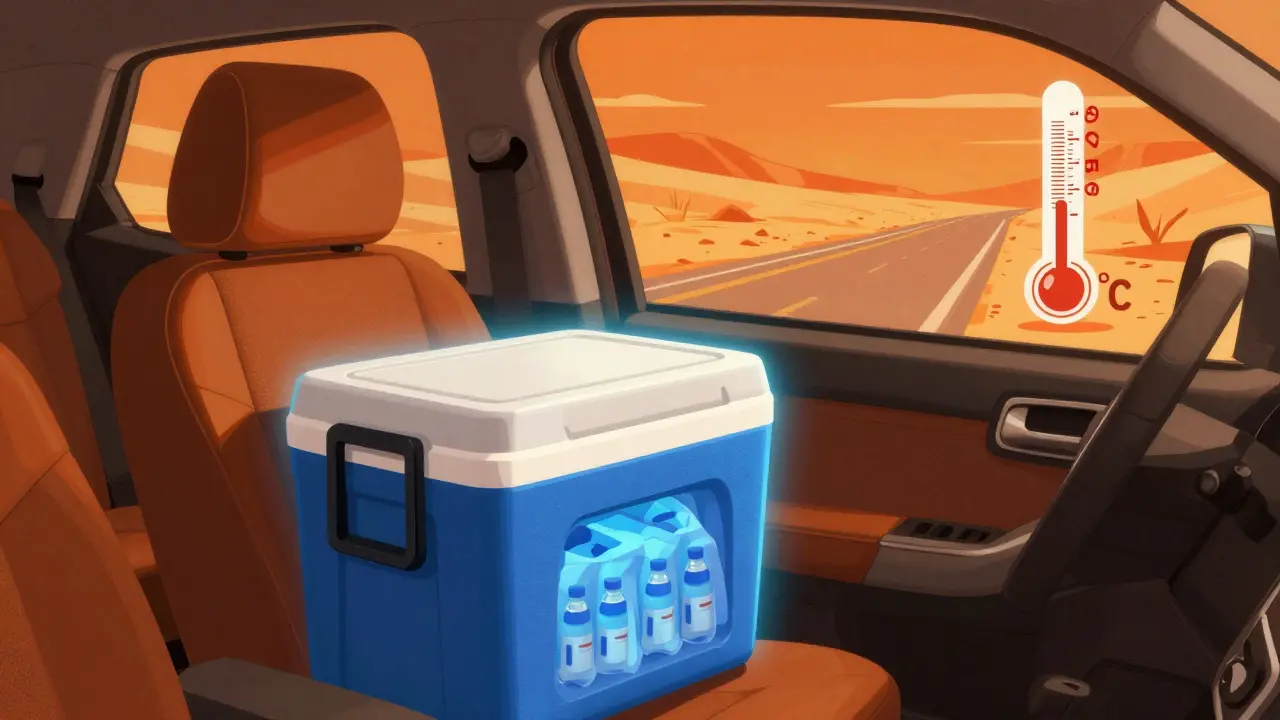
When you're traveling with medications like insulin, vaccines, or biologics, the weather outside your car or suitcase can be just as dangerous as the disease you're treating. A hot car in summer or a freezing airport gate in winter can ruin your medicine before you even get to the pharmacy. You might not realize it, but your insulin could lose potency, your vaccine might stop working, or your antibiotic could become completely ineffective-all without you knowing until it's too late.
Why Temperature Matters More Than You Think
Not all medications are created equal when it comes to heat and cold. Some, like tablets and capsules, can handle room temperature just fine. But others? They’re fragile. Insulin, for example, starts breaking down at temperatures above 25°C (77°F). Every hour it sits in a hot car, it loses about 1.2% of its strength. After just 30 minutes above 40°C (104°F), some antibiotics are no longer safe to use. Vaccines like MMR can lose 10% of their potency in under an hour if they get too warm. And if they get too cold? Insulin can freeze and form clumps, making it unusable. You won’t see it. You won’t smell it. But your body will know.
The WHO calls these time- and temperature-sensitive pharmaceutical products (TTSPPs). They make up about 30% of all prescription drugs. That means if you’re managing diabetes, autoimmune conditions, or chronic infections, you’re likely carrying something that needs careful handling. And the stakes are high: 37% of all pharmaceutical quality issues reported to the European Medicines Agency are due to temperature problems during transport.
What Temperature Ranges You Need to Know
There are three main temperature zones for medications, and knowing which one your drug falls into is the first step to keeping it safe.
- Ambient (15°C-25°C / 59°F-77°F): This is where most pills, capsules, and some liquid medications live. If your drug label says "store at room temperature," this is your zone. But don’t assume it’s safe in a hot car-even here, temperatures above 30°C can cause problems over time.
- Refrigerated (2°C-8°C / 36°F-46°F): This is the most common critical range. Insulin, many vaccines, biologics, and some antibiotics must stay here. Even a few hours outside this range can damage the product. A fridge is ideal, but if you’re on the road, you need a cooler.
- Cryogenic (below -150°C / -238°F): Only used for a few specialized treatments like certain mRNA vaccines or tissue samples. Most travelers won’t encounter this, but if you do, you’ll need professional-grade dry shippers and trained handlers.
Check your prescription label or ask your pharmacist. If it says "refrigerate," treat it like a live animal-keep it cold, but never frozen.
How to Keep Medications Cool in Hot Weather
Summer travel is the biggest risk. A car dashboard can hit 60°C (140°F) in direct sun. That’s not just hot-it’s deadly for medicine.
Here’s what actually works:
- Use a hard-shell insulated cooler. A regular lunch bag won’t cut it. Look for one with thick walls and a tight seal. The TempAid 2.0, for example, holds 2°C-8°C for 48 hours and has been tested in 45°C heat.
- Pair it with phase-change gel packs. These aren’t regular ice packs. They’re designed to stay at exactly 4°C for hours, even in extreme heat. Freeze them before you leave. Place them on the sides and bottom of the cooler-not directly touching the medication. Wrap the meds in a cloth or towel to avoid freezing them.
- Keep it out of direct sunlight. Put the cooler under your seat, not in the trunk. Trunks get hotter. The passenger footwell is often the coolest spot.
- Don’t leave it unattended. A 2023 survey found that 68% of pharmacists saw temperature excursions because packages were left outside delivery doors or in hot mailboxes. Always carry your meds with you.
Pro tip: A standard insulated lunch bag with two frozen gel packs can keep insulin cool for up to 8 hours in 90°F weather. That’s enough for a long flight or road trip-but not for a whole day in a parked car.
How to Keep Medications Warm in Cold Weather
Winter is trickier than most people think. Cold isn’t just uncomfortable-it can freeze and destroy your meds.
Here’s how to protect them:
- Avoid freezing. Insulin and many biologics freeze at around -0.5°C. Once frozen, they form crystals and lose effectiveness. Even if they thaw, they’re ruined.
- Use body heat. If you’re traveling in freezing conditions, keep your medication in an inside pocket of your coat. Your body temperature (around 37°C) is a natural buffer against extreme cold.
- Insulate, don’t overheat. Wrap your cooler in a towel or thermal blanket. Don’t put it near a heater or car vent. You’re not trying to warm it up-you’re trying to stop it from getting too cold.
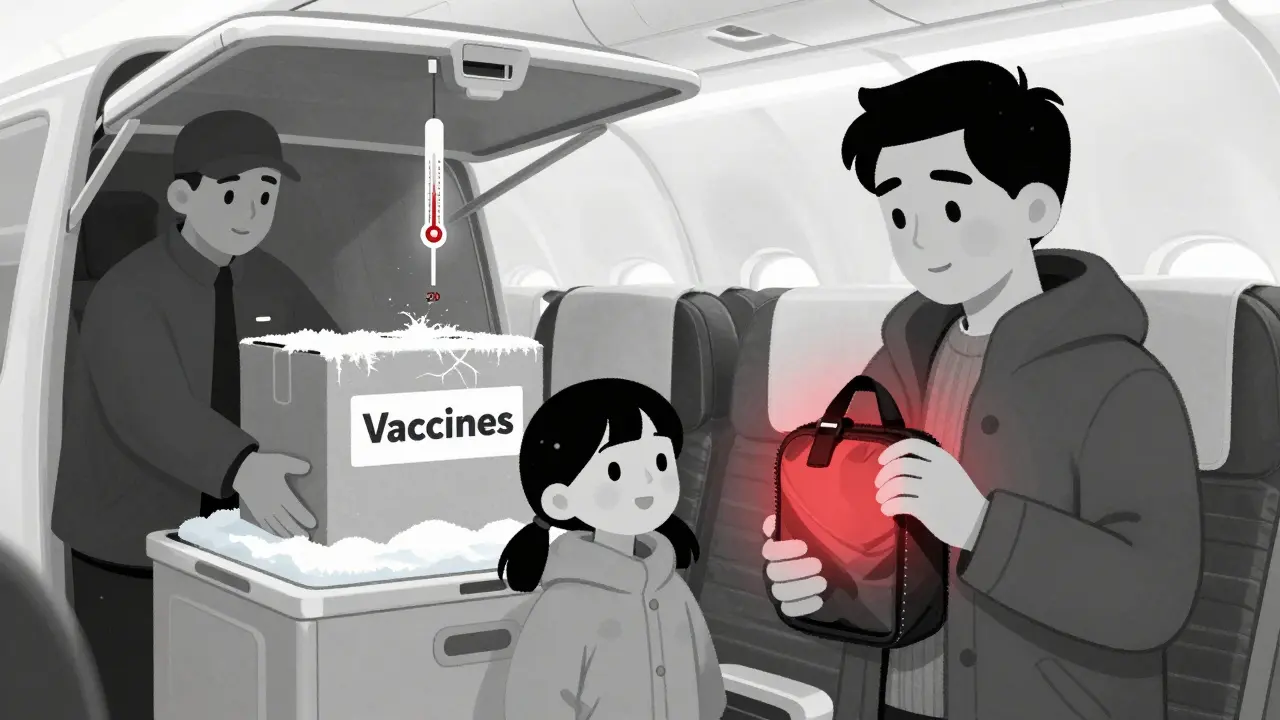
- Watch for airport security. X-ray machines won’t harm meds, but the baggage hold can drop below -20°C. Always carry refrigerated meds in your carry-on. Tell security you’re carrying temperature-sensitive medication-they’re trained to handle it.
Logistics managers at Pfizer say winter transport has 17% more excursions below range than above. Why? Because most packaging is designed for heat, not cold. A simple thermal blanket during transfer between vehicle and building can make all the difference.
What to Avoid at All Costs
There are some habits that seem harmless but are actually dangerous:
- Leaving meds in the car. Even for 15 minutes. A parked car in 30°C weather can hit 50°C in under an hour.
- Using regular ice cubes. They melt fast and can drip water on your meds. Use gel packs instead.
- Relying on a fridge at your destination. What if your hotel doesn’t have one? Or the power goes out? Always plan for the journey, not just the end point.
- Using expired coolers. If the insulation is cracked or the seal is loose, it’s useless. Replace it every 2-3 years.
- Assuming "room temperature" means safe everywhere. A desert hotel room at 35°C is not room temperature. It’s a risk zone.
Real-World Scenarios That Go Wrong
People think they’re being careful, but small mistakes add up.
One Reddit user left their insulin in a 95°F car for 45 minutes during a road trip. The liquid turned cloudy. The pharmacist confirmed it was degraded. They had to get a new prescription on the spot.
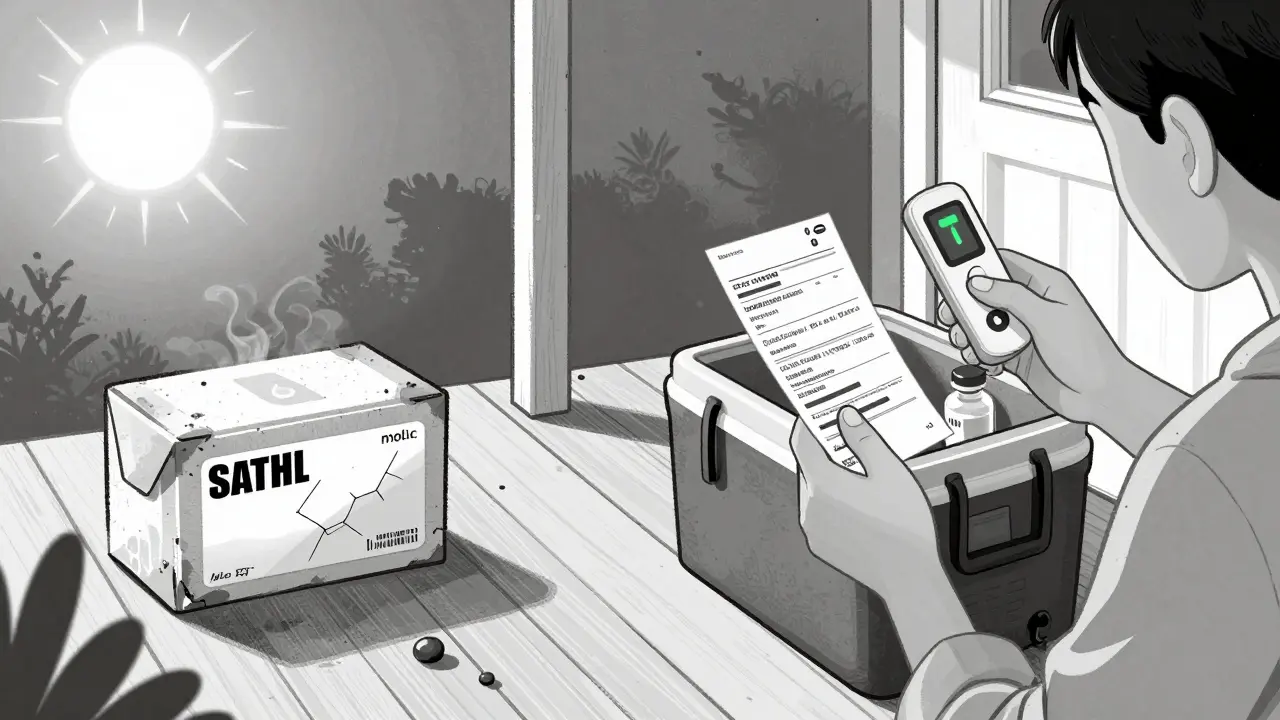
An elderly patient in Melbourne had their insulin shipped in a box that sat outside a delivery porch for 6 hours in 38°C heat. The pharmacy refused to dispense it. They were out of meds for 3 days.
A family flying to the U.S. put their vaccine vials in checked luggage. The cargo hold dropped to -15°C. The vaccines froze. They had to reschedule the entire trip.
These aren’t rare. They’re common. And they’re preventable.
What to Bring on Your Trip
Here’s your checklist for safe transport:
- Insulated cooler with phase-change gel packs (pre-frozen)
- Thermal blanket or towel (for cold weather)
- Original prescription labels
- Temperature logger (optional but powerful-devices like the TempTraq record every 15 minutes and show you if your meds were exposed to bad temps)
- Backup supply (if possible) stored separately
- Pharmacist’s contact info
For long trips, carry two doses in separate containers. If one gets damaged, you still have a backup.
Documentation and Proof Matter
The FDA says: "A properly transported shipment without documentation is considered out of specification." That applies to you, too.
If you’re flying, keep your prescription with you. Some countries require proof you’re carrying medication for personal use. If your meds are confiscated or questioned, you need to show:
- Original prescription or doctor’s note
- Pharmacy label with your name
- Temperature log if you used one
Even if you don’t think you need it, having proof protects you. Airlines and customs agents are more likely to help if you can show you’ve taken responsibility.
What’s Coming Next
The industry is changing fast. By 2026, autonomous temperature-controlled delivery vehicles will be rolling out-cutting last-mile errors by 65%. Blockchain-based temperature tracking is already being tested for international shipments. And the WHO is updating its guidelines to handle mRNA vaccines that need -70°C storage.
But for now, the tools you need are simple: insulation, planning, and awareness. You don’t need a lab-grade cooler. You just need to treat your medicine like something that can’t be replaced.
Frequently Asked Questions
Can I put my insulin in the freezer to keep it cold?
No. Freezing insulin damages its structure. Once frozen, it forms clumps and loses effectiveness. Always keep it between 2°C and 8°C. If it freezes, throw it away-even if it thaws later.
How long can insulin last in a cooler without ice packs?
In a well-insulated cooler with no cooling source, insulin can stay safe for 12-24 hours if the outside temperature is below 30°C. But once it gets hotter, that time drops fast. Always use gel packs. Don’t rely on passive insulation alone.
Do I need a prescription to travel with insulin or vaccines?
You don’t always need one, but you should carry it. Some countries require proof that you’re carrying medication for personal use. A prescription label with your name and the prescribing doctor’s info is the best way to avoid delays at customs or security.
Can I use a regular thermos to transport medication?
No. Thermoses are designed for liquids, not precise temperature control. They don’t insulate evenly and can cause hot or cold spots. Use a medical-grade insulated cooler with phase-change gel packs instead.
What if my medication gets exposed to extreme temps? Can I still use it?
If you suspect your medication was exposed to temperatures outside its range, don’t use it. You can’t see or smell degradation. The safest choice is to contact your pharmacist or doctor. They can advise whether it’s safe or if you need a replacement. When in doubt, throw it out.

Bridgette Pulliam
March 11, 2026 at 05:37Just got back from a 12-hour road trip with my insulin. Used the TempAid 2.0 like the article said-no issues. But honestly? I didn’t know how much I was risking until I read this. My old lunchbox cooler? Yeah, that’s trash now.
Also, never leave meds in the car. Not even for "just a minute." I learned that the hard way last summer. Lesson learned.
Thanks for the practical advice. This is the kind of info that actually saves lives.
Gene Forte
March 12, 2026 at 20:13Medicines aren’t just chemicals-they’re lifelines. And we treat them like spare change sometimes. That’s not negligence. That’s ignorance. And ignorance kills.
This isn’t about being careful. It’s about being responsible. Your insulin doesn’t care if you’re tired, busy, or stressed. It just needs to stay between 2°C and 8°C. Period.
Let that sink in.
David L. Thomas
March 14, 2026 at 06:56Phase-change gel packs are the real MVP here. Most people think ice packs = cold, but they’re not engineered for precision thermal stability. Phase-change materials maintain isothermal conditions via latent heat transfer-critical for TTSPPs.
Also, the 1.2% degradation per hour above 25°C? That’s linear degradation, not exponential. Important distinction for pharmacokinetic modeling. Most studies assume exponential decay, which overestimates risk.
And yes, checked luggage is a death trap. Cargo holds hit -30°C. I’ve seen the data.
Mike Winter
March 14, 2026 at 15:40I’ve been managing my own biologics for 8 years. This guide is spot-on.
One thing I’d add: always carry a small digital thermometer. Not a fancy logger, just a $12 one from Amazon. Check your meds every 2 hours. If it’s above 26°C or below 1°C? Act.
Also, never trust hotel mini-fridges. They cycle too much. I keep mine in a cooler with gel packs under my bed. Works like a charm.
Randall Walker
March 15, 2026 at 11:15So let me get this straight… we’re all supposed to become pharmaceutical logistics engineers just to take our diabetes meds on vacation?
And if we don’t? We’re just… dead?
Wow. Just… wow. What a world we live in.
Tom Bolt
March 16, 2026 at 16:36My sister’s insulin froze on a flight because she put it in checked baggage. She ended up in the ER with DKA. They had to fly her home on a medevac. Her insurance denied the claim because "the meds were improperly stored."
So now I carry my meds in a custom-made thermal vest. Yes, it looks ridiculous. But I’m alive.
And if you think this is overkill? You’re one bad layover away from becoming a statistic.
Shourya Tanay
March 17, 2026 at 11:57As someone from India, I’ve seen people wrap insulin in towels and leave it on car seats. They think "cool shade" is enough.
Here’s the truth: 45°C outside means 60°C inside. No towel fixes that.
We need public awareness campaigns. Not just blogs. Billboards. Radio. TV ads. People are dying because they don’t know. And nobody is telling them.
Education isn’t optional anymore.
LiV Beau
March 17, 2026 at 13:34OMG I just realized I’ve been storing my GLP-1 in the glove compartment 😱
Thank you for this. I’m ordering a TempAid right now. Also, gel packs? Yes. Ice cubes? No. Got it.
And I’m printing this out and taping it to my fridge. Because I’m a forgetful human. 🙃❤️
Adam Kleinberg
March 19, 2026 at 12:31Who made this guide? Big Pharma? The government? The WHO?
They’re making us dependent on expensive gear so they can charge more for "medical-grade" coolers.
My cousin took insulin for 3 years in a regular cooler. Never had an issue.
They’re scaring people to sell products.
And if you believe this? You’re part of the problem.
Denise Jordan
March 20, 2026 at 11:07Yeah but like… how many people actually die from this? Like… really?
I mean, I get it. But is this really worth all the drama? Can’t we just… I dunno… not go on vacation?
Kenneth Zieden-Weber
March 20, 2026 at 12:09That guy who left his insulin in the car? Yeah, I’ve been there. Didn’t know it was ruined until I had a high reading.
Here’s what changed me: I started carrying a backup. Two pens. Two coolers. One in my bag, one in my coat.
And I check the temp every time I get in the car.
It’s not hard. It’s just… a habit. And habits save lives.
Chris Bird
March 20, 2026 at 21:47Stop lying. Insulin doesn't degrade that fast. You're just scared. I've seen people use old insulin for years. Nothing happened.
They just want you to buy new ones. That's all.
Miranda Varn-Harper
March 22, 2026 at 14:28While the article provides a comprehensive overview of temperature-sensitive pharmaceutical transport, it fails to address the systemic inequities inherent in such recommendations. The cost of a TempAid 2.0 exceeds the monthly income of 47% of U.S. households. Furthermore, the reliance on phase-change gel packs presupposes access to reliable refrigeration infrastructure-a privilege not universally available.
One cannot reasonably expect individuals living in food deserts or without access to electricity to adhere to these standards. This is not a guide to safe transport. It is a manifesto of medical elitism.