
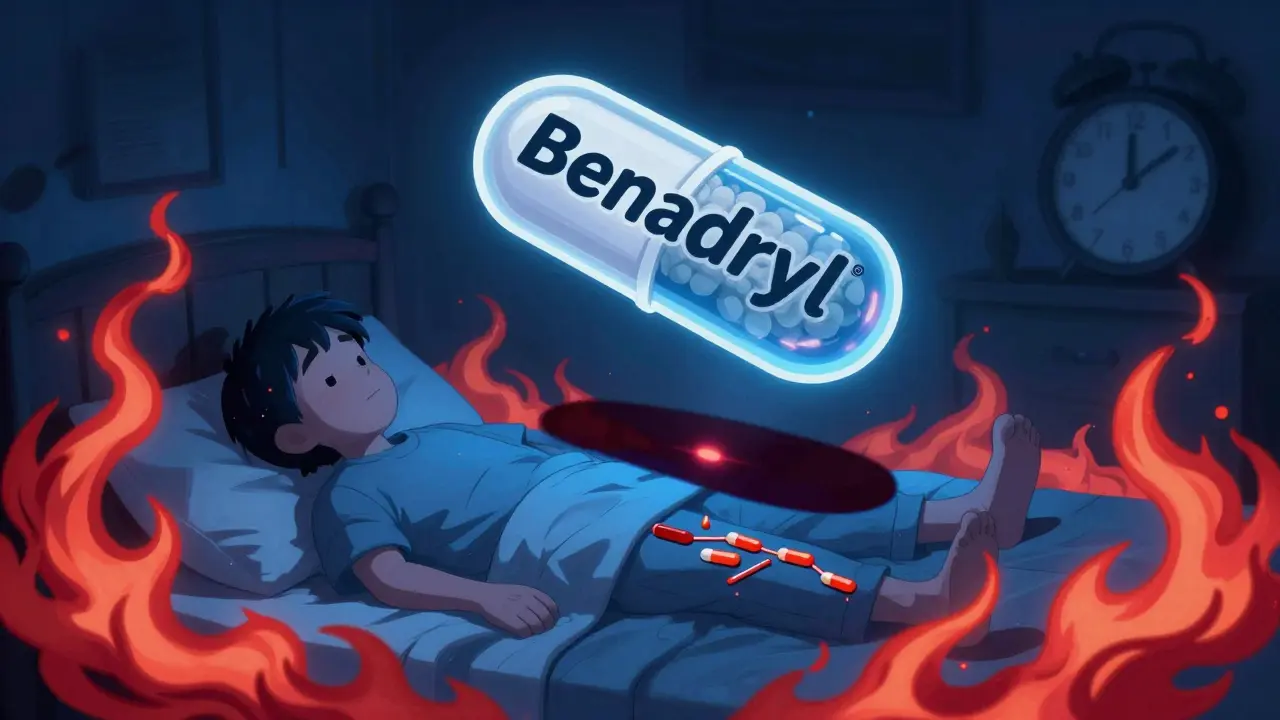
If you have restless legs syndrome (RLS), you know how frustrating it is to lie down at night only to feel like your legs are crawling, tingling, or burning. You just want to sleep. But if you’ve reached for an over-the-counter allergy pill like Benadryl to quiet your sniffles, you might be making your RLS worse-without even realizing it.
Why Antihistamines Make Restless Legs Worse
Restless Legs Syndrome isn’t just about discomfort. It’s a neurological condition tied to how your brain handles dopamine, a chemical that helps control movement. When dopamine pathways get disrupted, your legs send confusing signals-especially at night or when you’re resting. Sedating antihistamines like diphenhydramine (Benadryl), chlorpheniramine (Piriton), and hydroxyzine (Atarax) don’t just make you drowsy. They cross the blood-brain barrier easily because they’re fat-soluble. Once inside, they block not only histamine receptors (which cause allergies) but also dopamine receptors. That’s the problem. Your brain is already struggling to regulate movement. Adding a dopamine blocker on top? It’s like pouring gasoline on a smoldering fire. A 2014 study of over 16,000 dialysis patients found those taking sedating antihistamines were nearly twice as likely to be diagnosed with RLS. Even after adjusting for other factors like kidney disease, the link stayed strong. That’s not coincidence. It’s biology. Dr. William Ondo, a neurologist at Houston Methodist Hospital, puts it plainly: "Patients with restless legs syndrome already have difficulty sleeping... but sedating antihistamines, such as Benadryl, can intensify the symptoms." He’s seen it hundreds of times. People come in thinking they’re treating allergies. They’re actually fueling their insomnia.Which Antihistamines Are Safe?
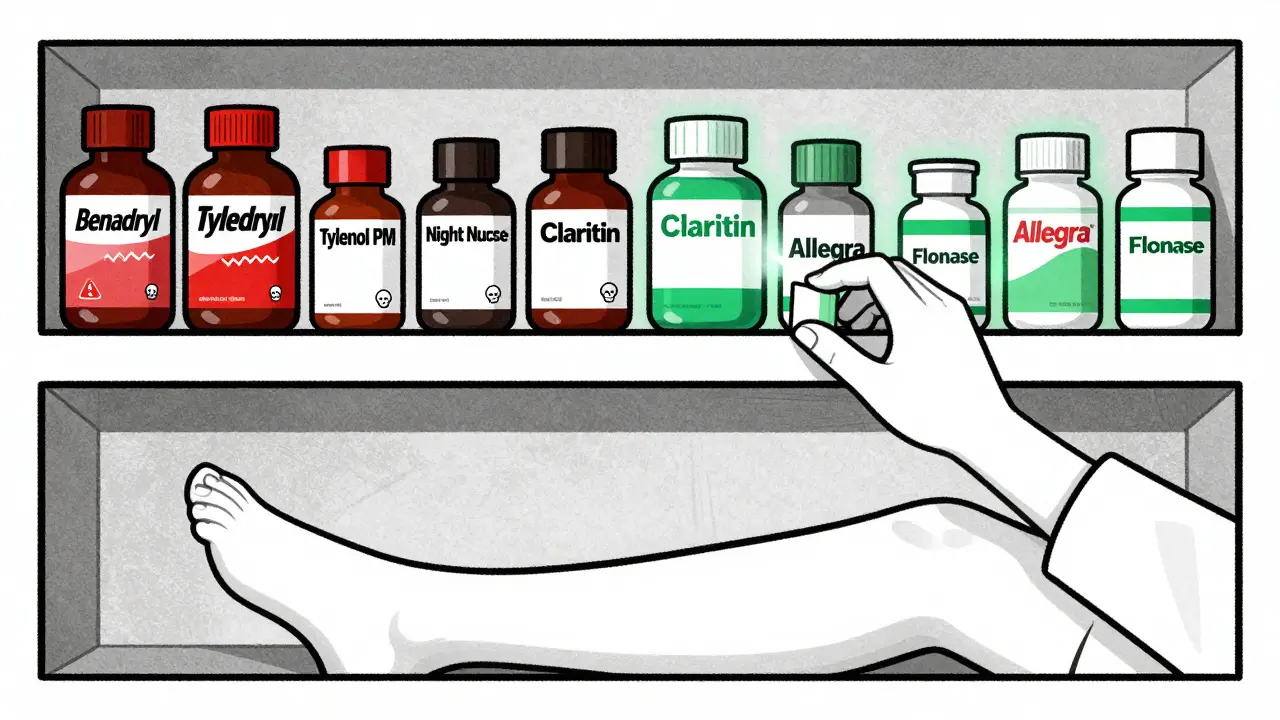
Not all antihistamines are created equal. The second-generation, non-sedating ones-like fexofenadine (Allegra), loratadine (Claritin), and desloratadine (Clarinex)-are designed differently. They’re built to stay out of the brain. Thanks to a natural pump called P-glycoprotein, these drugs get kicked back out before they can interfere with dopamine. Here’s what the data says about safety:- Fexofenadine (Allegra): Only 5% of RLS patients report any worsening. Best choice for most.
- Loratadine (Claritin): Also around 5%. Reliable, cheap, and widely available.
- Desloratadine (Clarinex): Similar to Claritin. Often prescribed for long-term use.
- Cetirizine (Zyrtec): Riskier than the others. About 15% of RLS patients report mild to moderate flare-ups. Not ideal, but sometimes necessary.
Hidden Traps in Common Medications
The real danger isn’t just Benadryl. It’s everything else that hides it. Look at these popular products:- Advil PM
- Bayer PM
- Tylenol PM
- Dimetapp
- TheraFlu
- Vicks Cough and Cold
- Night Nurse cough syrup
What to Use Instead
You don’t have to suffer through allergy season. There are better ways. For nasal allergies:- Fluticasone (Flonase): A nasal steroid spray. No brain impact. 82% of RLS patients in a 2019 Vanderbilt study reported symptom control.
- Saline nasal rinses: Simple, cheap, and effective. 76% of RLS patients in the RLS Foundation survey found relief.
- Melatonin (0.5-5 mg): Not a sedative. Doesn’t block dopamine. 65% of RLS patients report improved sleep without worsening symptoms.
- Iron supplements (if deficient): Low iron is one of the most common underlying causes of RLS. Get tested. Many people feel better after correcting deficiency.
- Topical antihistamines like hydrocortisone cream (not oral)
- Cool compresses
- Moisturizers with ceramides
Real Stories, Real Results
RLSsurvivor, a long-time member of the RLS Foundation forum, wrote in March 2020: "I took Benadryl for allergies and couldn’t sleep for 3 nights straight-my legs felt like they were on fire. Switched to Claritin and symptoms improved within 24 hours." That’s not an outlier. In a 2019 survey of 1,247 RLS patients by RLS-UK, 68% said sedating antihistamines made their symptoms worse. Of those who switched to non-sedating options, 87% saw improvement. One woman in Melbourne told her neurologist she’d been taking Benadryl every night for years because "it helped me fall asleep." Once she stopped, her RLS improved so much she stopped needing gabapentin. She didn’t need stronger meds. She just needed to stop the thing making it worse.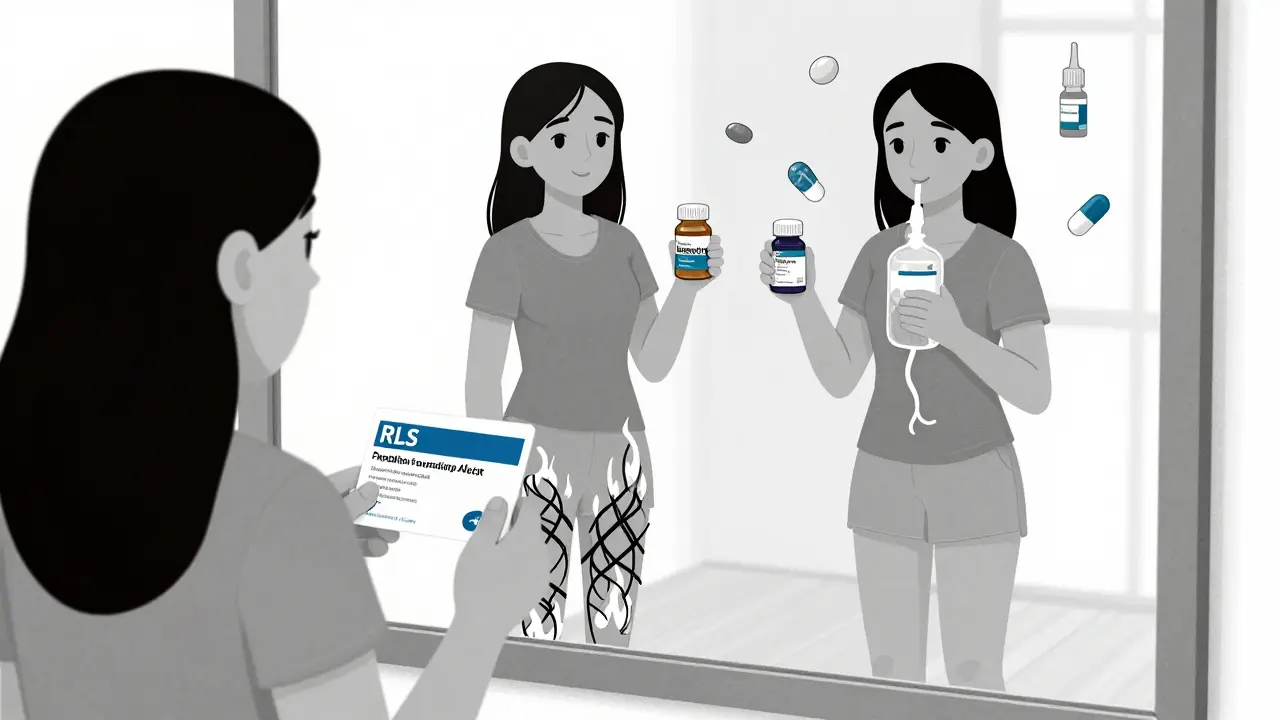
How to Avoid the Trap
Here’s what you need to do right now:- Check every label. Look for: diphenhydramine, doxylamine, chlorpheniramine, hydroxyzine. If it’s there, skip it.
- Don’t assume "PM" means safe. "PM" almost always means sedating antihistamine.
- Ask your pharmacist. Say: "I have restless legs syndrome. Is this safe?" They’re trained to know.
- Use the RLS Foundation’s medication alert card. It’s free online. Print it. Keep it in your wallet.
- Give it 2-3 weeks. If you switch from Benadryl to Claritin, give your body time to reset. Symptoms won’t vanish overnight, but they’ll ease.
What’s Changing in 2025
Awareness is growing. The FDA now requires stronger warnings on prescription antihistamines that affect the brain. Medicare Part D covers non-sedating antihistamines in 98% of plans-up from 76% in 2019. Sales of Claritin and Allegra keep rising. Sales of Benadryl? Dropping. Researchers are now studying why some people still react to "safe" antihistamines like Zyrtec. Early signs point to genetics. But for now, the rule is simple: if you have RLS, avoid anything that makes you sleepy.Bottom Line
You don’t have to choose between breathing well and sleeping well. The solution isn’t stronger meds. It’s smarter ones. Skip Benadryl. Skip PM pills. Skip anything that makes you drowsy. Choose Claritin, Allegra, or Clarinex. Use nasal sprays. Try saline rinses. Take melatonin if you need help sleeping. Your legs will thank you. And so will your sleep.Can Zyrtec make restless legs worse?
Yes, for some people. While Zyrtec (cetirizine) is less likely to cross into the brain than Benadryl, about 15% of RLS patients report mild to moderate symptom worsening after taking it. It’s not as risky as diphenhydramine, but it’s not completely risk-free. If you notice your legs feeling worse after starting Zyrtec, switch to Claritin or Allegra instead.
Is Claritin safe for people with restless legs?
Yes, Claritin (loratadine) is one of the safest antihistamines for RLS. It barely enters the brain and doesn’t block dopamine receptors. Studies and patient surveys show only about 5% of RLS users experience any symptom worsening. It’s the top recommendation from the RLS Foundation and neurologists like Dr. William Ondo.
Does Benadryl make restless legs worse?
Yes, absolutely. Benadryl (diphenhydramine) is one of the worst offenders. It crosses into the brain easily and blocks dopamine, which directly worsens RLS symptoms. Studies show it increases the risk of RLS diagnosis by nearly 2.3 times. Even one dose can trigger severe symptoms that last for days. Avoid it completely if you have RLS.
What over-the-counter cold medicines should I avoid?
Avoid any product with diphenhydramine, doxylamine, or chlorpheniramine. That includes Advil PM, Tylenol PM, NyQuil, TheraFlu, Dimetapp, Vicks Cough and Cold, and Night Nurse. Many also contain pseudoephedrine, which can worsen RLS on its own. Always read the "Active Ingredients" list-not just the brand name.
Can I take melatonin if I have restless legs?
Yes, melatonin is generally safe for RLS patients. It doesn’t block dopamine or interfere with movement pathways. In fact, 65% of RLS patients in a 2021 study reported better sleep after using melatonin (0.5-5 mg). It’s a better choice than sleep aids containing antihistamines. Just avoid combination products that include diphenhydramine.
Why do some people react to non-sedating antihistamines?
The reason isn’t fully understood, but researchers believe genetics may play a role. Some people’s bodies may process these drugs differently, allowing small amounts to enter the brain. A 2022 study is currently looking into whether certain gene variants make RLS patients more sensitive-even to "safe" antihistamines like Zyrtec. Until more is known, stick with Claritin or Allegra if you’re sensitive.
How long does it take for RLS symptoms to improve after stopping Benadryl?
Most people notice improvement within 24 to 72 hours after stopping diphenhydramine. But full recovery can take up to two weeks, especially if the medication was taken regularly. The brain needs time to reset its dopamine sensitivity. Don’t give up-symptoms will ease. Keep a symptom diary to track progress.
Is there a test to see if I’m sensitive to antihistamines?
No formal test exists yet. But the best approach is practical: stop all sedating antihistamines for 2-3 weeks. Switch to Claritin or Allegra. Monitor your symptoms. If they improve, you’ve identified the trigger. Many neurologists recommend this "elimination trial" as the most reliable method for RLS patients.

Emma Duquemin
December 28, 2025 at 15:07Okay, but let’s be real-Benadryl is the OG sleep aid for a reason. I used to take it every night for years, and yeah, my legs felt like they were being electrocuted by tiny spiders. Switched to Claritin out of desperation, and within 48 hours, I actually slept through the night. No more 3 a.m. leg marathons. I didn’t even know my allergies were sabotaging my sleep. Game changer. Thank you for this post.
Sharleen Luciano
December 28, 2025 at 21:39Of course the RLS Foundation has a ‘medication alert card.’ Because nothing says ‘medical authority’ like a laminated pamphlet you keep in your wallet like a driver’s license. Meanwhile, people are still popping NyQuil like candy. The real tragedy isn’t the antihistamines-it’s that we’ve turned medical advice into a BuzzFeed quiz.
Jim Rice
December 29, 2025 at 09:40Actually, the study you cited was on dialysis patients. That’s not the general population. You’re conflating correlation with causation. Also, Zyrtec isn’t ‘risky’-it’s just less effective for some. And melatonin? That’s just a hormone supplement. You’re not solving the root cause-you’re just swapping one bandaid for another.
Henriette Barrows
December 30, 2025 at 16:22I’ve had RLS for 12 years and I never connected my nightly allergy meds to the screaming legs. I thought I was just ‘bad at sleeping.’ Reading this felt like someone finally handed me a flashlight in a dark room. I switched to Flonase last week and my husband said I stopped thrashing in my sleep. I cried. Not because I’m dramatic-because I finally feel like I’m not broken.
Kevin Lopez
December 31, 2025 at 07:46Pharmacokinetic profile of H1 antagonists is well-documented. P-gp efflux efficiency determines CNS penetration. Diphenhydramine: low P-gp affinity → high CNS exposure → D2 antagonism → RLS exacerbation. Fexofenadine: high P-gp affinity → negligible CNS penetration → minimal RLS impact. Case closed.
Greg Quinn
January 2, 2026 at 06:21It’s funny how we blame the medicine when the real issue is that we’ve outsourced our health to convenience. We want to fix allergies, sleep, and pain with one pill. But biology doesn’t work like a vending machine. Maybe the real solution isn’t finding the ‘safe’ antihistamine-it’s asking why we’re so dependent on them in the first place.
Alex Ronald
January 3, 2026 at 19:42For anyone reading this and thinking ‘I’ll just try Zyrtec’-be careful. I did. Thought I was being smart since it’s ‘non-drowsy.’ First night, legs felt like they were wrapped in live wires. Switched to Claritin the next day. 80% better by morning. Don’t assume ‘less bad’ means ‘safe.’ Your nervous system doesn’t negotiate.
Teresa Rodriguez leon
January 4, 2026 at 06:00I took Benadryl for 17 years. I thought it was helping me sleep. Turns out it was just numbing me enough to ignore the screaming in my legs. When I stopped, I had three nights of pure hell. I didn’t sleep. I just sat there, rocking, wondering if I’d ever feel normal again. I’m still not ‘fixed.’ But now I know the enemy. And I’m not letting it back in.
Manan Pandya
January 4, 2026 at 22:36As someone from India where OTC medications are often sold without clear labeling, this post is a lifeline. Many pharmacists here still recommend diphenhydramine for ‘sleep and cold.’ I’ve shown this to my local pharmacist-he’s now printing copies for his customers. Thank you for the clarity.
Aliza Efraimov
January 6, 2026 at 02:22Let me tell you about the time I took Tylenol PM for a headache and spent the night walking in circles because my legs felt like they were full of ants on fire. I didn’t even realize it was the medicine until I read this. I’ve been advocating for this info in my RLS support group-everyone’s shocked. This isn’t niche. It’s epidemic-level ignorance.
Lisa Dore
January 7, 2026 at 15:51Hey, if you’re reading this and you’re scared to switch meds-start slow. Try Claritin for one week. Don’t quit your Benadryl cold turkey unless your doctor says so. But if you’re tired of lying awake with your legs screaming? This is the easiest win you’ll ever get. You don’t need a miracle. Just a new label.
Nisha Marwaha
January 9, 2026 at 02:09For those asking about genetic sensitivity: there’s emerging data on ABCB1 gene variants affecting P-gp function. Some individuals metabolize cetirizine differently, leading to unexpected CNS uptake. It’s not common, but if you’ve had a bad reaction to Zyrtec despite no prior history, genetic testing may be worth exploring with a neurologist.