
What Your Prescription Label Really Means
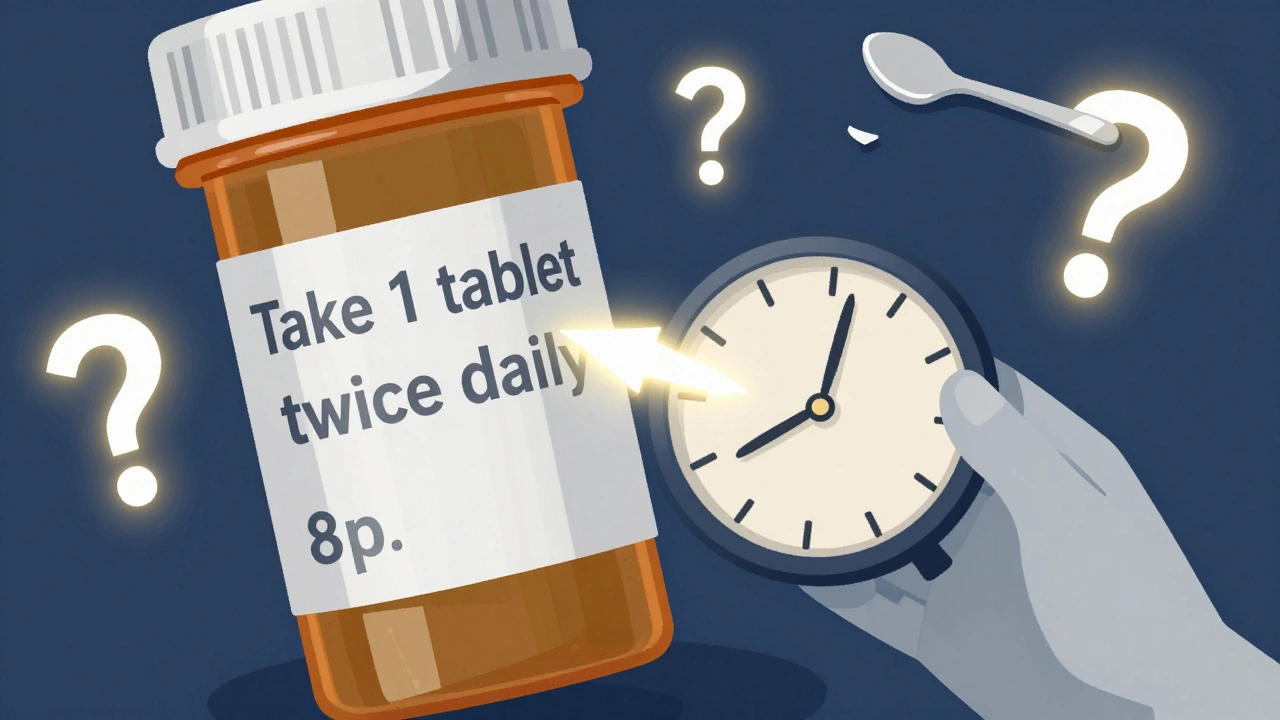
Look at your prescription label. It says "Take 1 tablet twice daily." Sounds simple, right? But how many people actually know what that means in real life? Do you take it at 8 a.m. and 8 p.m.? Or just whenever you remember? If you’ve ever been confused - you’re not alone. Nearly half of all patients misinterpret basic dosage instructions, and that’s not just a small mistake. It can lead to missed doses, overdoses, or even hospital visits.
The FDA says 43.7% of all medication errors tied to prescription labels come from unclear timing. That’s not because patients are careless. It’s because the language on the label is often vague, outdated, or poorly designed. The good news? Things are changing. And understanding what’s on your label today can help you stay safe - no matter what pharmacy you use.
Why "Twice Daily" Isn’t Enough
"Twice daily" is still the most common instruction you’ll see. But it’s also one of the most dangerous. Why? Because it doesn’t tell you when to take it. For some meds, timing matters a lot. Blood pressure pills, antibiotics, insulin, and thyroid meds all need to be taken at consistent times to work right.
Take levothyroxine, for example. The FDA-approved label says you must take it on an empty stomach, at least 30 minutes before breakfast. If you take it with your morning coffee and toast, your body won’t absorb it properly. That means your thyroid levels stay off - and you feel tired, gain weight, or get depressed without knowing why.
Studies show patients given labels that say "Take 1 tablet with breakfast and 1 tablet with dinner" are 34.7% more likely to take their meds correctly than those who just see "Take 2 tablets daily." That’s not a small difference. That’s the difference between your treatment working - or failing.
What the Law Actually Requires
Here’s something most people don’t know: the FDA has clear rules about how dosage instructions must be written. Since 2014, they’ve required that labels include specific time frames, not vague terms. "Twice daily" should be replaced with "Take in the morning and in the evening." For time-sensitive drugs - like some cancer treatments - labels must even say "Take between 8:00 a.m. and 10:00 a.m."
But here’s the gap: most pharmacies still don’t follow this. A 2023 study found that 82.7% of retail pharmacy labels still use "twice daily," "three times daily," or worse - "as needed" without a daily maximum. Even worse, CVS Health got it right 93% of the time. Walgreens? Only 38%. Independent pharmacies? Just 28%.
The law says it should be clear. But in practice, it’s still a mess. And that’s on the pharmacy, not you.
Units That Can Hurt You
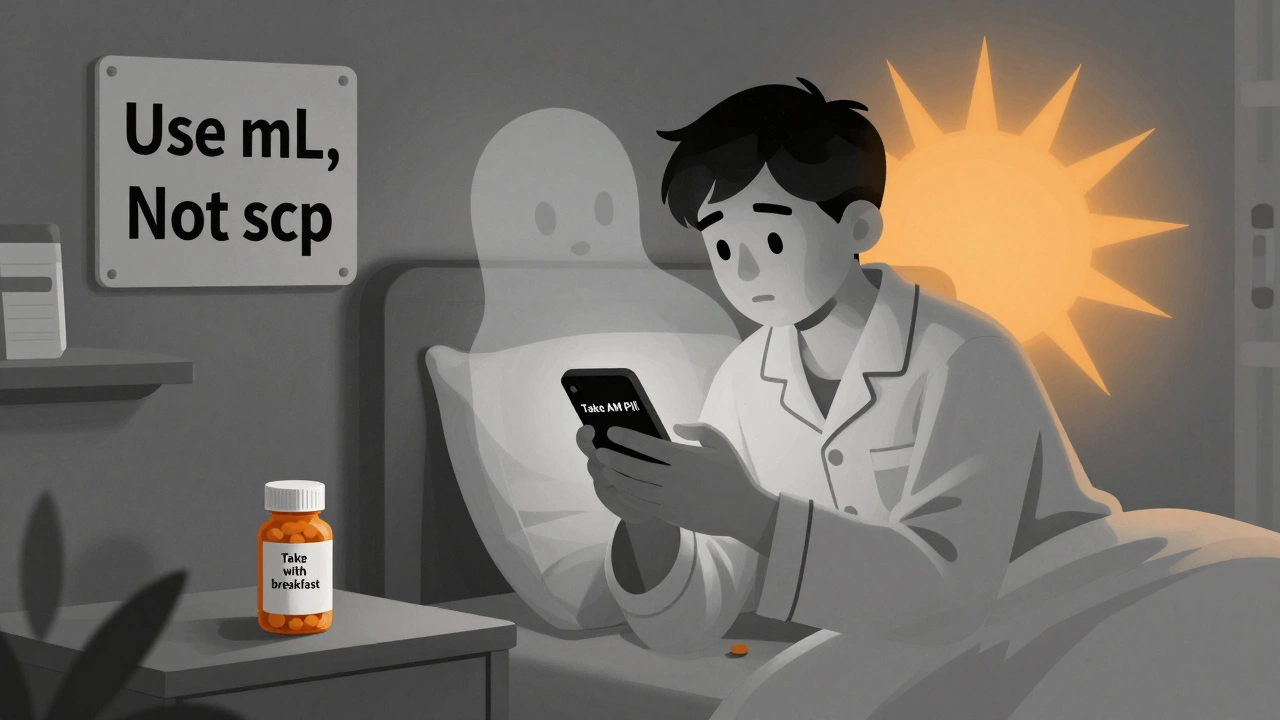
Another hidden danger? Units of measurement. If your prescription says "Take 1 tsp," stop. That’s not safe. A teaspoon from your kitchen isn’t the same as a medical teaspoon. The FDA and U.S. Pharmacopeia have required all liquid medications to use milliliters (mL) since 2020. Yet, a 2021 FDA audit found 63.8% of liquid medication labels still used "teaspoon" or "tablespoon."
Why does this matter? A teaspoon holds about 5 mL. But many people use bigger spoons. One study found patients using kitchen spoons overdosed by 30-50% on liquid antibiotics. That’s enough to cause vomiting, dizziness, or even liver damage.
If your label says "5 tsp," ask for a new one that says "25 mL." And always use the plastic dosing cup or syringe that comes with the medicine - never a kitchen spoon.
Abbreviations You Should Never Trust
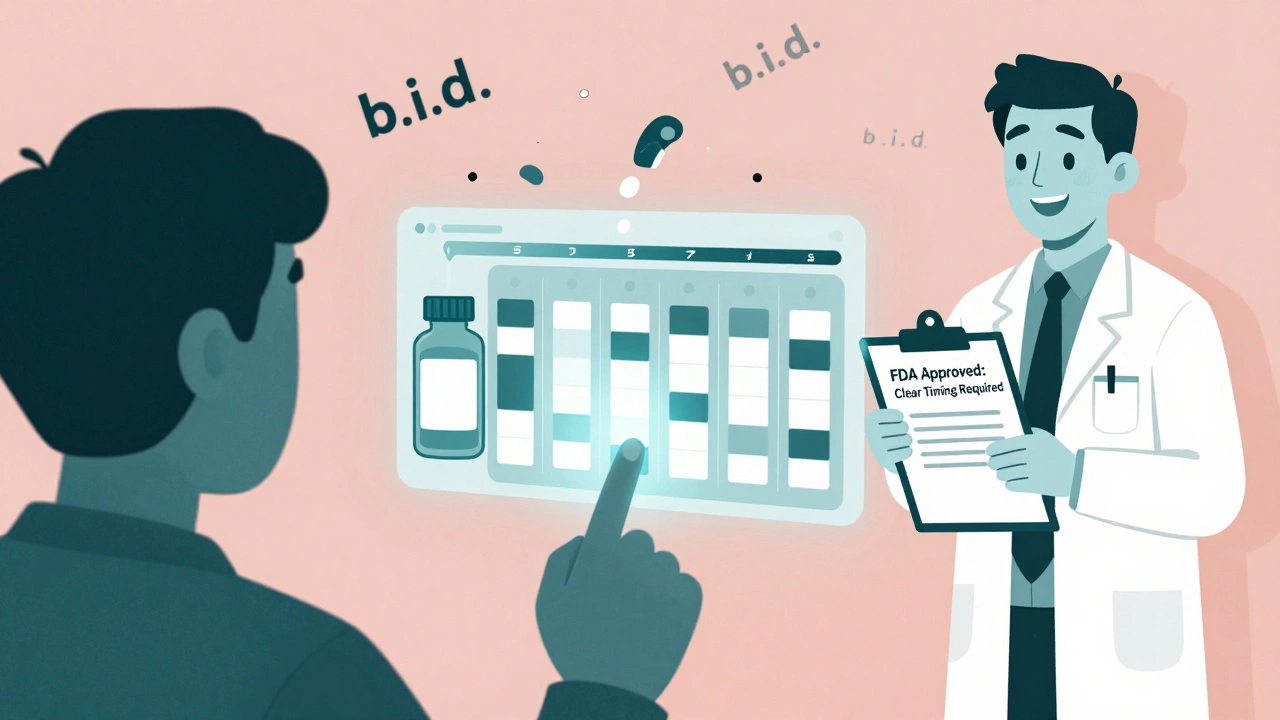
You might see "b.i.d." or "t.i.d." on your label. That’s Latin for "twice daily" and "three times daily." But here’s the truth: only 37.4% of patients understand these abbreviations. The American Medical Association says they should be banned from patient labels - and they’re right.
Even pharmacists get confused. A 2022 survey found 1 in 5 pharmacists misread "q.i.d." (four times daily) as "q.d." (once daily) when rushed. That’s why your label should never use Latin. It should say exactly what you need to do: "Take 1 tablet four times a day."
What "As Needed" Really Means
"Take as needed for pain" is one of the most misunderstood instructions. People think it means "take whenever you feel pain." But that’s not what it means. It means "take up to [X] times per day, no more." For example, ibuprofen labeled "Take 1 tablet every 6 hours as needed for pain" should never be taken more than 4 times in 24 hours - even if your headache won’t quit.
Consumer Reports found that 67.8% of people didn’t know the maximum daily dose for their "as needed" pain meds. That’s how people end up with stomach bleeding or liver failure. Always ask: "What’s the most I can take in one day?" Write it down. Put it on your fridge.
Shift Workers and Real Life
What if you work nights? What if your schedule changes every week? That’s where the system still falls short. Explicit instructions like "Take with breakfast" don’t work if you eat at 3 a.m. A 2022 study found 22.3% of night-shift workers took their morning meds at night - or skipped them entirely - because the label didn’t account for their life.
There’s no perfect solution yet. But you can fix it yourself. If your label says "Take in the morning and evening," and you work nights, ask your pharmacist: "Can I take it when I wake up and when I go to bed?" Most will say yes - as long as the doses are 10-12 hours apart. Don’t assume. Ask.
What You Can Do Right Now
- Always ask your pharmacist: "Can you write out the exact times I should take this?"
- If you see "tsp" or "tbsp," ask for a new label with "mL."
- If you see "b.i.d." or "t.i.d.", ask them to spell it out.
- For "as needed" meds, ask: "What’s the max per day?" Write it down.
- Use the dosing syringe - never a kitchen spoon.
- Set phone alarms labeled "Take AM pill" and "Take PM pill."
The Future Is Here - And It’s Visual
Some pharmacies are already using new tools. The FDA is testing augmented reality labels. Point your phone at the bottle, and a video shows you exactly when to take each pill. One pilot found it cut timing errors by over half.
By 2027, all new prescription labels may include a "Medication Schedule Grid" - a simple chart showing Monday through Sunday with boxes for each dose. You’ll know exactly when to take your meds, even if you forget the words.
But you don’t have to wait. Right now, you can ask for clarity. You can demand better labeling. And if your pharmacy refuses? Call your state pharmacy board. California already made it law. Other states are following.
When to Call Your Doctor or Pharmacist
Don’t guess. Don’t assume. If you’re unsure about any part of your label - call. Here’s when to reach out:
- You don’t know what time to take it
- The label says "as needed" but doesn’t say how many times
- You’re taking more than one med and aren’t sure if they clash
- You work nights, travel often, or skip meals
- You’ve missed a dose and don’t know if you should take it late
Pharmacists are trained to help. But they can’t help if you don’t ask. And your safety isn’t something you should risk guessing about.
Final Thought: Your Label Is Your Safety Tool
A prescription label isn’t just a piece of paper. It’s your roadmap to staying healthy - or avoiding harm. The system isn’t perfect. But you have more power than you think. Ask questions. Demand clarity. Use the dosing tool. Write down the times. Set alarms. Don’t let outdated labels put your health at risk.
Because when it comes to your meds, there’s no such thing as "close enough." It’s either right - or it’s dangerous.
What does "twice daily" really mean on a prescription?
"Twice daily" means take the medication two times in a 24-hour period. But it doesn’t tell you when. For safety, ask your pharmacist to specify exact times - like "Take one tablet at 8 a.m. and one at 8 p.m." This helps you stick to a routine and avoid missed or doubled doses.
Can I use a kitchen spoon to measure liquid medicine?
No. Kitchen spoons vary in size and can lead to dangerous overdoses. Always use the dosing cup or syringe that comes with your medicine. The label should say the dose in milliliters (mL), not teaspoons. If it doesn’t, ask for a new label.
Why do some labels use "b.i.d." and "t.i.d."?
These are Latin abbreviations for "bis in die" (twice daily) and "ter in die" (three times daily). But only 37.4% of patients understand them. The American Medical Association recommends removing them from patient labels. Always ask your pharmacist to spell out the instructions in plain English.
What should I do if my prescription says "take as needed"?
Ask your pharmacist: "What’s the maximum number of doses I can take in one day?" Write that number down. "As needed" doesn’t mean "take whenever you want." It means "take up to [X] times per day, at least [Y] hours apart." For example, acetaminophen should never exceed 4,000 mg in 24 hours.
I work nights. How do I follow "take in the morning and evening"?
Ask your pharmacist to adjust the timing to match your schedule. Instead of "morning and evening," you might take it when you wake up and when you go to bed - as long as the doses are 10-12 hours apart. Your body needs consistency, not clock time.
Is it okay to take my pill with food if the label doesn’t say?
No. Some meds must be taken on an empty stomach (like levothyroxine) or with food (like certain antibiotics) to work right. If the label doesn’t say, ask. Never assume. A small change in timing or food can make your medicine less effective - or cause side effects.

Webster Bull
December 12, 2025 at 16:10This is the kind of info nobody tells you until you almost kill yourself. I took my blood pressure med with coffee for years. Turns out it was useless. Now I set alarms. Life changed.
Lauren Scrima
December 12, 2025 at 22:51Seriously?? We still live in a world where "twice daily" isn't spelled out??
Lara Tobin
December 14, 2025 at 08:24I cried reading this. My grandma died because she thought "as needed" meant "whenever it hurt." No one ever explained the max dose. Please share this with everyone you know.
Keasha Trawick
December 15, 2025 at 02:41The FDA’s mandate for mL-only labeling is a godsend, but the implementation is a dumpster fire. You’ve got pharmacists still printing "tsp" like it’s 1998. The system’s broken, but at least the intent is there. We need mandatory visual grids on every script. QR codes that play a 10-second video of someone pouring the liquid. No more guessing.
Alvin Montanez
December 16, 2025 at 18:47This is why America is collapsing. People can’t read a label. They don’t set alarms. They use kitchen spoons. They trust CVS because it’s convenient. And now we’re surprised when someone ends up in the ER? Wake up. This isn’t a pharmacy problem. It’s a cultural problem. We’ve turned healthcare into a click-and-go service and now we’re surprised when it fails. Stop outsourcing your responsibility. Your life is not a Walmart pickup.
Jade Hovet
December 17, 2025 at 19:45I just printed this out and taped it to my fridge 🙏🏻 My mom’s on 7 meds and I finally get it. Also, I asked my pharmacist for a schedule grid - they looked at me like I asked for a unicorn. But they printed it. I’m crying happy tears. Thank you for writing this.
nithin Kuntumadugu
December 18, 2025 at 09:52They’re hiding the truth. The real reason they don’t fix this? Pharma doesn’t want you to take meds on time. If you took them right, you’d need less of them. Less profit. That’s why they still use "b.i.d." - to confuse you into taking more. Wake up, sheeple.
Rawlson King
December 20, 2025 at 01:18I’ve been a pharmacist for 22 years. The law requires clarity. But most pharmacies don’t train their techs on it. They’re rushed. They print what the system spits out. It’s not malice. It’s systemic neglect. You’re not dumb. The system is lazy.
John Fred
December 20, 2025 at 02:16The visual schedule grid is coming. I’ve seen the beta. It’s like a calendar with pill icons. You tap it, and it says "Take with food" or "Wait 2 hours after coffee." It’s genius. They’re testing it in VA hospitals. If it works there, it’ll be everywhere by 2026. Stay tuned.
Harriet Wollaston
December 21, 2025 at 10:26I’m a night shift nurse and this article made me feel seen. I used to take my thyroid med at midnight because that’s when I woke up. My doctor thought I was noncompliant. Turns out I just needed to reframe the instructions. Now I say "when I wake up" and "when I go to bed." It works. You’re not broken - the label is.
sharon soila
December 23, 2025 at 08:26It is imperative that every patient understand that precision in medication timing is not optional. It is a matter of physiological necessity. Your body operates on rhythms. Disrupt them, and you disrupt your health. Do not rely on memory. Do not assume. Always clarify. Always document. Always ask.
nina nakamura
December 24, 2025 at 17:38If you’re still using a kitchen spoon you’re an idiot. That’s it. End of story. No excuses. You’re not special. Your spoon isn’t special. You’re just risking your liver for convenience.
Hamza Laassili
December 26, 2025 at 08:52I don’t care what the FDA says - if my pharmacy gives me a label with tsp, I’m taking it to the news. We don’t need fancy apps. We need accountability. Pharmacies need to be fined for this crap. This isn’t advice. It’s negligence.
Jamie Clark
December 27, 2025 at 21:29You think this is bad? Try being on insulin and having a label that says "take with meals." What if you skip breakfast? Do you skip your dose? Do you eat just to take it? The system doesn’t care. It’s designed for people who live in 9-to-5 boxes. People like me? We’re just collateral damage.