
Serotonin Syndrome Risk Checker
This tool helps you determine if you're experiencing symptoms of serotonin syndrome after taking 5-HTP with an SSRI. Serotonin syndrome is a medical emergency that requires immediate attention.
Important: If you're experiencing severe symptoms like high fever, muscle rigidity, seizures, or confusion, seek emergency medical help immediately.
Select your symptoms:
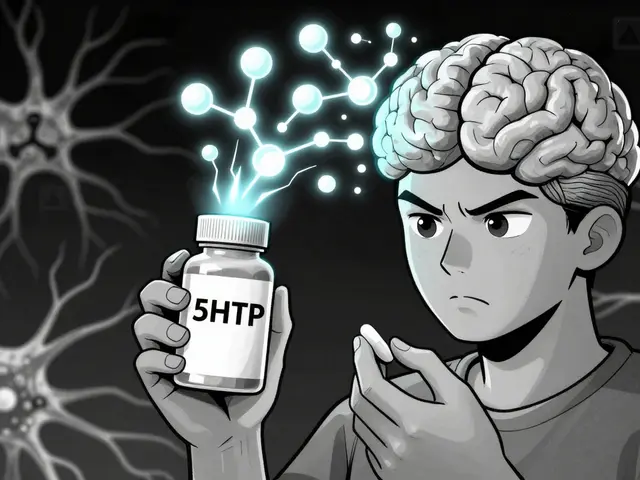
Combining 5-HTP with SSRIs isn’t just a bad idea-it’s a medical emergency waiting to happen. You might think, "It’s just a natural supplement," but 5-HTP doesn’t play by the same rules as vitamins or herbal teas. When you take it alongside an SSRI like fluoxetine, sertraline, or escitalopram, you’re stacking two powerful ways to flood your brain with serotonin. And that’s exactly what triggers serotonin syndrome-a rare but deadly condition that can turn mild shivering into a fever of 106°F, muscle rigidity, seizures, and organ failure in hours.
What Exactly Is Serotonin Syndrome?
Serotonin syndrome isn’t a myth or a vague warning on a label. It’s a real, measurable, and life-threatening reaction caused by too much serotonin in your central nervous system. The body normally keeps serotonin levels in check: it makes it, uses it, then reabsorbs it. SSRIs block the reabsorption, so serotonin stays active longer. 5-HTP? It’s the direct building block your body uses to make serotonin. Take both, and you’re not just increasing serotonin-you’re forcing your brain to produce it nonstop while also preventing it from being cleared out. The result? A dangerous buildup.The Hunter Criteria, the most accurate diagnostic tool doctors use, requires just one sign to confirm serotonin syndrome: spontaneous clonus (involuntary muscle spasms) OR inducible clonus with agitation or diaphoresis (sweating) OR ocular clonus with agitation or diaphoresis. That’s it. No lab test needed. If you’re on an SSRI and start having uncontrolled muscle twitches, sweating, confusion, or a rapid heartbeat after adding 5-HTP, you’re likely in serotonin syndrome. And you need help now.
Why 5-HTP Is Riskier Than You Think
Most people assume supplements are safe because they’re sold over the counter. That’s a dangerous myth. 5-HTP isn’t regulated like prescription drugs. A 2022 test by ConsumerLab.com found that 31% of 5-HTP supplements didn’t even contain the amount listed on the label-some had 28% less, others 28% more. You think you’re taking 50 mg? You might be getting 36 mg or 64 mg. No one knows. No one checks. And your doctor probably doesn’t ask.Even more alarming: the risk of serotonin syndrome from 5-HTP plus SSRIs is comparable to combining SSRIs with MAOIs-the most dangerous drug interaction in psychiatry. A 2019 study found MAOI-SSRI combinations carry a 16.4% risk of serotonin syndrome. 5-HTP plus SSRIs? Close behind. Meanwhile, other common combinations like SSRIs with tramadol (painkiller) or St. John’s Wort (herbal antidepressant) carry much lower risks: 4.6% and 2.3%, respectively. 5-HTP isn’t just risky-it’s among the riskiest supplements you can mix with antidepressants.
Who’s at Risk-and Why Nobody’s Talking About It
The people most likely to combine 5-HTP with SSRIs? Women between 35 and 54. According to the 2022 National Health Interview Survey, nearly 19% of women in that group use 5-HTP while on antidepressants. Why? They’re looking for relief. Maybe their SSRI isn’t working fast enough. Maybe they’re tired of side effects. Maybe they read a blog saying 5-HTP "boosts mood naturally." They don’t realize they’re playing Russian roulette with their brain chemistry.And doctors? Many don’t know either. A 2020 survey by the American Society of Health-System Pharmacists found only 38% of primary care physicians correctly identified 5-HTP as a serotonin syndrome risk. Most medication guides for SSRIs say "avoid herbal supplements"-but they don’t name 5-HTP. So patients assume it’s safe unless explicitly warned. The FDA issued a Drug Safety Communication in 2020 after collecting 127 adverse event reports-including 9 deaths-between 2015 and 2019. Yet, the supplement industry keeps selling it like a wellness product.
Real Stories, Real Consequences
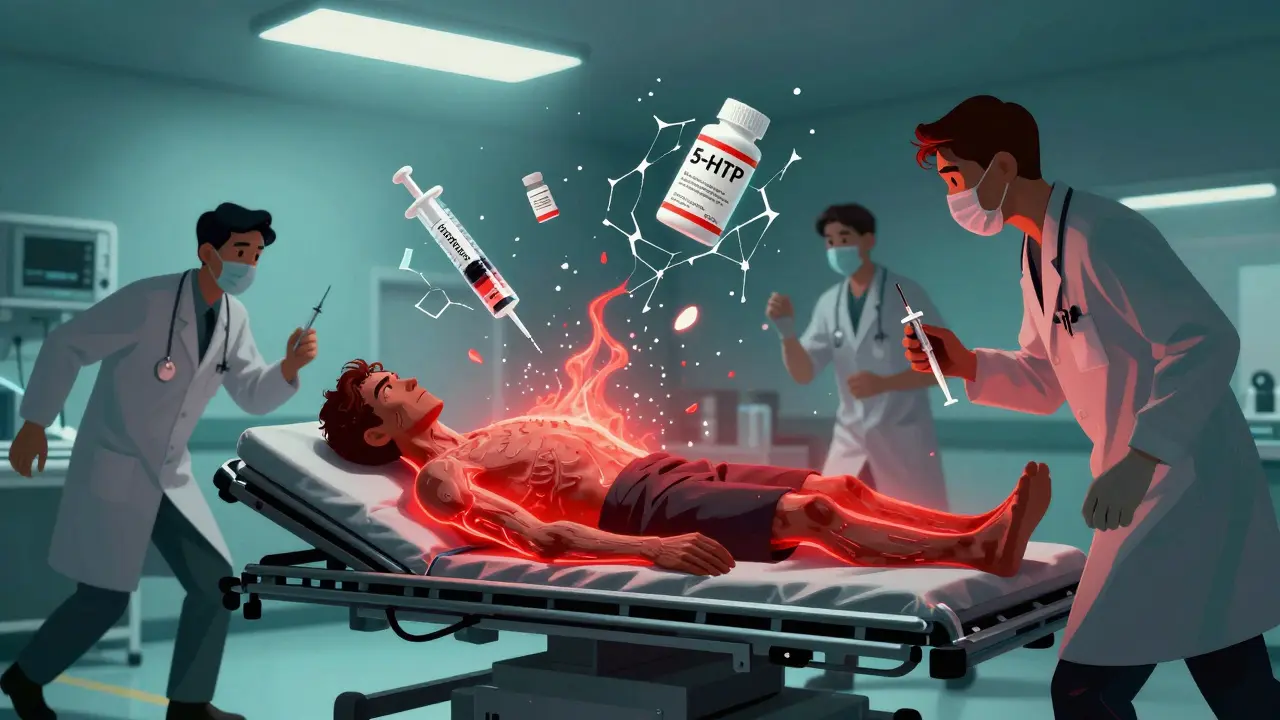
Reddit’s r/SSRI community has over 140,000 members. Between 2020 and 2022, over 1,200 posts mentioned 5-HTP. Of those, 237 users reported serious reactions. One user wrote: "Added 100 mg of 5-HTP to my 20 mg fluoxetine. Three hours later, I was shaking uncontrollably, my body felt like concrete, and my temperature hit 104°F. I called 911. I thought I was dying." Another described being hospitalized for three days after muscle rigidity and hallucinations. These aren’t outliers. They’re textbook cases.On the flip side, a few people claim they "successfully tapered off SSRIs using 5-HTP." But when you dig into those stories, there’s no medical documentation. No lab results. No doctor supervision. Just personal anecdotes. That’s not science-it’s hope. And hope doesn’t prevent serotonin syndrome.
What to Do Instead
If you’re on an SSRI and considering 5-HTP: don’t. Not even for a day. The American College of Medical Toxicology says it outright: concurrent use is contraindicated. There’s no safe dose, no safe timing, no safe method. The FDA and Mayo Clinic both recommend a minimum two-week washout period between stopping an SSRI and starting 5-HTP. But even that’s not enough for some SSRIs. Paroxetine, for example, stays in your system for up to four weeks. Waiting two weeks could still leave you vulnerable.If you’re struggling with your SSRI’s side effects or lack of effectiveness, talk to your prescriber. There are proven alternatives: adjusting the dose, switching to a different SSRI, adding cognitive behavioral therapy, or trying a non-serotonergic antidepressant like bupropion. None of these carry the same risk as stacking 5-HTP.
What If You Already Took Them Together?
If you’ve taken 5-HTP and an SSRI together in the last 24-72 hours and feel off-shivering, sweating, confused, your muscles twitching, your heart racing-go to the ER. Don’t wait. Don’t Google it. Don’t call your pharmacist. Go. Serotonin syndrome can escalate fast. Mild cases resolve in a day or two with supportive care. Severe cases need ICU-level treatment: benzodiazepines to control seizures, IV fluids, cooling measures, and cyproheptadine-a serotonin blocker that can reverse the syndrome.Don’t assume you’re "just anxious." If your symptoms started after adding a supplement, it’s not anxiety. It’s serotonin syndrome. And it’s treatable-if you act fast.
The Bigger Problem: Regulation Is Broken
The Dietary Supplement Health and Education Act of 1994 lets companies sell supplements without proving they’re safe or effective. That’s why 5-HTP is on shelves next to gummy vitamins. The FDA can only act after someone gets hurt. And even then, enforcement is slow. Since 2018, the FDA has issued 14 warning letters to 5-HTP manufacturers for making illegal health claims-but the products stay on shelves.Meanwhile, the industry is booming. The 5-HTP market hit $187 million in 2022 and is growing at over 7% per year. Most buyers don’t know they’re risking their lives. The FDA plans to require serotonin syndrome warnings on all SSRI packaging by 2025. That’s a start. But it’s too late for the people already hurt.
Bottom Line: Don’t Risk It
There’s no high-quality evidence that 5-HTP is safe with SSRIs. There’s plenty of evidence that it’s dangerous. The risk isn’t theoretical. It’s documented in emergency rooms, toxicology reports, and death certificates. No supplement is worth a trip to the ICU. No "natural" boost is worth losing control of your body. If you’re on an SSRI, leave 5-HTP off your shopping list. Talk to your doctor about real solutions. Your brain isn’t a lab experiment. Treat it like the vital organ it is.Can I take 5-HTP with my SSRI if I start with a low dose?
No. There is no safe low dose of 5-HTP when combined with an SSRI. Even small amounts can trigger serotonin syndrome because the two work together to flood your system with serotonin. The risk isn’t linear-it’s exponential. A 25 mg dose of 5-HTP with an SSRI has caused severe reactions in documented cases. The only safe approach is to avoid combining them entirely.
How long should I wait after stopping an SSRI before taking 5-HTP?
Wait at least two weeks, but longer for some SSRIs. Paroxetine and fluoxetine have very long half-lives-up to four weeks. That means they stay active in your body long after you stop taking them. Waiting only two weeks isn’t enough if you were on one of these. Consult your doctor to determine the right washout period based on the specific SSRI you were taking.
Is St. John’s Wort safer than 5-HTP when combined with SSRIs?
No, and it’s not safer either. St. John’s Wort also increases serotonin and can cause serotonin syndrome when mixed with SSRIs. Its risk is lower than 5-HTP-about 2.3% versus up to 16%-but it’s still dangerous. Neither should be used with SSRIs. Both are unregulated, unpredictable, and carry serious risks.
What are the first signs of serotonin syndrome?
Early signs include shivering, diarrhea, rapid heartbeat, sweating, muscle twitching, and restlessness. These can appear within hours of taking 5-HTP with an SSRI. If you notice any of these symptoms, stop the supplement immediately and seek medical help. Don’t wait for fever, seizures, or muscle rigidity-that’s already severe serotonin syndrome.
Can a doctor safely prescribe 5-HTP with an SSRI?
No reputable medical organization supports this combination. While a few alternative practitioners claim they’ve done it successfully, there’s no peer-reviewed, controlled evidence proving it’s safe. Major institutions like the American College of Medical Toxicology and the FDA explicitly warn against it. If a doctor suggests combining them, ask for published data. You won’t find any.
Are there any supplements that are safe to take with SSRIs?
Some supplements like omega-3 fatty acids, magnesium, and vitamin D have no known interaction with SSRIs and are generally considered safe. But always check with your doctor before starting anything new. Even "safe" supplements can interact with other medications or health conditions. Never assume a supplement is harmless just because it’s natural.

Jeffrey Hu
January 9, 2026 at 11:12Look, I get why people think 5-HTP is harmless-it’s in gummies next to vitamin C. But this post isn’t scare tactics, it’s pharmacology. Serotonin syndrome isn’t some myth from a 90s TV drama. It’s in the medical literature, and the Hunter Criteria are real. If you’re on an SSRI and you add 5-HTP, you’re not being ‘natural’-you’re playing Russian roulette with your brainstem.
Meghan Hammack
January 9, 2026 at 12:43I was on Zoloft for anxiety and tried 5-HTP because I thought it’d help me sleep better. Three hours later, I was shaking so bad I dropped my phone into the toilet. Thought I was having a panic attack. Turned out I was in early serotonin syndrome. ER saved me. Don’t be me.
Micheal Murdoch
January 11, 2026 at 10:03It’s wild how we treat supplements like they’re harmless because they’re ‘natural.’ But if you took a bottle of pure serotonin and injected it into your bloodstream, you’d be dead in minutes. 5-HTP is just the body’s way of making that serotonin inside your brain-without any safety valves. SSRIs lock the doors, and 5-HTP keeps hammering on the windows. No wonder people end up in the ICU.
And the fact that 31% of supplements are mislabeled? That’s not negligence-that’s systemic failure. We regulate aspirin like a controlled substance, but you can buy a chemical that can kill you on Amazon with two clicks and a $12 shipping fee. Something’s broken here.
Doctors aren’t always trained on this either. I’ve had my GP say, ‘Oh, herbal stuff is fine,’ like it’s tea. But this isn’t chamomile. This is neurochemistry on steroids. We need better labeling, better education, and honestly-better laws. Supplements shouldn’t be treated like fashion accessories.
And yes, I’ve seen people say they ‘tapered off SSRIs with 5-HTP.’ But no lab data, no doctor oversight, no controlled trials. That’s not recovery-that’s hope dressed up as a protocol. Hope doesn’t reverse serotonin syndrome.
There are real alternatives: bupropion, CBT, even exercise. They’re slower, sure. But they don’t make your muscles lock up like a robot with a glitch. Your brain isn’t a DIY project. Treat it like the delicate, irreplaceable organ it is.
Ian Long
January 11, 2026 at 14:29People keep saying ‘natural’ like it’s a shield against consequences. But nature doesn’t care if you’re ‘well-intentioned.’ Poison ivy is natural. Botulism is natural. Serotonin syndrome? Also natural-if you stack the wrong chemicals. The supplement industry profits off your ignorance. They don’t want you to know the difference between a vitamin and a neuroactive compound. And the FDA? They’re stuck playing catch-up while people end up on ventilators.
And don’t get me started on the ‘I took 25mg and was fine’ crowd. That’s like saying ‘I drove 100mph once and didn’t crash.’ Congrats, you got lucky. That doesn’t make it safe. It makes you a statistical outlier.
Stop romanticizing supplements. This isn’t yoga and kale. This is neurochemistry with no safety net.
Heather Wilson
January 12, 2026 at 11:01Let’s be honest: most people who take 5-HTP with SSRIs are self-diagnosing and self-medicating because they’re frustrated with their doctor’s ‘one-size-fits-all’ approach. But that doesn’t make it smart. It makes them statistically doomed. The data is clear. The risks are documented. The deaths are real. If you’re going to risk your life because you ‘felt like it,’ that’s your choice-but don’t pretend it’s science.
RAJAT KD
January 14, 2026 at 05:05My cousin took 5-HTP with fluoxetine. Ended up in ICU for 5 days. Muscle rigidity. High fever. They had to sedate him. He’s fine now, but he won’t touch supplements again. Don’t be stupid.
Alicia Hasö
January 14, 2026 at 22:24As someone who’s been on SSRIs for over a decade, I get the desperation. The slow onset. The emotional numbness. The feeling that nothing’s working. I’ve been there. I’ve wanted to ‘boost’ it with something quick, something ‘natural.’ But here’s the truth: your brain isn’t broken-it’s adjusting. And rushing it with unregulated chemicals? That’s not healing. That’s self-sabotage.
There’s dignity in patience. There’s courage in waiting. There’s wisdom in trusting the process-even when it’s slow. I switched to bupropion after talking to my psychiatrist. Took three months. But I didn’t end up in the ER. I didn’t lose control of my body. I didn’t scare my kids.
Don’t trade your safety for a quick fix. Your life isn’t a blog post. It’s real. And it’s worth protecting.
Chris Kauwe
January 15, 2026 at 08:55Let’s not ignore the elephant in the room: the FDA’s regulatory capture by the supplement industry is a textbook case of neoliberal failure. The DSHEA of 1994 was a corporate gift wrapped in ‘freedom’ rhetoric. Meanwhile, people are dying because a $12 Amazon product has no batch testing, no pharmacokinetic data, and no accountability. This isn’t about ‘natural vs synthetic’-it’s about power. The pharmaceutical industry gets demonized, but the supplement industry? It’s the Wild West with a wellness aesthetic. And the victims? They’re the ones Googling symptoms at 3 a.m., hoping they’re just ‘anxious.’
We need mandatory labeling: ‘DANGER: SEROTONIN SYNDROME RISK WITH SSRIs.’ We need FDA pre-market review for neuroactive supplements. We need to treat serotonin modulation like we treat opioids-not as a lifestyle choice, but as a medical intervention with life-or-death stakes.
Until then, don’t be a statistic. Don’t be a ‘hero’ for ‘trying natural remedies.’ Be smart. Be alive.