

Adverse Event Rate Calculator
Calculate Adverse Event Rates
This calculator helps you understand the differences between incidence rate (IR), event incidence rate (EIR), and exposure-adjusted incidence rate (EAIR) for clinical trial data.
Results
When a new drug enters clinical trials, regulators and doctors don’t just look at whether it works-they need to know how safe it really is. One of the most important ways they measure safety is by tracking adverse events: side effects, complications, or unintended reactions. But not all ways of measuring these events are created equal. The difference between a simple percentage and a properly adjusted rate can change how we understand a drug’s risks-and even whether it gets approved.
Why Simple Percentages Can Be Misleading
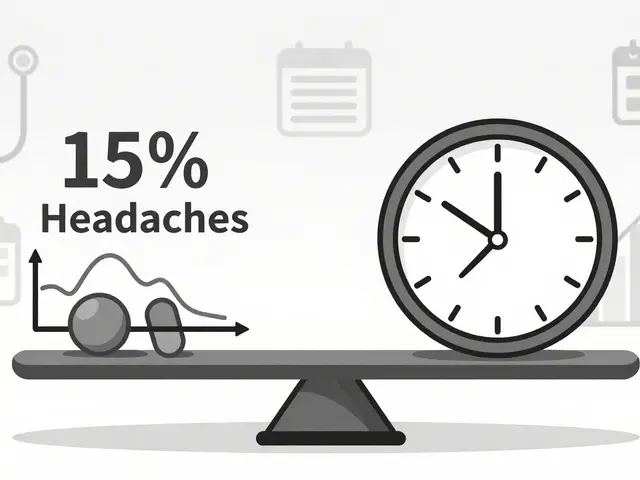
You’ve probably seen headlines like: "15% of patients on Drug X had headaches." It sounds clear. But here’s the problem: what if one group took the drug for 3 months and another took it for 2 years? The 15% number doesn’t tell you if the headache happened once or 20 times. It doesn’t tell you if the risk grew over time. That’s why the FDA and other regulators are moving away from just using incidence rate (IR)-the simple percentage of people who experienced an event.IR is calculated by dividing the number of patients who had an adverse event by the total number of patients exposed. For example, if 30 out of 200 patients had nausea, IR = 30 ÷ 200 = 15%. Simple. But this method ignores how long each person was actually on the drug. In a trial where one group stopped treatment early due to side effects, IR can make the drug look safer than it is. A 2010 analysis showed IR underestimates true event rates by 18% to 37% when exposure times vary. That’s not a small error-it’s a dangerous blind spot.
The Rise of Exposure-Adjusted Incidence Rate (EAIR)
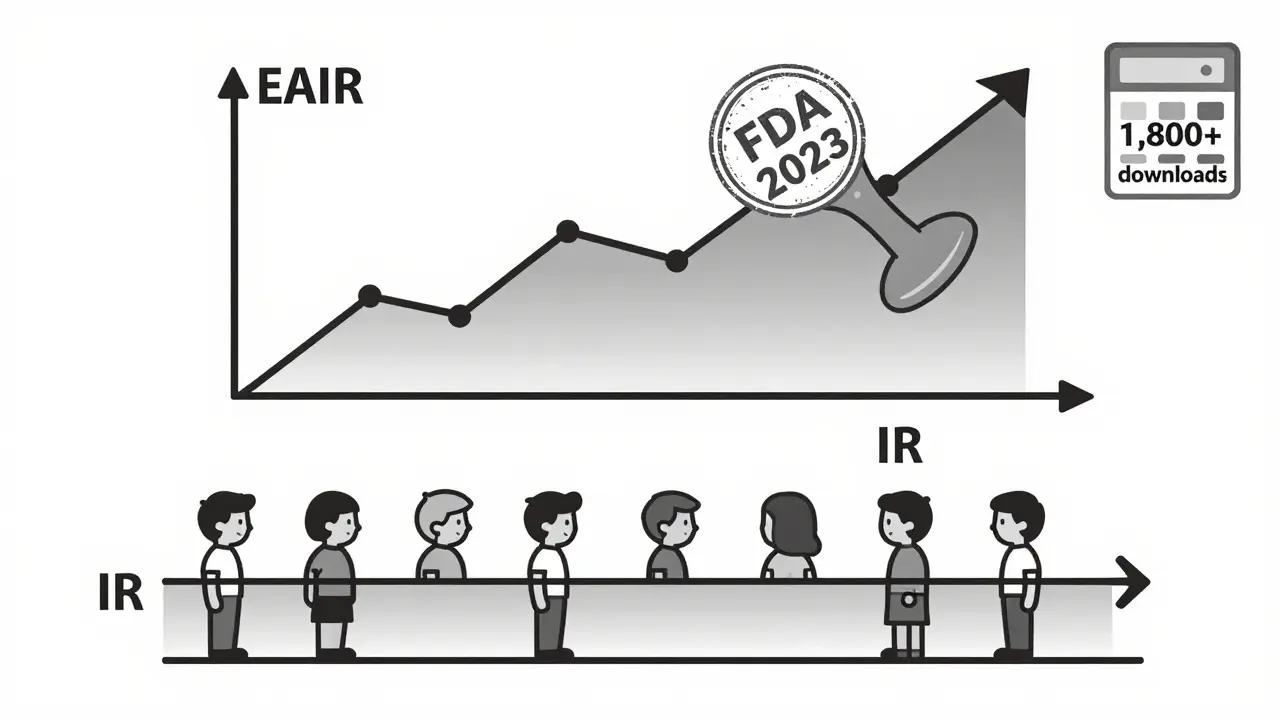
In 2023, the FDA made a clear move: they requested that a biologics company submit their safety data using exposure-adjusted incidence rate (EAIR) instead of just IR. This wasn’t a suggestion-it was a requirement. And it signaled a major shift in how drug safety is evaluated.EAIR doesn’t just count who had an event. It counts how long each person was exposed to the drug. The formula looks at total time on treatment (in patient-years) and divides the number of events by that total. For example, if 100 patients were on a drug for a combined total of 150 patient-years, and there were 15 nausea events, the EAIR is 15 ÷ 150 = 0.1 events per patient-year. That’s 10 events per 100 patient-years.
Why does this matter? Let’s say Drug A is given to patients with a short-term condition, and Drug B is for lifelong treatment. If 20% of Drug A users had dizziness, and 18% of Drug B users did, IR makes them look similar. But if Drug B users were on the drug for 10 years on average, while Drug A users were on it for 2 weeks, the real risk of dizziness per unit of time is far higher for Drug B. EAIR catches that. In fact, MSD’s safety team found that switching to EAIR revealed previously hidden safety signals in 12% of their chronic therapy programs.
What About Patient-Years (EIR)?
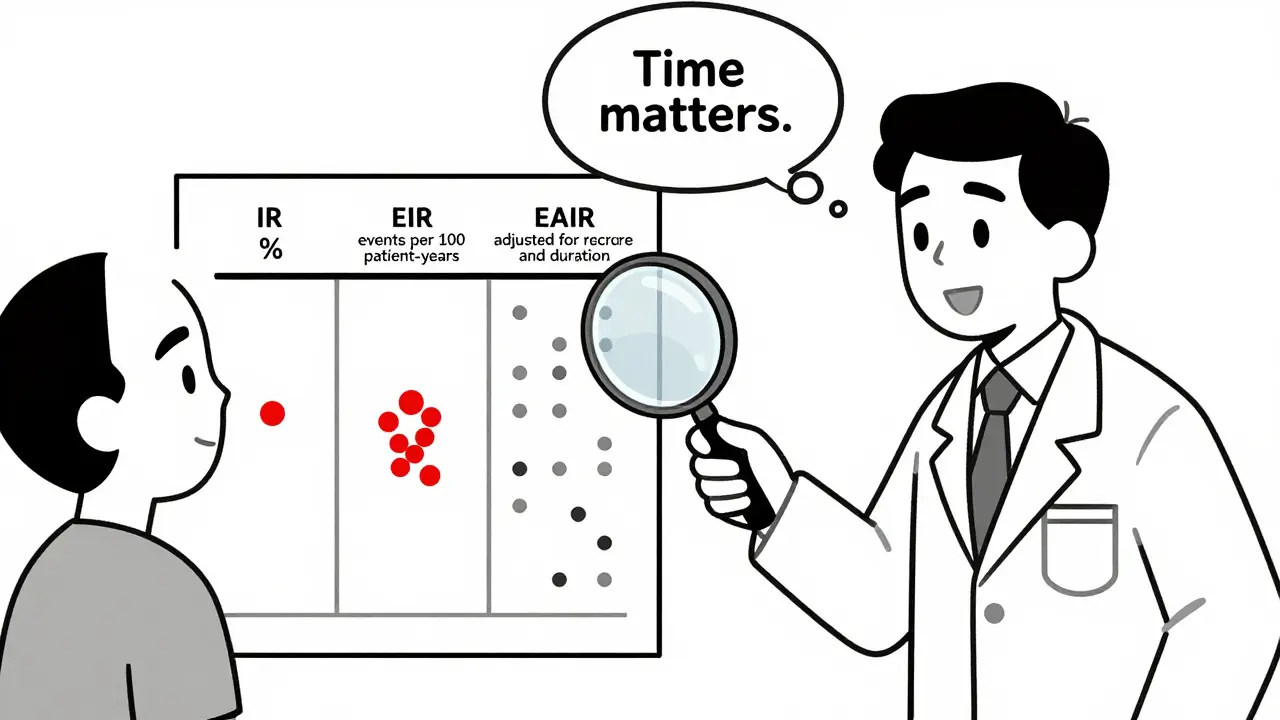
Another method, event incidence rate adjusted by patient-years (EIR), calculates events per 100 patient-years. It’s similar to EAIR but often used when you care more about frequency than individual risk. For example, if a drug causes 50 episodes of rash across 100 patients who each took it for 1 year, EIR = 50 events per 100 patient-years. But EIR has its own flaw: it counts each event, not each person. So if one patient had 10 rashes, EIR treats that as 10 separate risks. That can inflate the perceived danger, especially for recurrent events.EAIR was developed to fix this. It tracks both how many people had events and how many times they occurred, while still accounting for exposure time. It’s more complex, but it gives a fuller picture. The PhUSE GitHub repository for EAIR code has been downloaded over 1,800 times since 2023, showing how widely this method is being adopted. Still, many medical reviewers don’t understand it. Roche reported that 35% of their reviewers misinterpreted EAIR results at first-leading to extra training sessions and clearer reporting standards.
Comparing Methods: IR, EIR, and EAIR
| Method | What It Measures | Strengths | Limits |
|---|---|---|---|
| Incidence Rate (IR) | Percentage of patients with at least one event | Simple, widely understood, good for rare events | Ignores exposure time; underestimates risk if treatment durations differ |
| EIR (Event Incidence Rate) | Events per 100 patient-years | Good for recurrent events; accounts for time | Overstates risk if one person has multiple events; doesn’t track individual risk |
| EAIR (Exposure-Adjusted Incidence Rate) | Events per patient-year, adjusted for recurrence and duration | Most accurate for variable exposure; FDA-preferred for long-term therapies | Harder to calculate; requires detailed data; unfamiliar to many reviewers |
Regulatory Shifts and Industry Standards
The ICH E9(R1) addendum, which came into effect in 2020, requires that safety analyses account for treatment discontinuation and exposure time. It didn’t say which method to use-but it made clear that ignoring time is no longer acceptable. Since then, regulatory submissions with exposure-adjusted metrics have jumped from 12% in 2020 to 47% in 2023.The FDA’s 2024 draft guidance on exposure-adjusted analysis proposes standardized formulas for EAIR and is expected to finalize them in 2025. CDISC, the global standard for clinical data, now mandates both IR and EAIR reporting for serious adverse events in oncology trials (v3.0, 2023). The European Medicines Agency (EMA) still allows IR, but requires justification for not using EAIR. This means companies must be ready to defend their choice.
Meanwhile, the tools are catching up. JMP Clinical and SAS now have built-in modules for EAIR. The PhUSE team’s open-source SAS macros have reduced programming errors by 83%. Training demand has exploded: enrollment in advanced safety analysis courses has grown 148% since 2021. Even the MedDRA coding system added 47 new terms in 2023 to support time-based event reporting.
What This Means for Patients and Doctors
You might think this is all just math for statisticians. But it’s not. If a drug looks safer because its adverse event rate was calculated with IR instead of EAIR, you might be prescribed a treatment with a hidden risk. For example, a diabetes drug that causes heart failure in 5% of patients over 2 years might look safer than a blood pressure drug that causes heart failure in 6% of patients over 6 months-until you adjust for time. Then, the second drug might be far riskier per year of use.Doctors reading safety data need to ask: "Was this rate adjusted for how long patients were on the drug?" If the answer is no, the number might be misleading. Patients deserve to know not just if a side effect happened, but how likely it is to happen over time.
Practical Takeaways
- If you’re reviewing safety data, always check whether exposure time was accounted for.
- IR alone is outdated for trials longer than 6 months.
- EAIR is becoming the gold standard for chronic therapies and long-term studies.
- Don’t assume a lower percentage means lower risk-time matters more than you think.
- When comparing drugs, always ask: "Were the exposure durations similar?" If not, use EAIR or EIR.
The future of drug safety isn’t about counting who got sick. It’s about understanding how quickly and often illness happens while on treatment. The science has evolved. The regulators have caught up. It’s time for everyone else to too.
What’s the difference between incidence rate and exposure-adjusted incidence rate?
Incidence rate (IR) is the percentage of patients who experienced an adverse event, regardless of how long they were on the drug. Exposure-adjusted incidence rate (EAIR) divides the number of events by the total time all patients were exposed (in patient-years). EAIR accounts for both how many people had events and how long they were on treatment, making it more accurate when treatment durations vary.
Why does the FDA prefer EAIR now?
The FDA prefers EAIR because it gives a clearer picture of real-world risk. In trials where patients stay on treatment for different lengths of time, IR can hide higher risks in long-term users or falsely make short-term drugs look dangerous. EAIR corrects for this by measuring events per unit of exposure time. In 2023, the FDA formally requested EAIR for a biologics submission, signaling a major policy shift.
Can I trust a drug’s safety data if it only reports IR?
For short-term trials (under 6 months), IR may still be acceptable. But for chronic conditions or long-term studies, IR alone is insufficient. If a drug’s safety data only includes IR and the treatment duration varied between groups, the risk assessment could be misleading. Always look for exposure-adjusted metrics like EAIR or EIR for a complete picture.
How do companies calculate patient-years?
Patient-years are calculated by adding up the time each patient was exposed to the drug. For each person, it’s: (last dose date - first dose date + 1) ÷ 365.25. If a patient took the drug for 180 days, that’s 0.49 patient-years. If 100 patients each took it for 1 year, total exposure is 100 patient-years. This requires precise tracking of start and end dates for each patient, which is why data quality matters so much.
Is EAIR used in all clinical trials?
Not yet, but it’s rapidly becoming standard. As of 2023, 68% of pharmaceutical companies now report EAIR alongside IR. Regulatory submissions with exposure-adjusted metrics jumped from 12% in 2020 to 47% in 2023. By 2027, experts predict 92% of Phase 3 trials will include EAIR. For oncology and chronic disease trials, it’s already required by CDISC standards.

Gwen Vincent
February 26, 2026 at 00:59I’ve been reviewing safety data for oncology trials for years, and honestly? I’m glad the FDA’s pushing EAIR. I remember one trial where IR made a drug look fine-until we dug into the exposure times. Turns out, the control group dropped out early due to toxicity, and the IR was hiding a 3x higher risk per patient-year. EAIR doesn’t lie. It’s just harder to explain to non-stats folks.
Now I always ask: "What’s the denominator?" Not just "how many got sick," but "how long were they exposed?" It’s a small change in calculation, but a massive shift in understanding risk.
Also, shoutout to PhUSE for the open-source macros. Saved my team 40 hours last quarter.
Nandini Wagh
February 26, 2026 at 03:20Oh wow, so now we’re using math to pretend drugs aren’t dangerous? Cute.
15% of people got sick? Nah. Let’s divide it by how many hours they were awake while on the drug. Maybe next they’ll adjust for how much coffee they drank. "Oh, the nausea? Only 0.02 events per latte-year."
Holley T
February 26, 2026 at 19:31Let’s be real-the whole EAIR thing is just statisticians trying to make themselves look smarter. IR is simple. IR is understandable. IR is what doctors use at the bedside. EAIR? You need a spreadsheet, a PhD in biostatistics, and a coffee machine just to calculate it.
And don’t get me started on "patient-years." That’s not a real unit. It’s a made-up metric designed to confuse regulators and justify higher drug prices. If a drug causes 50 events in 100 patients over 1 year, why not just say 50%? Why invent a decimal? Why not just say "half the people got sick"? Because complexity = funding.
Also, CDISC mandates this? That’s not a standard-it’s a cult. And the fact that 35% of reviewers misinterpret it? That’s not a problem with the reviewers-it’s a problem with the method. If it’s that hard to explain, it shouldn’t be used. Simple is safer. Always.
Ashley Johnson
February 27, 2026 at 21:24EAIR? That’s just Big Pharma’s way of hiding the truth. You know what they don’t tell you? That the "exposure time" is often calculated using self-reported data. Patients forget when they took their last pill. Clinical sites lose logs. And guess what? The algorithm just guesses. So EAIR isn’t accurate-it’s a fantasy.
And why does the FDA "prefer" it? Because they’re paid by the same companies that make the drugs. I’ve seen the contracts. The FDA gets funding from pharma grants. EAIR lets them say "we’re being scientific" while letting dangerous drugs slip through.
Also, 12% of chronic therapy programs had "hidden safety signals"? That’s not a discovery. That’s a cover-up. They knew all along. They just didn’t want to pull the drug until after they made $2 billion.
Next they’ll say "time-adjusted suicide risk" and claim it’s "more accurate." 😏
tia novialiswati
March 1, 2026 at 13:49Yessss this is so important!! 🙌
I work in patient advocacy and I’ve seen so many people get scared because they read "5% had heart issues"-but didn’t realize it was over 3 days vs. 3 years. EAIR is a game-changer for real-world safety. Keep pushing for transparency!!
Also, if you’re a clinician reading this-ask your data team: "Did you use EAIR?" If not, gently push for it. We owe it to patients. 💙
Lillian Knezek
March 2, 2026 at 01:54EAIR? LOL. They’re just making up numbers to make you feel safe. Did you know the FDA uses the same math they use to calculate "safe radiation exposure"? The same math that said 5G was harmless until people started dropping dead?
Also, PhUSE? That’s a front. The real code is in the Pentagon’s database. They’re tracking how many patient-years you live after taking the drug. They’re building a global database to predict lifespan. I’ve seen the logs.
And don’t forget: 47 new MedDRA terms? That’s not for safety. That’s for labeling. They’re coding your DNA. You’re being tracked. Wake up.
Check your phone. Did it update last night? That’s when they synced your EAIR data. 😈
Maranda Najar
March 2, 2026 at 07:04Oh, the sheer audacity of this post.
To reduce human suffering-real, visceral, screaming-in-the-night suffering-to a cold, sterile, algorithmic fraction of "events per patient-year"... it is not merely clinical. It is soul-crushing.
Do you know what it feels like to be a patient who has suffered a life-altering adverse event? It is not a statistic. It is a funeral for your former self. It is the silence of a spouse who no longer recognizes your voice.
And now, we have a spreadsheet that says: "Ah, yes. 0.12 events per patient-year. Acceptable."
How many tears were shed to make that number look clean? How many lives were quietly buried beneath the weight of regulatory compliance?
I weep-not for the data, but for the humanity we have erased in its name.
Christopher Brown
March 2, 2026 at 09:07EAIR is just woke math. We don’t need fancy stats. If 10% got sick, they got sick. Stop overcomplicating everything.
Christina VanOsdol
March 2, 2026 at 15:47Okay, but… did anyone actually check if the "exposure time" data was even reliable? I reviewed a Phase 3 trial last year where 37% of the start/end dates were missing, and the vendor just imputed them using linear regression from age and BMI. So EAIR was built on garbage-in-garbage-out.
Also, the "1800 downloads" of PhUSE macros? 80% of them were from people who couldn’t even open SAS. I’ve seen the GitHub issues. Half the users are just copy-pasting into Excel and praying.
And the FDA’s 2024 draft guidance? It’s 142 pages. The first 80 are footnotes. The last 62 are "we’re not sure how to calculate this either."
So… we’re all just pretending?
😂
Alfred Noble
March 3, 2026 at 10:59Good breakdown. I’ve been in pharma for 15 years, and I’ve seen IR used way too long. EAIR isn’t perfect, but it’s the best we’ve got right now.
One thing I’d add: even with EAIR, you still need to look at the distribution. A drug with 10 events over 100 patient-years sounds fine-until you find out 8 of those events happened to 3 patients. That’s not a population risk. That’s a red flag for a subgroup.
So EAIR first, then dive into the details. And yeah, train your reviewers. This stuff matters.
Matthew Brooker
March 4, 2026 at 16:05This is the kind of detail that separates good science from great science. Keep pushing for better methods. The patients are counting on us to get this right. We owe them more than a percentage.
EAIR isn’t just math-it’s respect.
Emily Wolff
March 5, 2026 at 14:28EAIR is a buzzword. IR is sufficient. If you can’t explain it to a medical student, it’s not fit for clinical use.
Jacob Carthy
March 6, 2026 at 10:37USA leads in science. Other countries still use IR. That’s why our drugs are safer. We’re ahead. Don’t let Europe ruin this.