
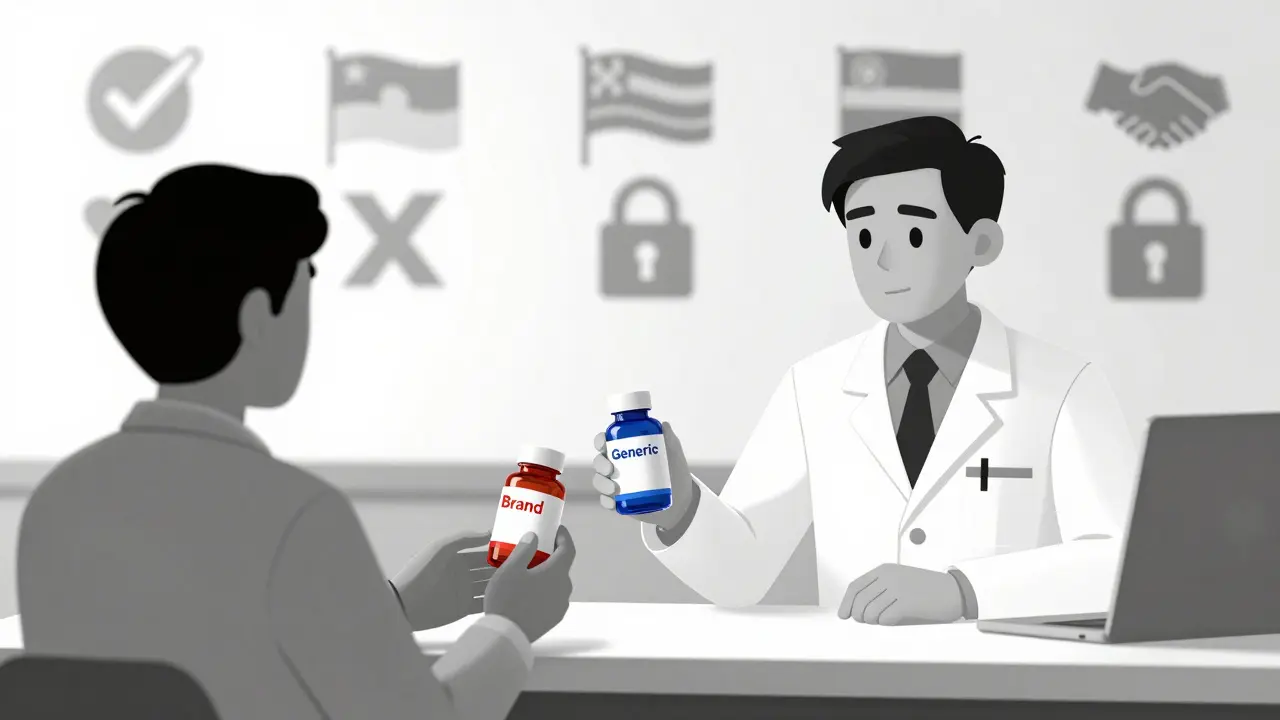
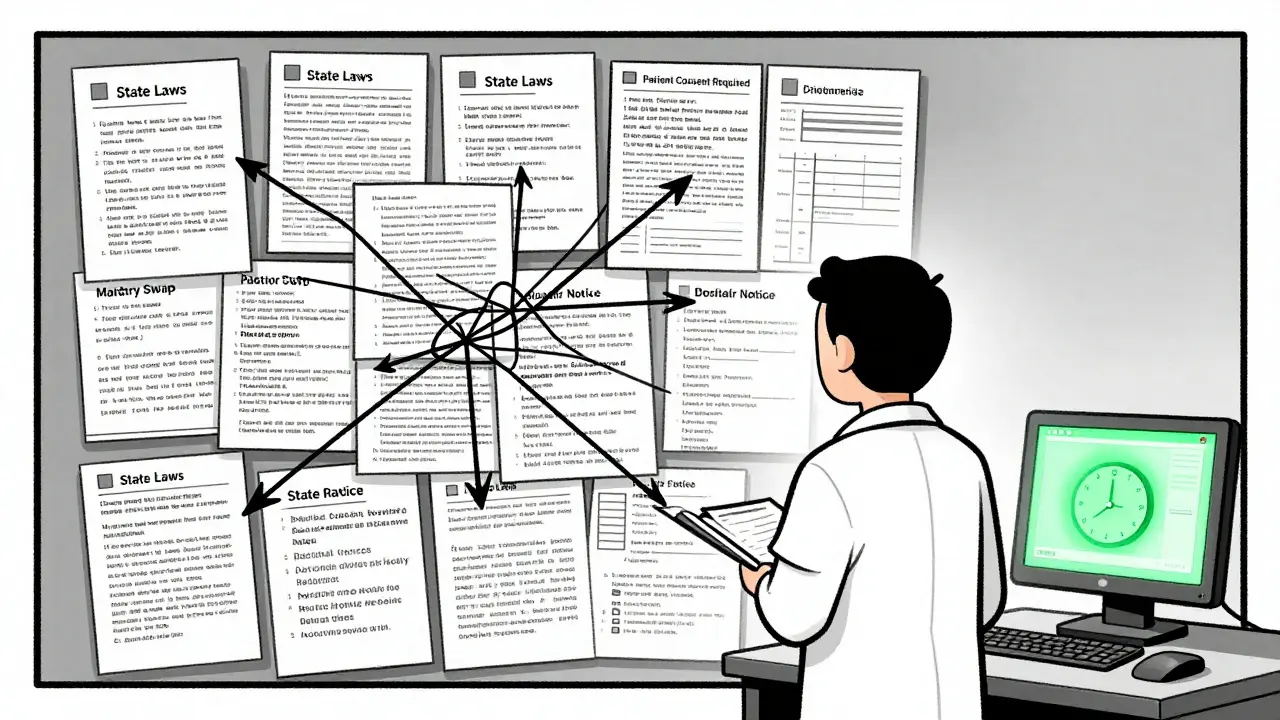
When you pick up a prescription, you might not realize that whether you get a brand-name drug or a generic version depends entirely on where you live. In some states, pharmacists are required to swap in a cheaper generic unless the doctor says no. In others, they can’t substitute at all without your explicit permission. This isn’t a national standard - it’s a patchwork of 51 different systems (50 states plus Washington, D.C.), each with its own rules, paperwork, and hidden traps.
How Generic Substitution Works - And Why It Matters
Generic drugs are chemically identical to their brand-name counterparts. They contain the same active ingredient, dosage, and route of administration. The FDA requires them to meet the same strict standards for safety and effectiveness. Yet, they often cost 80% less. That’s why states have laws allowing or requiring pharmacists to substitute generics - to cut costs and keep care affordable.
But here’s the catch: not all states treat substitution the same way. Some force pharmacists to substitute. Others make it optional. A few require patients to sign paperwork. A handful don’t even tell patients when a switch happens. These differences aren’t just paperwork - they affect how much you pay, how safe your medication is, and whether your doctor even knows what you’re taking.
Mandatory vs. Permissive Substitution Laws
As of 2026, 19 states have mandatory substitution laws. That means if a generic is available and the prescription doesn’t say "dispense as written," the pharmacist must give you the generic. These states include California, New York, Texas, Florida, and Illinois. In these places, the default is substitution - unless something blocks it.
The other 31 states plus D.C. operate under permissive rules. Pharmacists can substitute, but they don’t have to. Many choose to, especially if the patient is on a high-cost drug and the generic is much cheaper. But they can also stick with the brand name - even if the prescriber didn’t specify it. This creates inconsistency. One pharmacy might swap your insulin, while another across town doesn’t, even if they use the same system.
What Happens When You Need a Biosimilar?
Biosimilars are the next generation of generics - but they’re not the same. They’re made from living cells, not chemicals, so they’re more complex. Because of that, states treat them differently. As of 2026, 45 states (including D.C.) have stricter rules for biosimilars than for regular generics.
In most of these states, the pharmacist must notify the prescribing doctor within a set time frame - often 5 days - after switching you to a biosimilar. California requires an electronic entry in the prescriber’s system. Other states require written notice. Some even require patient consent before the switch. Only 6 states allow biosimilar substitution without any extra steps - and those are mostly the same ones that mandate generic substitution.
This fragmentation is slowing adoption. Even though the FDA has approved over 30 biosimilars, they make up less than 15% of eligible prescriptions. The reason? Pharmacists in 45 states fear legal or administrative fallout if they don’t follow the exact local rule.
Who Gets to Say No - The Prescriber, Patient, or Pharmacist?
Three parties can block substitution: the doctor, the patient, or the pharmacist.
Prescribers can write "dispense as written" or "do not substitute" on the prescription. This is allowed everywhere. In fact, 48 states let doctors do this - even if the generic is cheaper and just as effective.
Patient consent is another layer. Only 7 states plus D.C. require the pharmacist to get your signature or verbal approval before substituting. In those places, patients report feeling more in control. But in the other 43 states, you might never know you got a different drug - unless you check the label.
Pharmacists themselves are caught in the middle. In 24 states, there’s no legal protection if something goes wrong after a substitution. That means if you have a bad reaction - even if the generic was FDA-approved - the pharmacist could be sued. In 26 states, the law shields them from liability if they follow the rules. That’s a huge difference in risk.
Formularies: Positive vs. Negative Lists
Some states use a positive formulary: they list which generics can be substituted. Only those on the list are allowed. Others use a negative formulary: they list drugs that can’t be substituted - everything else is fair game.
California uses a positive formulary based on the FDA’s Orange Book. If the drug isn’t rated "A" in the Orange Book, substitution isn’t allowed - even if a pharmacist thinks it’s equivalent. New York, on the other hand, lets pharmacists use broader clinical judgment. They can substitute based on therapeutic equivalence, even if the FDA hasn’t officially rated it.
Oklahoma is an outlier. Even if a generic is rated "A," the pharmacist still needs written permission from the prescriber or the patient’s insurance before switching. That’s extra work - and extra delays.
Real-World Impact: Costs, Errors, and Time
These rules aren’t just about paperwork. They cost money and risk lives.
States with mandatory substitution have 8.7% higher generic use and $55 less in annual per-person prescription costs. That’s $1.2 billion saved every year just from those 19 states.
But the cost isn’t just financial. Pharmacists spend an average of 8.2 hours a month just keeping up with state rules. In multi-state telepharmacy operations, some spend 15-20 minutes per prescription checking regulations. One pharmacist reported refusing to substitute warfarin - a blood thinner - because her state offered no liability protection. That’s a dangerous choice: she knew the generic was safe, but she didn’t want to risk her license.
Errors happen. A 2021 study found 22% of substitution-related medication errors occurred in states with weak notification rules. Patients didn’t know they were switched. Their doctors didn’t know. Blood tests didn’t match. A patient on a brand-name drug might have their dose adjusted - then suddenly get a generic and not realize why their INR levels spiked.

What’s Changing - And What’s Coming
Change is coming, but slowly. In 2024, the National Association of Boards of Pharmacy launched a project to reduce 51 different laws into just three regional models by 2027. The FDA is pushing for alignment too. Commissioner Robert Califf called state-level fragmentation the "single greatest barrier" to biosimilar adoption.
Already, 9 states passed reforms in 2023-2024 to make their rules for biosimilars match those for generics. Texas, Illinois, and Pennsylvania are among them. But 42 states still treat biosimilars like special cases - even though they’re proven safe.
Technology is helping. Systems like ScriptPro SP 200 now update state rules in real time. Pharmacies using them saw a 37% drop in substitution errors. But only 28 states have fully integrated these tools with major electronic health records. The rest? Still using paper, phone calls, and guesswork.
What You Need to Know
If you’re a patient: Always check your pill bottle. If the name or color changed, ask why. If you’re on a high-risk drug like warfarin, thyroid meds, or epilepsy drugs, ask your pharmacist if substitution was made - and whether your doctor was notified.
If you’re a prescriber: Write "dispense as written" only when medically necessary. Don’t assume your patient knows what they’re getting. Use electronic prescribing - it’s the only way to reliably block substitution in states that allow it.
If you’re a pharmacist: Use the National Association of Boards of Pharmacy’s free online tool. It’s updated quarterly. But don’t rely on it alone - cross-check with your state board’s website. And if you’re in a state without liability protection? Document every substitution. Keep notes. Cover your back.
The system is broken - not because generics are unsafe, but because the rules are scattered, outdated, and inconsistent. Until states align, patients will pay more, pharmacists will work harder, and mistakes will keep happening.
Can a pharmacist substitute a generic drug without telling me?
Yes, in 20 states, pharmacists are not required to notify you when they substitute a generic drug. You might only find out by checking the label or noticing a change in pill color or shape. In 31 states plus D.C., notification is required - but not always in writing. Some states only require a verbal explanation or an entry in your electronic health record.
Do all states allow substitution for biosimilars?
No. While all 51 jurisdictions (50 states + D.C.) allow biosimilar substitution in some form, 45 of them have stricter rules than for regular generics. These include mandatory physician notification, patient consent, or specific labeling requirements. Only 6 states treat biosimilars the same way as small-molecule generics - meaning no extra steps are needed.
Why do some states require patient consent for substitution?
Seven states plus D.C. require patient consent to protect autonomy - especially for drugs with narrow therapeutic windows, like warfarin or thyroid medication. The idea is that patients should be informed before a switch, even if the generic is safe. But critics argue this adds delay and confusion, and doesn’t improve safety if patients don’t understand the difference between brand and generic.
Can my doctor prevent me from getting a generic drug?
Yes. In all 50 states and D.C., a prescriber can write "dispense as written" or "no substitution" on the prescription. This overrides any state law requiring substitution. Many doctors do this out of habit, concern for stability, or lack of awareness that generics are equivalent. But this practice can increase costs - and sometimes isn’t medically necessary.
What’s the FDA’s Orange Book, and why does it matter?
The FDA’s Orange Book lists drugs approved as therapeutically equivalent - meaning generics that can be safely substituted. It assigns ratings like "A" (substitutable) or "B" (not substitutable). Most states use this as their official guide. But 18 states allow pharmacists to use additional clinical evidence beyond the Orange Book. This means in some places, a drug not rated "A" might still be substituted if the pharmacist has clinical justification.
Are independent pharmacies more likely to make substitution errors?
Yes. A 2023 survey found that 68% of independent pharmacies reported at least one substitution-related error in the past year, compared to 42% of chain pharmacies. The reason? Chains invest in automated systems and compliance teams. Independent pharmacies often lack the resources to track 51 different state laws. That’s why tools like ScriptPro SP 200, which auto-updates state rules, are becoming critical.
Will federal law ever override state substitution rules?
It’s possible - but unlikely soon. While 72% of pharmacy leaders support federal preemption to create national standards, state control over pharmacy practice is deeply rooted in law. The FDA and Congress have pushed for alignment, especially for biosimilars, but political resistance remains. Any federal action would need to pass Congress and survive legal challenges from state pharmacy boards.
What’s Next?
If you’re a patient: Ask your pharmacist what substitution rules apply in your state. Keep a list of your medications and note any changes. If you’re on a critical drug, request a copy of the prescription label every time.
If you’re a provider: Don’t default to "dispense as written." Only block substitution when clinically necessary. Use e-prescribing to communicate clearly with pharmacists.
If you’re a pharmacist: Use the NABP’s online tool. Update your state’s rules quarterly. And if you’re in a state without liability protection - document everything. Your license might depend on it.
The system is messy. But awareness is the first step to change. Knowing your state’s rules - and pushing for clarity - is the only way to make substitution work for everyone.

Korn Deno
March 24, 2026 at 09:20It's wild how we treat medication like it's a regional specialty. You'd think a pill that cures the same thing should be interchangeable anywhere. But nope. We've turned healthcare into a patchwork quilt stitched by lawyers. And the patient? They're just trying to stay alive while navigating 51 different rulebooks. We don't need more bureaucracy. We need consistency.
Aaron Sims
March 25, 2026 at 03:04Wait… so you’re telling me the government doesn’t just hand out the same drug everywhere? That’s a scam. I bet Big Pharma is behind this. They pay off state legislators to keep prices high. And now they’re using ‘biosimilars’ as a distraction. Next thing you know, they’ll say your aspirin has to be approved by a committee in Vermont. Mark my words - this is all about control.
Stephen Alabi
March 26, 2026 at 17:00The fundamental issue here is not regulatory fragmentation per se, but the absence of a unified, scientifically grounded, federally mandated framework for pharmaceutical substitution. The current state-by-state paradigm is not merely inefficient; it is epistemologically incoherent. Pharmacists, as frontline healthcare professionals, are being asked to perform complex clinical decision-making under conditions of profound legal ambiguity. This is not governance - it is chaos.
Agbogla Bischof
March 28, 2026 at 05:55In Nigeria, generics are the only option - no brand-name drugs unless you’re paying out of pocket. We don’t have 51 laws. We have one: if it’s FDA-approved and cheap, use it. Your system isn’t broken because of generics. It’s broken because you overthink everything. Stop making paperwork harder than the medicine itself.
Pat Fur
March 29, 2026 at 00:17I never realized how much I didn’t know until I checked my pill bottle one day and saw a different color. That’s when I started asking questions. Turns out, my state doesn’t require notification. I’ve been switching drugs for years without knowing. It’s scary. But also… kind of empowering to learn how to advocate for myself.
Chris Crosson
March 29, 2026 at 15:46You say 19 states have mandatory substitution. That’s great. But what about the other 31? They’re not just permissive - they’re actively letting people get brand-name drugs at triple the price. That’s not choice. That’s exploitation. If the science says generics are equal, then the law should reflect that. No exceptions. No loopholes. Just do the right thing.
Chris Farley
March 31, 2026 at 09:27America’s strength is in its diversity. Why should California dictate to Texas how to run its pharmacies? We don’t need federal overreach. We need local control. If someone in New York wants to sign papers to get their brand-name insulin, let them. That’s freedom. You want uniformity? Move to Canada.
Mihir Patel
March 31, 2026 at 13:38OMG I JUST REALIZED MY PHARMACY SWITCHED MY MEDS AND I NEVER KNEW!!! I THOUGHT I WAS TAKING THE SAME THING FOR 3 YEARS!!! THIS IS A DISASTER!!! SOMEONE PLEASE HELP ME!!! I THINK I MIGHT BE DANGEROUSLY UNSTABLE NOW!!!
Kevin Y.
April 1, 2026 at 22:14Thank you for this comprehensive and meticulously researched overview. The alignment of clinical outcomes, economic data, and regulatory structure presented here is both illuminating and compelling. I would respectfully suggest that the next logical step involves a collaborative task force comprising state pharmacy boards, the FDA, and patient advocacy groups to draft model legislation. Such an initiative could serve as a blueprint for national harmonization.
Raphael Schwartz
April 2, 2026 at 00:02This is why we need to stop letting doctors and pharmacists play god. Just give everyone the cheap stuff. End of story. Why are we even having this debate? It’s not rocket science. Pills are pills. If it works, use it. If it’s cheaper, use it. Stop making it complicated.