
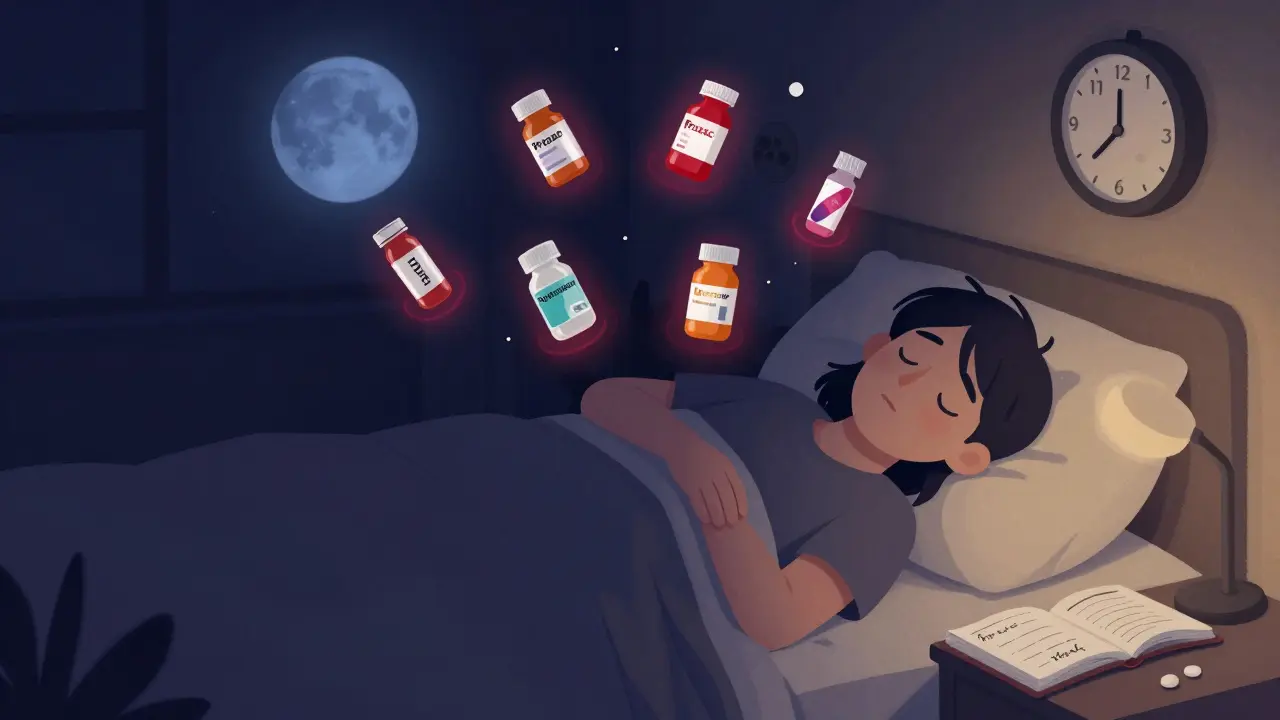
More than 1 in 5 adults say their sleep troubles come from something they’re taking - not stress, not screens, not aging. It’s not just caffeine or late-night scrolling. It’s the blood pressure pill, the antidepressant, the steroid, even the allergy medicine you picked up without a prescription. Medication-induced insomnia is real, common, and often ignored. You’re not imagining it. You’re not broken. You’re just taking something that’s interfering with your body’s natural sleep rhythm.
Which Medications Are Most Likely to Ruin Your Sleep?
Not all drugs affect sleep the same way. Some keep your brain wired. Others shut down your body’s natural sleep signal. Here are the big offenders:
- SSRIs like fluoxetine (Prozac) and sertraline (Zoloft): These antidepressants boost serotonin, which sounds good - until it keeps you awake. About 1 in 4 users report waking up multiple times at night. REM sleep, the deep restorative phase, drops by nearly a quarter.
- Beta-blockers like metoprolol (Lopressor): Used for high blood pressure and heart conditions, these drugs slash melatonin production by 42%. That’s your body’s natural sleep hormone. Result? More nightmares, more awakenings, less deep sleep.
- Corticosteroids like prednisone: Even a 20mg daily dose can cut deep sleep by almost half and triple nighttime wake-ups. These drugs flood your system with cortisol - the wake-up hormone - at the wrong time.
- Stimulants like Adderall XR: For ADHD, these are lifesavers during the day. But if taken too late, they can delay sleep by over an hour for nearly 4 out of 10 users.
- Over-the-counter cold meds like pseudoephedrine (Sudafed): That decongestant you take for a stuffy nose? It’s a stimulant. About 1 in 8 users can’t fall asleep after taking it.
- Non-drowsy antihistamines like loratadine (Claritin): You think they’re safe because they don’t make you sleepy? Wrong. They can still block sleep signals in your brain. About 1 in 10 users report trouble falling asleep.
- St. John’s wort and glucosamine-chondroitin: Even natural supplements aren’t immune. St. John’s wort, often taken for mood, causes insomnia in 15% of users. Glucosamine? About 7% of people can’t sleep after taking it.
And here’s the kicker: some of these aren’t even labeled as sleep disruptors. You won’t see it on the bottle. But the data doesn’t lie.
Why Do These Drugs Keep You Awake?
It’s not random. Each drug messes with your brain chemistry in a specific way.
SSRIs flood your brain with serotonin. That’s good for mood, but too much serotonin in the wrong areas can overstimulate the parts of your brain that control wakefulness. Your brain thinks it’s daytime - even at midnight.
Beta-blockers block adrenaline receptors. That’s good for your heart. But your pineal gland - the tiny part of your brain that makes melatonin - needs those signals to work. No signal? No melatonin. No melatonin? No sleep.
Corticosteroids mimic stress hormones. Your body naturally lowers cortisol at night. These drugs keep it high. You’re literally flooding your system with wake-up juice when you should be winding down.
Stimulants like Adderall pump up dopamine and norepinephrine - chemicals that keep you alert. They’re designed to work for hours. If you take them after noon, your brain doesn’t know when to shut off.
Even non-drowsy antihistamines? They don’t make you sleepy, but they still bind to receptors in your brain that help regulate sleep. That interference can be enough to delay sleep onset.
What You Can Do Right Now
You don’t have to suffer. There are practical, science-backed ways to fix this - without quitting your meds cold turkey.
1. Change the Timing
When you take your pill matters more than you think.
- Corticosteroids: Take them before 9 a.m. Studies show this cuts insomnia risk by 63%. Your cortisol spike happens when you’re awake, not when you’re trying to sleep.
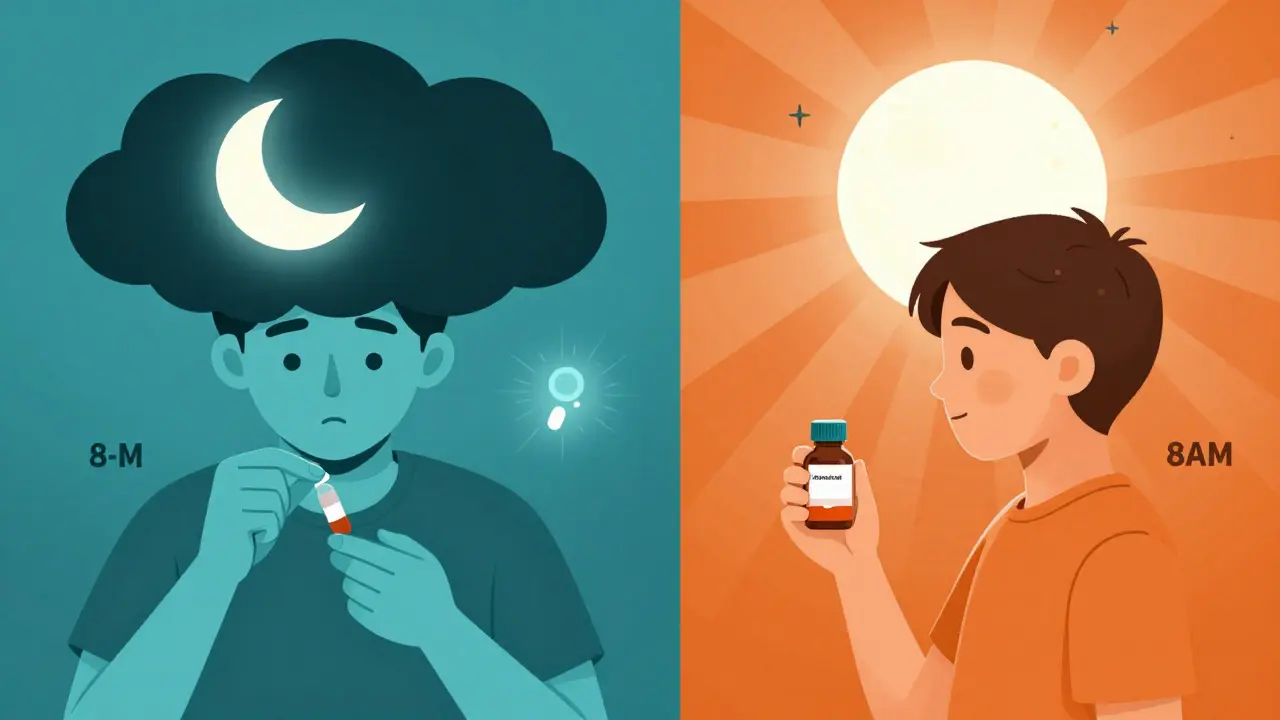
- SSRIs: Switch from nighttime to morning dosing. One study found this reduced sleep problems by 45%. Your brain gets the serotonin boost during the day - not when you’re trying to rest.
- Stimulants: Never take them after 2 p.m. Even if you feel fine, your brain is still processing the drug hours later.
- Beta-blockers: If you’re on a fat-soluble version like propranolol, ask your doctor about switching to atenolol. It’s water-soluble and causes 37% fewer nighttime awakenings.
2. Try Melatonin - But Do It Right
For beta-blocker users, melatonin isn’t just helpful - it’s a game-changer. Taking 0.5 to 3 mg, 2 to 3 hours before bed, restores sleep quality by over half in clinical trials. Don’t take it right before bed. That’s too late. Your body needs time to absorb it.
3. Swap for a Sleep-Friendly Alternative
If your SSRI is wrecking your sleep, ask about mirtazapine (Remeron). It’s an antidepressant that actually makes you sleepy. In clinical trials, 68% of patients who switched from SSRIs to mirtazapine saw their insomnia disappear.
For allergies, try a drowsy antihistamine like diphenhydramine - but only if you’re under 65. For older adults, even these can cause confusion and falls. The American Geriatrics Society says they’re risky for seniors.
4. Track Your Sleep - Seriously
Before you blame your meds, prove it. Use a simple sleep diary for two weeks. Write down:
- What time you took each medication
- What time you got into bed
- How long it took to fall asleep
- How many times you woke up
- How rested you felt in the morning
Doctors use this to spot patterns. If you’re waking up every night after taking your 8 p.m. pill, that’s not coincidence. That’s data.
When to See a Sleep Specialist
Not every sleep problem is from a pill. Sometimes, the pill is just exposing an existing issue.
Experts say if your sleep troubles:
- Last longer than 3 weeks
- Happen 3 or more nights a week
- Make you tired, irritable, or unable to focus on 3 or more days a week
Then it’s time to see a sleep specialist. About half of people who think their insomnia is drug-related actually have an underlying sleep disorder like sleep apnea or restless legs syndrome.
Don’t assume. Get checked.
Don’t Quit Cold Turkey
If you’re taking a sleep aid like zolpidem (Ambien) and want to stop, don’t just quit. You’ll get rebound insomnia - worse than before. The American Academy of Sleep Medicine recommends cutting your dose by 25% every two weeks under medical supervision. That drops your risk of rebound from 65% to just 18%.
The same goes for steroids, antidepressants, and stimulants. Stopping suddenly can cause withdrawal symptoms, mood crashes, or even heart problems. Talk to your doctor. Make a plan.

What No One Tells You
Over a third of people who stop their meds because of sleep problems never told their doctor. They just quit. That’s dangerous. You might be treating one problem and creating another.
Also, don’t trust online reviews alone. On Drugs.com, beta-blocker users report insomnia in 21% of cases - but only 63% of those reports mention metoprolol specifically. That means if you’re on a different beta-blocker, your risk might be lower. Your experience isn’t universal.
And here’s the truth: sleep problems from meds are treatable. You don’t have to live with it. You don’t have to choose between your health and your sleep. There’s a middle ground.
Start with timing. Track your nights. Talk to your doctor. Swap if needed. Use melatonin if it fits. And if it’s still not working? See a sleep specialist. You’ve already done the hard part - you’re looking for answers. Now take the next step.
What to Ask Your Doctor
Bring this list to your next appointment:
- “Could any of my medications be causing my insomnia?”
- “Is there a version of this drug that’s less likely to disrupt sleep?”
- “Can we try taking this in the morning instead?”
- “Would melatonin help with the side effects?”
- “Should I get checked for another sleep disorder?”
Don’t be afraid to push. Your sleep matters. Your health matters. And you deserve to feel rested.

Erwin Kodiat
January 19, 2026 at 12:50Man, I didn’t realize my beta-blocker was wrecking my sleep until I read this. Took me six months to connect the dots. Switched to atenolol and now I’m actually sleeping through the night. No more nightmares either. Who knew?
Christi Steinbeck
January 21, 2026 at 04:58THIS. I’ve been screaming into the void about my SSRIs for years. My doctor kept saying ‘it’s just stress.’ Nope. It was Prozac. Switched to mirtazapine and I haven’t felt this rested in a decade. You’re not broken-you’re just on the wrong pill.
Tracy Howard
January 22, 2026 at 17:20Of course Americans are sleeping poorly-your entire healthcare system is a corporate buffet of profit-driven pharmaceuticals. Meanwhile, in Europe, they prescribe melatonin like it’s aspirin. But no, let’s just keep prescribing stimulants to treat stimulant-induced insomnia. Brilliant.
Aman Kumar
January 24, 2026 at 13:39Let’s be real: the pharmaceutical-industrial complex has weaponized sleep as a revenue stream. SSRIs, beta-blockers, corticosteroids-all engineered to create dependency. You think you’re healing? You’re just becoming a lifelong customer. The data doesn’t lie, but the FDA does.
Jacob Hill
January 26, 2026 at 10:36I’ve been tracking my sleep for three weeks now, and wow-it’s crystal clear. I take my Claritin at 8 p.m., and I’m wide awake at 2 a.m. every night. I switched to Zyrtec at noon, and now I’m falling asleep by 11. I’m so glad someone finally put this in writing.
Jake Rudin
January 26, 2026 at 12:34It’s fascinating how we’ve outsourced our biological rhythms to chemistry-then blamed ourselves when it fails. The body doesn’t need more drugs; it needs alignment. Timing isn’t just a suggestion-it’s a biological law. The fact that we treat sleep as an afterthought speaks volumes about our cultural disconnect from nature.
Astha Jain
January 27, 2026 at 03:02st johns wort?? like the herb?? i thought that was safe?? lol i guess not. i took it for 3 months and slept like a rock. wait… no i didnt. now i get it. thanks for the heads up.
Phil Hillson
January 28, 2026 at 14:39Why are we even talking about this like it’s a surprise? Of course your meds mess with your sleep. Big Pharma doesn’t care if you’re tired-they care if you keep buying. Just quit everything and go live in a cabin. Problem solved.
Josh Kenna
January 28, 2026 at 21:00OMG I’ve been taking prednisone for my eczema and I thought I was just going crazy. Woke up at 3 a.m. every night like clockwork. I didn’t even know it was the steroid! I started taking it at 8 a.m. instead of 7 p.m. and holy crap-I slept 7 hours straight last night. I’m crying. This changed my life.
Valerie DeLoach
January 30, 2026 at 04:34For anyone reading this who’s afraid to talk to their doctor: you’re not being difficult. You’re being responsible. Your sleep is foundational. No pill is worth sacrificing your rest. Bring the sleep diary. Bring the list of questions. Bring your truth. They’re trained to help you-not to dismiss you.
Jackson Doughart
January 30, 2026 at 04:41There’s something deeply ironic about prescribing stimulants to treat depression, then prescribing sleep aids to treat the side effects. We’ve built a system that creates problems, then sells you the cure-over and over again. It’s not medicine. It’s a cycle.
Malikah Rajap
January 31, 2026 at 07:49Wait, so you’re telling me that the ‘non-drowsy’ allergy pill I’ve been taking for years is actually keeping me awake?? Like… the whole point of ‘non-drowsy’ is that it doesn’t make you sleepy, but it still messes with sleep?? That’s so sneaky. I feel betrayed by Claritin.
sujit paul
February 1, 2026 at 11:04Let me be the first to say: this is all part of the global sleep suppression agenda. The WHO, FDA, and Big Pharma are working in tandem to keep the population docile, overworked, and dependent on pharmaceuticals. Melatonin is banned in 47 countries. Coincidence? I think not.
Lydia H.
February 1, 2026 at 15:05I used to think I was just a bad sleeper. Then I realized I was taking my antidepressant at night. Moved it to morning. Slept like a baby. Sometimes the fix is that simple. Don’t overcomplicate it. Just try the timing.
Lewis Yeaple
February 2, 2026 at 02:08While the article presents a compelling clinical overview, it lacks sufficient methodological context regarding the cited prevalence rates. For instance, the claim that SSRIs reduce REM sleep by 25% derives from a 2017 meta-analysis with a pooled sample size of 1,200 subjects-yet no confidence intervals or effect sizes are referenced. Moreover, the recommendation to switch from propranolol to atenolol assumes homogeneity in pharmacokinetics across populations, which is empirically unsupported in elderly or renally impaired cohorts. Without addressing these limitations, the advice risks being misapplied. Sleep medicine requires nuance, not blanket prescriptions.