
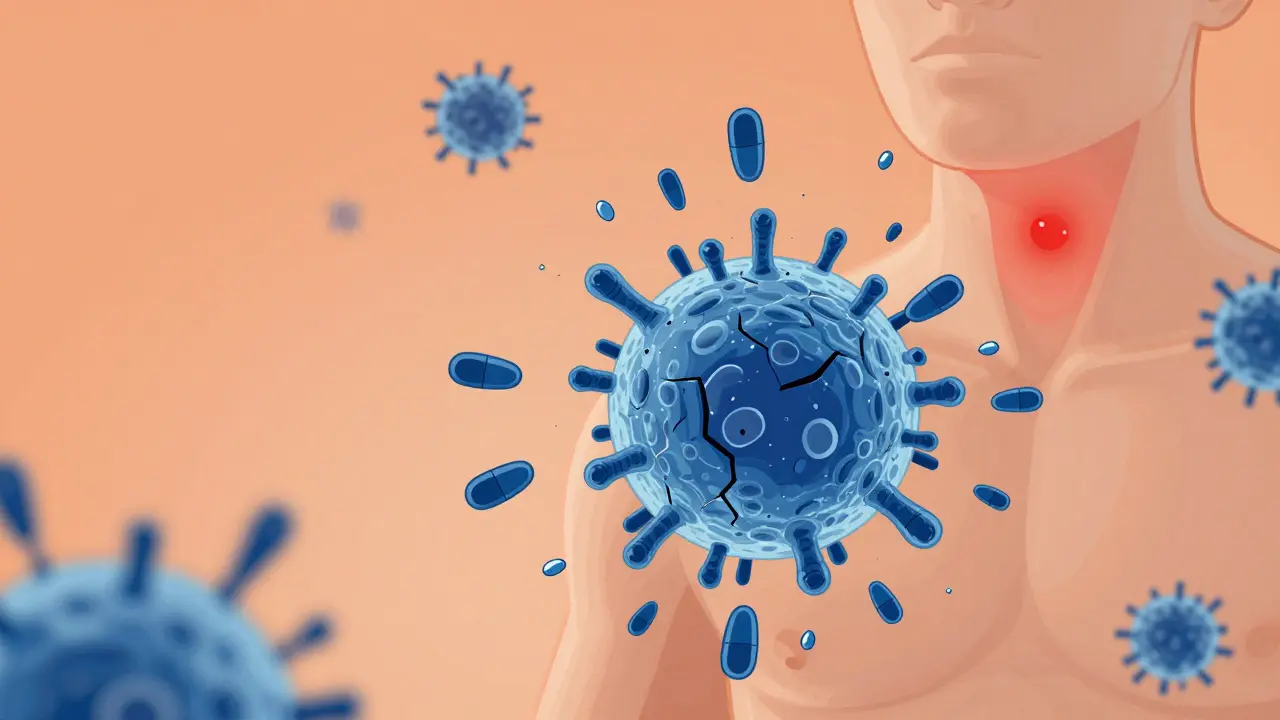
Antibiotics are one of the most important medical breakthroughs in history. Before they existed, a simple cut or sore throat could turn deadly. Today, they save millions of lives every year by targeting bacteria - not viruses, not fungi, just bacteria. But not all antibiotics are the same. They work in different ways, attack different parts of bacteria, and are used for different infections. Knowing how they work helps you understand why your doctor picks one over another - and why taking them wrong can make things worse.
How Antibiotics Kill or Stop Bacteria
Antibiotics don’t work like painkillers or fever reducers. They don’t make you feel better directly. Instead, they attack the bacteria causing the infection. There are four main ways they do this.
First, some antibiotics break down the bacterial cell wall. Bacteria have a tough outer shell made of peptidoglycan - like a brick wall that keeps their insides from bursting. Antibiotics like penicillin and amoxicillin stop bacteria from building or repairing this wall. Without it, water rushes in, and the bacteria swell and burst. This is called bactericidal action - meaning they kill the bacteria outright.
Second, some antibiotics stop bacteria from making proteins. Bacteria need proteins to grow, multiply, and survive. Drugs like azithromycin and doxycycline sneak into the bacterial ribosome - the tiny factory that builds proteins - and jam the machinery. This doesn’t always kill the bacteria right away, but it stops them from multiplying. This is called bacteriostatic action. The immune system then clears the weakened bacteria.
Third, antibiotics like ciprofloxacin and levofloxacin go after bacterial DNA. These drugs block enzymes that unwind and copy DNA during cell division. No DNA copy = no new bacteria. This is especially useful for fast-growing infections like urinary tract infections or pneumonia.
Finally, some antibiotics mess with the bacterial membrane. This is less common because human cells have similar membranes, so these drugs can be toxic. But for serious infections like those caused by MRSA, drugs like daptomycin punch holes in the bacterial membrane, causing the cell to leak and die.
Main Antibiotic Classes and What They Treat
Antibiotics are grouped into classes based on how they work and what bacteria they target. Here are the most common ones you’ll hear about.
Beta-lactams - This group includes penicillins (like amoxicillin), cephalosporins (like cefalexin), and carbapenems (like meropenem). They all share a chemical structure called the beta-lactam ring. That’s what lets them bind to the bacterial cell wall and break it down. First-generation cephalosporins like cefazolin work best on Gram-positive bacteria like staph and strep. Third-generation ones like ceftriaxone can reach deeper into the body and fight Gram-negative bugs like E. coli and Salmonella. Fourth-generation cephalosporins like cefepime cover both, making them useful in hospitals for severe infections.
Macrolides - Azithromycin and erythromycin fall here. They bind to the 50S part of the bacterial ribosome and stop protein production. They’re often used for respiratory infections like bronchitis or pneumonia, especially when someone is allergic to penicillin. Azithromycin is popular because it’s taken as just a few pills over a few days.
Tetracyclines - Doxycycline is the most common today. It blocks protein synthesis by attaching to the 30S ribosomal subunit. It’s used for acne, Lyme disease, chlamydia, and even some types of pneumonia. But it can make your skin super sensitive to sunlight - and it’s not safe for kids under 8 because it stains developing teeth.
Aminoglycosides - Gentamicin and tobramycin are powerful, but they come with risks. They bind to the 30S ribosome and cause errors in protein-making. They’re often given in hospitals for serious infections like sepsis. But they can damage kidneys and hearing, so doctors monitor blood levels closely. They also don’t work on anaerobic bacteria - the kind that live without oxygen - because they need oxygen to enter the cell.
Fluoroquinolones - Ciprofloxacin and levofloxacin are broad-spectrum antibiotics. They stop DNA replication by blocking enzymes called topoisomerases. They’re used for urinary tract infections, kidney infections, and some lung infections. But the FDA added a black box warning: they can cause tendon ruptures and nerve damage. Because of that, they’re now reserved for cases where no safer option exists.
Oxazolidinones - Linezolid is the only one in this class. It’s synthetic - meaning it was made in a lab, not pulled from soil bacteria like most antibiotics. It stops protein synthesis at the very start, before the ribosome even forms. It’s used for drug-resistant infections like MRSA or VRE (vancomycin-resistant enterococci). It’s expensive and can cause low blood counts with long use, so it’s kept in reserve.
Sulfonamides and Trimethoprim - These are often combined (like in Bactrim). They block folate production - something bacteria need to make DNA and proteins. Humans get folate from food, but bacteria have to make it themselves. That’s why these drugs can target bacteria without hurting us too much. They’re still used for urinary tract infections and a type of pneumonia called Pneumocystis jirovecii, especially in people with weakened immune systems.
Nitroimidazoles - Metronidazole is the main one. It’s activated inside anaerobic bacteria and protozoa, then shreds their DNA. That’s why it’s used for C. diff infections, dental abscesses, and parasitic infections like giardia. But if you drink alcohol while taking it, you’ll get sick - nausea, vomiting, fast heartbeat. About 70% of people react this way.
Why Some Antibiotics Don’t Work Anymore
Antibiotic resistance isn’t science fiction. It’s happening right now. When antibiotics are overused or misused - like taking them for a cold or not finishing the full course - bacteria survive and adapt. They evolve defenses. Some make enzymes that break down penicillin. Others change their cell walls so the drug can’t bind. Some pump the antibiotic out before it can do damage.
For example, over 50% of E. coli strains in 72 countries are now resistant to fluoroquinolones. In the U.S., up to 30% of outpatient antibiotic prescriptions are unnecessary - often for viral infections like colds or flu, which antibiotics can’t touch. This misuse fuels resistance.
Even worse, some bacteria have become “superbugs.” MRSA (methicillin-resistant Staphylococcus aureus) resists nearly all beta-lactams. VRE (vancomycin-resistant enterococci) can’t be killed by one of our last-resort drugs. C. diff explodes in people who’ve taken broad-spectrum antibiotics because the drugs wiped out their good gut bacteria.
And it’s not just about individual use. In farms, antibiotics are given to livestock to make them grow faster. That creates resistant bacteria that can spread to humans through food or water.
What Doctors Do to Choose the Right Antibiotic
Choosing the right antibiotic isn’t guesswork. Doctors use a mix of science and experience.
First, they try to figure out what kind of bacteria is causing the infection. Is it Gram-positive or Gram-negative? That tells them which class is likely to work. For a simple urinary tract infection, they might start with nitrofurantoin or trimethoprim-sulfamethoxazole. For strep throat, it’s penicillin or amoxicillin. For pneumonia, they might pick azithromycin or doxycycline.
But sometimes, they don’t know for sure. That’s when they use “empiric therapy” - guessing based on the most likely bacteria in that situation. Then they wait for lab results. If the infection doesn’t improve, they switch.
Doctors also check local resistance patterns. In one hospital, 80% of E. coli might be resistant to amoxicillin. In another, it’s only 20%. The CDC’s Antibiotic Resistance Laboratory Network gives real-time data across 700 labs in the U.S. That helps doctors pick drugs that still work in their area.
They also consider side effects. A teenager with acne might get doxycycline - but only if they avoid sun. An older adult with kidney problems might not get gentamicin. A pregnant woman can’t take tetracycline or fluoroquinolones.
And they look at how the drug gets into the body. Some antibiotics work well in the lungs, others in the urine, others in the bones. Ciprofloxacin penetrates deep into tissues, making it good for bone infections. Vancomycin doesn’t enter the bloodstream well, so it’s given intravenously for serious infections.
What You Can Do to Help
You don’t need to be a doctor to help fight antibiotic resistance. Here’s how:
- Don’t ask for antibiotics for colds, flu, or sore throats unless your doctor says so. Most are viral.
- Take antibiotics exactly as prescribed - the right dose, the right time, for the full length of the prescription. Stopping early lets the toughest bacteria survive.
- Never share antibiotics or use leftover pills from a previous infection. The wrong drug can make things worse.
- Wash your hands regularly. Preventing infection means fewer antibiotics needed.
- Ask your doctor: “Is this really necessary?” and “Are there other options?”
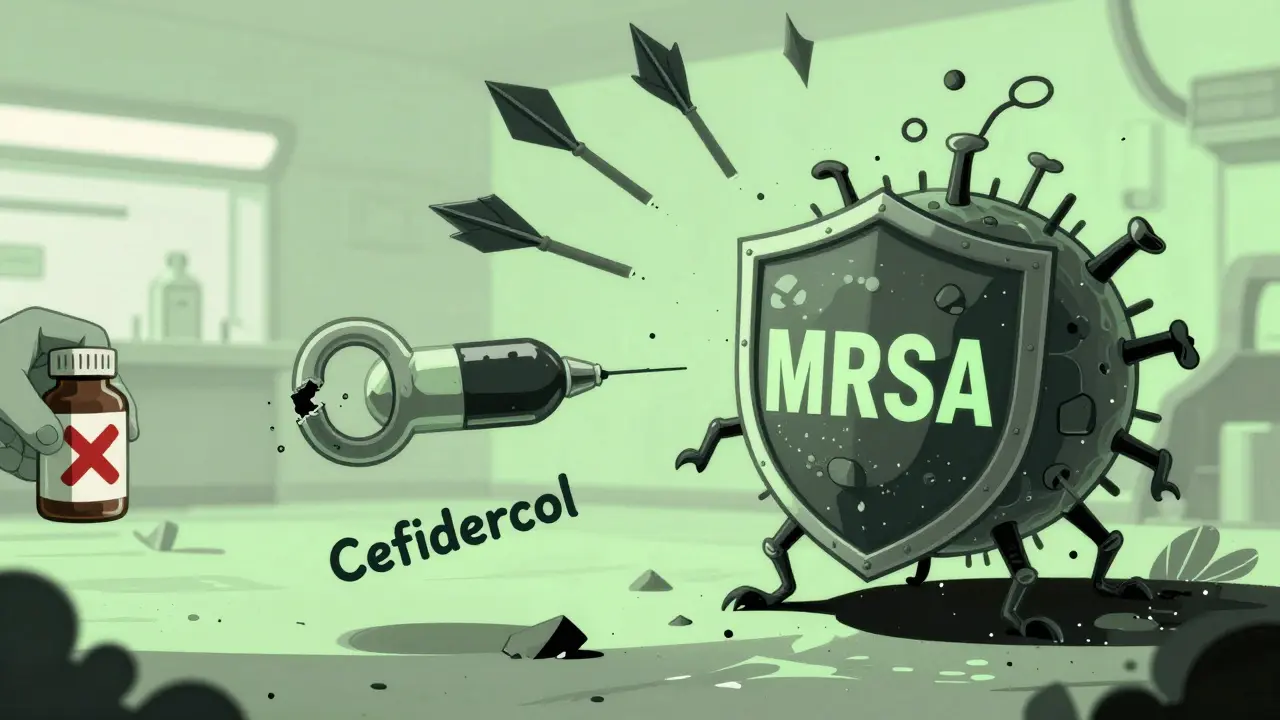
There’s also new hope. Scientists are developing antibiotics that use clever tricks - like cefiderocol, which hijacks bacteria’s own iron-uptake system to get inside. Phage therapy - using viruses that attack bacteria - is being tested in clinical trials. But these are still in early stages.
The truth is, we’re running out of options. The last new class of antibiotics approved for widespread use was over 30 years ago. Today, only 42 new antibiotics are in development globally - and only 16 target the most dangerous superbugs. Without better funding, smarter use, and global cooperation, we could return to a time when a small infection kills.
What’s on the Horizon
Researchers are exploring new paths. One is precision antibiotics - drugs that target only one type of bacteria, leaving the rest of your microbiome alone. That could cut down on C. diff and other side effects.
Another is AI-driven drug discovery. Machines are scanning millions of compounds to find ones that kill resistant bacteria. In 2023, a new antibiotic called halicin was discovered this way - and it worked against several drug-resistant strains.
Some countries are trying new payment models. The UK launched a “Netflix-style” plan: pay a flat fee for access to new antibiotics, no matter how many are used. That way, companies aren’t punished for making antibiotics that are only used as last resorts.
But none of this matters if we keep using antibiotics like they’re candy. The science is advancing - but only if we change how we use them.
Can antibiotics treat viral infections like the flu or cold?
No. Antibiotics only work on bacteria. Colds, flu, most sore throats, and bronchitis are caused by viruses. Taking antibiotics for these won’t help you feel better faster, and it increases your risk of side effects and antibiotic resistance. Doctors use tests like procalcitonin to tell if an infection is bacterial before prescribing antibiotics.
Why do some antibiotics cause diarrhea?
Antibiotics kill both bad and good bacteria in your gut. When the balance is upset, harmful bacteria like C. diff can overgrow and cause severe diarrhea. This is especially common with broad-spectrum antibiotics like clindamycin or fluoroquinolones. Narrow-spectrum antibiotics that target only one type of bacteria are less likely to cause this.
Are natural remedies like honey or garlic as effective as antibiotics?
Some natural substances, like honey, have mild antibacterial properties and can help with wound healing. Garlic contains compounds that may slow bacterial growth in lab settings. But none have been proven to reliably treat serious bacterial infections like pneumonia, sepsis, or meningitis. Relying on them instead of antibiotics can be dangerous. Antibiotics are rigorously tested, dosed precisely, and regulated for safety and effectiveness.
How long does it take for antibiotics to start working?
You might start feeling better in 24 to 48 hours, especially for common infections like strep throat or a urinary tract infection. But feeling better doesn’t mean the infection is gone. Bacteria can still be present. That’s why it’s critical to finish the full course - even if symptoms disappear. Stopping early lets surviving bacteria multiply and become resistant.
What happens if I miss a dose of my antibiotic?
If you miss a dose, take it as soon as you remember - unless it’s almost time for the next one. Don’t double up to make up for it. Missing doses lowers the drug’s concentration in your body, which lets bacteria survive and adapt. For some antibiotics, like penicillin, timing matters a lot - they need to be taken every 6-8 hours to stay effective. Always check the label or ask your pharmacist.
Can I drink alcohol while taking antibiotics?
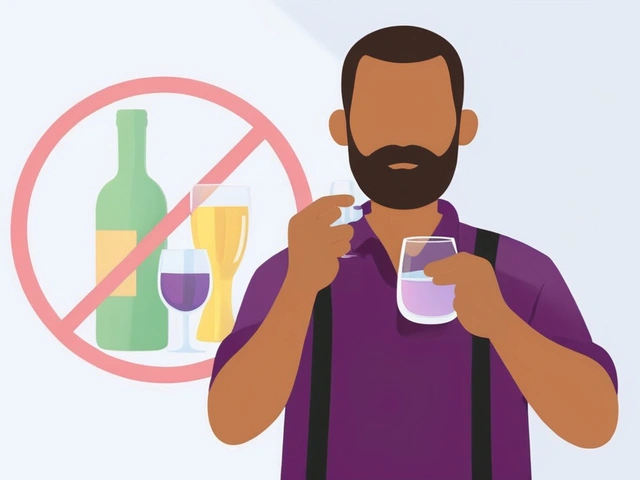
For most antibiotics, moderate alcohol is safe. But with metronidazole, tinidazole, and some others, alcohol causes a dangerous reaction - nausea, vomiting, fast heartbeat, and flushing. With others like linezolid, alcohol can raise blood pressure. Even if it’s not dangerous, alcohol can weaken your immune system and slow recovery. When in doubt, avoid alcohol until you finish the course.
Final Thoughts
Antibiotics are powerful tools - but they’re not magic. They work best when used correctly, for the right infections, and only when needed. Understanding how they work helps you ask better questions, follow treatment more closely, and protect their effectiveness for the future. Every time you use an antibiotic wisely, you’re helping preserve it for someone else - maybe even your child.

Elizabeth Ganak
December 26, 2025 at 15:31I love how this breaks it down so simply. I used to think all antibiotics were the same until I got a UTI and my doc switched me from amoxicillin to nitrofurantoin. Made me realize how smart dosing actually is.
Also, never knew about the alcohol-metronidazole thing. Learned the hard way. Oof.
Nicola George
December 27, 2025 at 20:19So let me get this straight - we’re still using 1940s-era drugs to fight 2020s superbugs, and the solution is to... take them less? Brilliant. The pharmaceutical industry is just waiting for us to collapse into a pre-antibiotic dark age so they can sell us the next miracle pill. Again.
Raushan Richardson
December 28, 2025 at 09:28This is the kind of post that makes me want to share it with my whole family. My mom still asks for antibiotics for her colds, and my brother took leftover cipro for a rash last year. 😳
Let’s all be smarter. Antibiotics aren’t candy. They’re precision tools. Use them right or we’re all screwed.
Robyn Hays
December 29, 2025 at 12:22The part about phage therapy gave me chills. Imagine viruses - the things we’ve spent a century trying to eradicate - becoming our allies against bacterial monsters. It’s poetic. Like nature’s own SWAT team, evolved over billions of years, finally getting its moment in the spotlight.
And AI discovering halicin? That’s not science fiction. That’s the future knocking. We just have to stop treating antibiotics like toilet paper.
Liz Tanner
December 29, 2025 at 20:18I appreciate how this doesn’t sugarcoat anything. The fact that 30% of outpatient prescriptions are unnecessary is criminal. And yet, patients ask for them. Doctors give them. Everyone’s just trying to feel better fast.
But we’re paying for it - in resistant infections, longer hospital stays, and kids who can’t get penicillin because it’s useless now. It’s a slow-motion crisis, and we’re all complicit.
Babe Addict
December 31, 2025 at 05:06You’re all missing the real issue. The FDA’s black box warnings are overblown. Fluoroquinolones have been around for decades. Tendon rupture? Rare. Nerve damage? Usually pre-existing conditions. The real problem is that we’ve turned antibiotics into a moral panic instead of a clinical tool.
Also, 'superbugs' is a media term. Bacteria don’t care about your fear. They evolve. Deal with it.
Satyakki Bhattacharjee
January 2, 2026 at 04:08God gave us antibiotics to save life. But now people use them like toys. This is not just medical ignorance - this is spiritual decay. When you take medicine you don’t need, you disrespect the gift of health. And you invite chaos.
Kishor Raibole
January 2, 2026 at 19:23It is, indeed, a matter of profound historical irony that the very agents designed to preserve human life are now, through anthropogenic misapplication, precipitating a return to the pre-modern epidemiological paradigm. The erosion of therapeutic efficacy, precipitated by non-adherence and agricultural overuse, constitutes not merely a clinical failure, but a civilizational regression.
John Barron
January 4, 2026 at 16:09I’ve been reading about this for 12 years. I’ve got a spreadsheet. I’ve got the CDC reports. I’ve got the Lancet meta-analyses. And let me tell you - nobody gets it. Not even the doctors.
Also, I take cipro and drink whiskey. No problems. 🍸💀
Also also, my dog got amoxicillin for a paw infection. He’s fine. So why are we freaking out?
Liz MENDOZA
January 5, 2026 at 05:11This post saved me. My sister had a bad UTI last year and stopped her antibiotics after 3 days because she 'felt fine.' She ended up in the ER with a kidney infection. I shared this with her. She cried. Then she started taking her meds again.
Thank you for writing this. Not everyone gets how high the stakes are.
Nikki Thames
January 7, 2026 at 03:22While I appreciate the comprehensive overview, I must emphasize that the underlying assumption - that human behavior can be corrected through information dissemination alone - is fundamentally flawed. The biological imperative of bacterial evolution is not countered by moral exhortations or educational pamphlets. The systemic failure lies in the economic architecture of pharmaceutical innovation, wherein profit motives are misaligned with public health imperatives. Until we restructure the incentive model - perhaps through public funding of antibiotic R&D, or mandatory global stewardship protocols - we are merely rearranging deck chairs on the Titanic. The microbiome does not negotiate. It adapts. And it will outlast us all.