
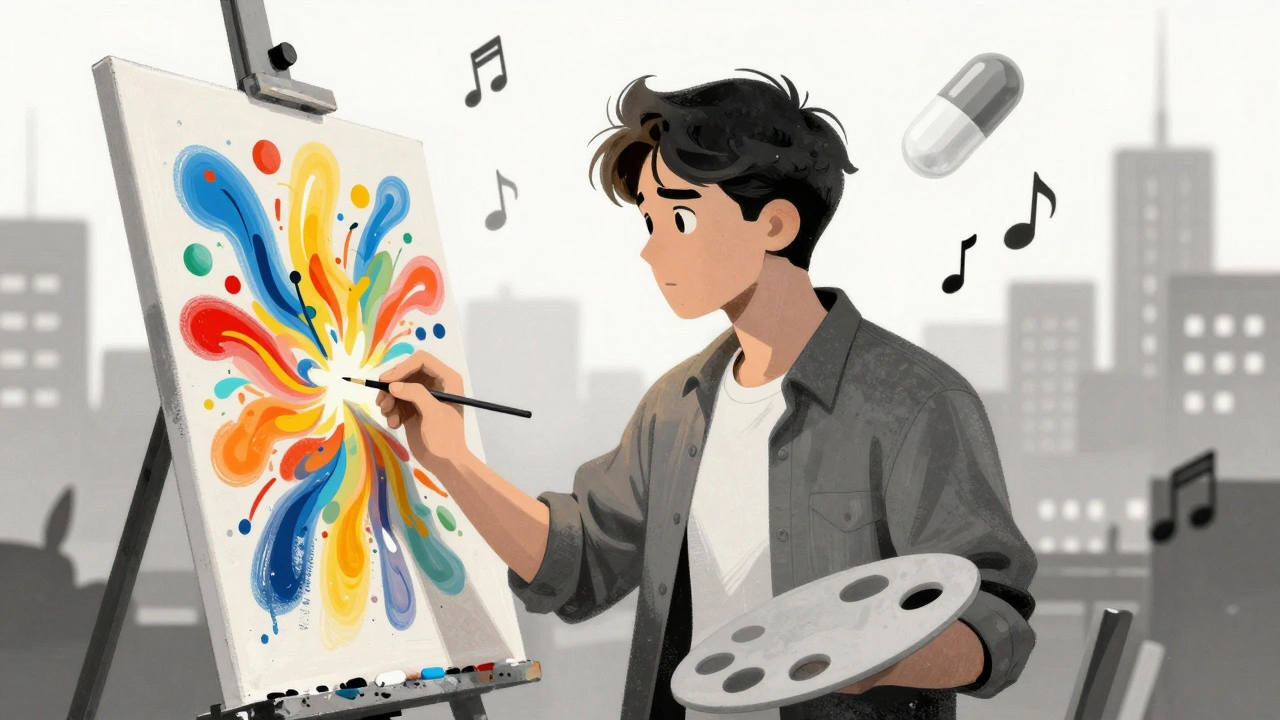
When people hear the word risperidone, they usually think of schizophrenia, bipolar disorder, or irritability in autism. But there’s another side to it-one that rarely gets talked about in clinics or drug leaflets. What happens to creativity when someone takes risperidone? Can a medication that quiets hallucinations also quiet the voice inside that paints, writes, or composes?
Artists and writers on risperidone often report the same thing: their mind feels clearer, but something essential has dimmed. One painter from Melbourne, who asked to remain anonymous, described it like this: "Before risperidone, I saw colors in the air. After, everything was sharp-but flat. Like watching a movie in black and white, even when the world was full of color."
How Risperidone Works in the Brain
Risperidone is an atypical antipsychotic. It blocks dopamine D2 receptors and serotonin 5-HT2A receptors. Dopamine isn’t just about movement or motivation-it’s tied to pattern recognition, novelty-seeking, and the brain’s ability to make unexpected connections. That’s the same circuitry that fuels creativity.
People with psychosis often have too much dopamine activity in certain brain areas. Risperidone brings that down. But in healthy brains, or even in creative minds with mild symptoms, that same dopamine drop can dull the spark that links unrelated ideas. A poet might stop seeing metaphors in rain on windows. A musician might lose the urge to experiment with dissonance. The brain becomes less chaotic-and less imaginative.
Clinical Studies: Creativity Isn’t Just a Feeling
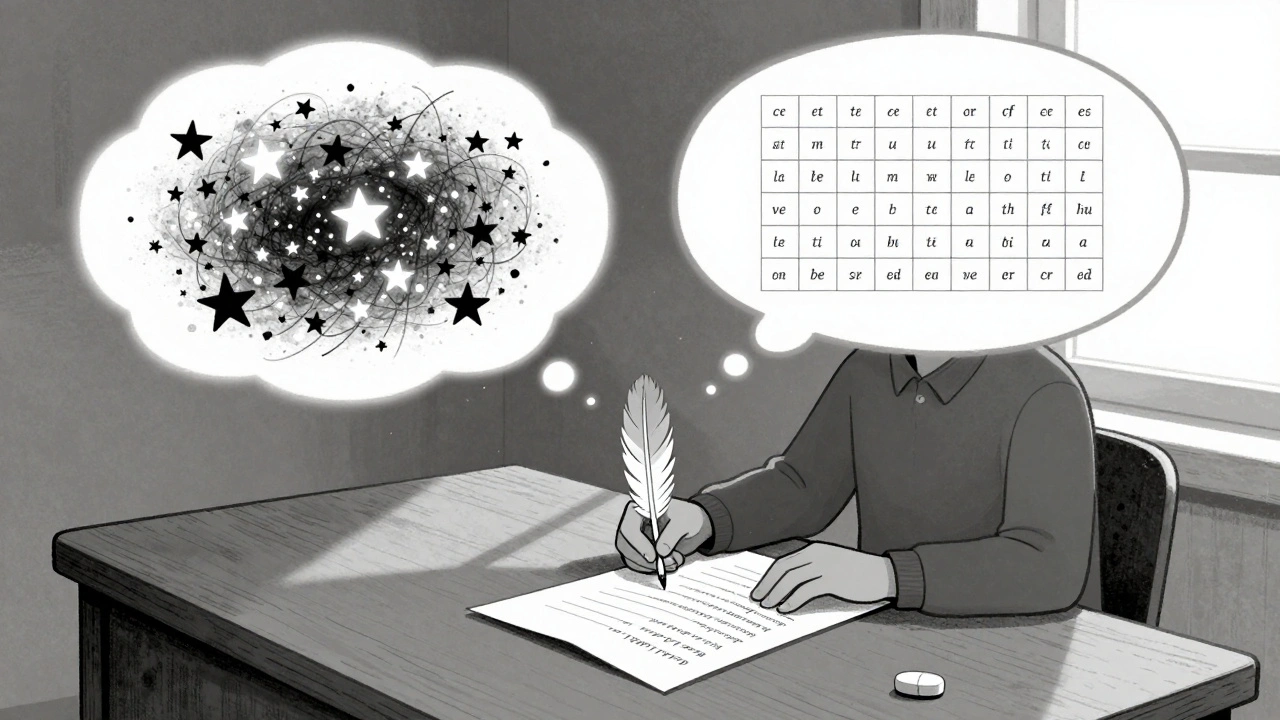
A 2022 study in the Journal of Psychopharmacology tracked 47 artists and writers diagnosed with schizophrenia or schizoaffective disorder over 18 months. Half were on risperidone; half weren’t. Those on risperidone showed a 34% drop in originality scores on standardized creativity tests. Their work became more technically accurate but less surprising. One participant, a poet, wrote 12 poems before starting risperidone. In the first year after starting it, she wrote two. Both were well-structured. Neither had a single line that made anyone pause and think, "I’ve never heard that before."
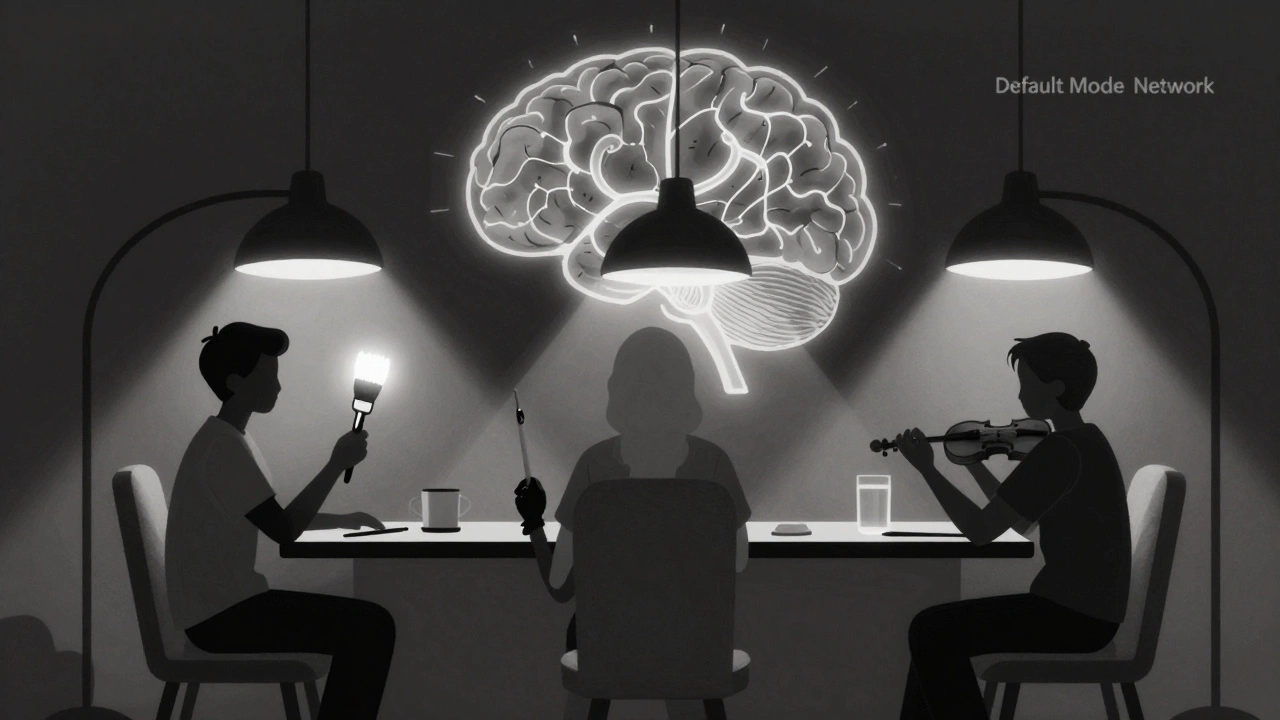
Another study from the University of Toronto, published in 2023, used fMRI scans to compare brain activity in creative tasks. People on risperidone showed reduced activation in the default mode network-the part of the brain that activates during daydreaming, free association, and self-referential thought. These are the mental spaces where new ideas are born.
It’s Not Just About the Drug-It’s About the Experience
Not everyone loses creativity on risperidone. Some say they finally feel well enough to create again. A composer in Sydney told me, "I was too sick to hold a pen for five years. Now I write music every morning. I don’t hear voices anymore. That’s worth losing a few wild ideas."
For some, the trade-off is clear: silence over chaos. But for others, the silence feels like erasure. The difference often comes down to dosage, timing, and whether the person was already creative before the illness took hold.
Those who were artists before psychosis often mourn the loss. Those who became creative after treatment say they found a new kind of expression-one that’s calmer, more controlled, and sometimes more accessible to others.
The Role of Other Medications
Risperidone isn’t the only antipsychotic out there. Olanzapine, quetiapine, and aripiprazole work differently. Aripiprazole, for example, is a partial dopamine agonist-it doesn’t fully block dopamine, it modulates it. Some artists report fewer creative side effects with aripiprazole than with risperidone.
A 2024 review in Psychiatric Services compared 120 patients on different antipsychotics. Those on aripiprazole were 2.3 times more likely to report maintaining their creative output than those on risperidone. The difference wasn’t huge, but it was consistent. It suggests that not all antipsychotics crush creativity the same way.
What Artists Say About Finding Balance
Some people adjust their medication to protect their art. They might lower the dose during creative periods, then increase it when symptoms flare. Others work with psychiatrists who understand art as part of recovery-not just a symptom to manage.
One painter in Adelaide told her doctor she was losing her ability to mix colors the way she used to. Her doctor didn’t push back. They tried switching her to a lower dose of risperidone and adding cognitive behavioral therapy. Within three months, she was painting again. Her work changed-less surreal, more grounded-but it still moved people.
There’s no universal answer. What works for one person can break another. The key is having a conversation-not just about symptoms, but about identity.
When Creativity Returns After Stopping
Some people stop risperidone because they feel their creativity is gone. Not everyone should. Stopping abruptly can trigger relapse. But for those who do, recovery isn’t guaranteed.
One writer from Brisbane stopped risperidone after two years. He didn’t go back to his old style. The wild, fragmented poetry he wrote before illness? It never came back. Instead, he wrote essays-clear, logical, deeply personal. He called it "the writing of a healed mind."
That’s the quiet truth: creativity doesn’t always return the same way. Sometimes it transforms. Sometimes it leaves. Sometimes, it finds a new voice.
What You Can Do If You’re on Risperidone and You’re an Artist
- Track your creative output. Keep a journal. Note when you feel inspired-or blocked.
- Don’t assume the drug is the only cause. Sleep, stress, and isolation also affect creativity.
- Ask your psychiatrist about alternatives. Mention creativity as a treatment goal, not just a side effect.
- Consider therapy that supports identity, not just symptom control. Art therapy, narrative therapy, or mindfulness can help you reconnect with your voice.
- Join a community. There are online groups for artists on psychiatric meds. You’re not alone.
Medication doesn’t erase your soul. But it can reshape how your soul speaks. The goal isn’t to be perfectly normal. It’s to be whole enough to create-on your own terms.
Does risperidone always kill creativity?
No. Some people feel more able to create after starting risperidone because their symptoms are under control. Others experience a reduction in spontaneous, wild ideas. The effect varies by person, dosage, and whether creativity existed before treatment.
Can I lower my risperidone dose to get my creativity back?
Only under medical supervision. Lowering your dose without guidance can lead to relapse, hospitalization, or worsening symptoms. Talk to your psychiatrist about adjusting your treatment plan-some people find a balance where symptoms stay managed and creativity returns.
Are there antipsychotics that don’t affect creativity as much?
Yes. Aripiprazole and clozapine tend to have less impact on creativity compared to risperidone, according to clinical studies. But they come with their own risks and side effects. The choice depends on your symptoms, medical history, and how your body responds.
Is losing creativity a sign the medication isn’t working?
Not necessarily. Creativity loss is a side effect, not a sign of treatment failure. If your psychosis is under control but you feel creatively empty, that’s still a valid concern. It means your treatment needs to be more personalized-not that it’s broken.
Should I stop taking risperidone if I want to be creative again?
No. Stopping without medical support can be dangerous. Many people find ways to live well on medication while preserving their art. Work with a doctor who understands your creative goals. There are options beyond quitting.
If you’re on risperidone and you’re an artist, writer, or musician-your creativity matters. It’s not a luxury. It’s part of who you are. The right treatment shouldn’t force you to choose between sanity and expression. It should help you find both.

Sean McCarthy
December 1, 2025 at 06:09Risperidone kills creativity like a bad Wi-Fi signal kills your streaming. You get stability but no flow. Simple as that.
Kshitij Shah
December 3, 2025 at 01:29Bro in India we call this the 'Bollywood vs. Netflix' dilemma. Before meds, your mind was a chaotic Bollywood musical. After? Clean Netflix documentary with subtitles you didn’t ask for. Still better than screaming at the moon though.
Dennis Jesuyon Balogun
December 4, 2025 at 04:16The neurochemical hegemony of dopamine suppression is a profound ontological rupture in the phenomenology of aesthetic production. Risperidone, as a D2/5-HT2A antagonist, induces a top-down regulatory cascade that dampens the default mode network’s stochastic resonance-thereby suppressing the emergent properties of divergent thought necessary for transgressive artistic expression. This is not side effect. This is epistemic violence disguised as treatment.
Grant Hurley
December 4, 2025 at 19:12my bro took risperidone and stopped drawing for a year. then he started sketching again but now its all like... calm trees and birds. no demons or fire. he says its better. i dont know. i miss the fire. but he seems happier. so idk man.
Lucinda Bresnehan
December 5, 2025 at 16:50as someone who's been on antipsychotics for 12 years, i can say this: creativity doesn't vanish, it transforms. i used to write poems full of blood and thunder. now i write haikus about morning coffee and the way light hits the cat. it's quieter, but it's mine. and that's enough. also, typo: 'artisit' in the article, just fyi lol.
Shannon Gabrielle
December 6, 2025 at 01:21Oh wow so now we’re treating creativity like it’s a fucking right? Next they’ll sue Big Pharma for stealing your muse. Get a job. Get stable. Your ‘wild ideas’ were just bad decisions with glitter on them.
ANN JACOBS
December 6, 2025 at 11:42It is of paramount importance to recognize that the neurological recalibration induced by atypical antipsychotic agents such as risperidone does not equate to the eradication of intrinsic human potential; rather, it facilitates a reorientation of expressive modalities toward a more sustainable, cognitively integrated paradigm of artistic output. The individual who once experienced hallucinatory synesthesia may now channel their aesthetic sensibility into disciplined, coherent, and profoundly resonant forms of representation-forms that, while less chaotic, are often more universally accessible and emotionally durable. One must not mourn the loss of turbulence, but rather celebrate the emergence of equilibrium.
Nnaemeka Kingsley
December 8, 2025 at 04:33my cousin on risperidone said he felt like his brain was cleaned out. no more voices, but also no more random ideas. he started writing short stories about his dog. they’re sweet. but he misses the weird stuff. i told him maybe he can write the weird stuff later, when he’s ready. not all art has to be loud to matter.
Linda Migdal
December 8, 2025 at 04:58Of course creativity takes a hit. America doesn’t need more unstable artists. We need stable citizens who pay taxes and don’t scream at pigeons. If you want to paint, go to community college. Not everyone gets to be a tortured genius.
Tommy Walton
December 8, 2025 at 23:31Art isn’t a side effect. It’s a soul signature. 🌌✨ Risperidone doesn’t kill creativity-it just makes you ask: "Is this still me?" And that’s the real masterpiece.