
Rifampin Birth Control Interaction Checker
Is your antibiotic affecting birth control?
Rifampin is the ONLY antibiotic proven to significantly reduce hormonal birth control effectiveness. Check your medication below.
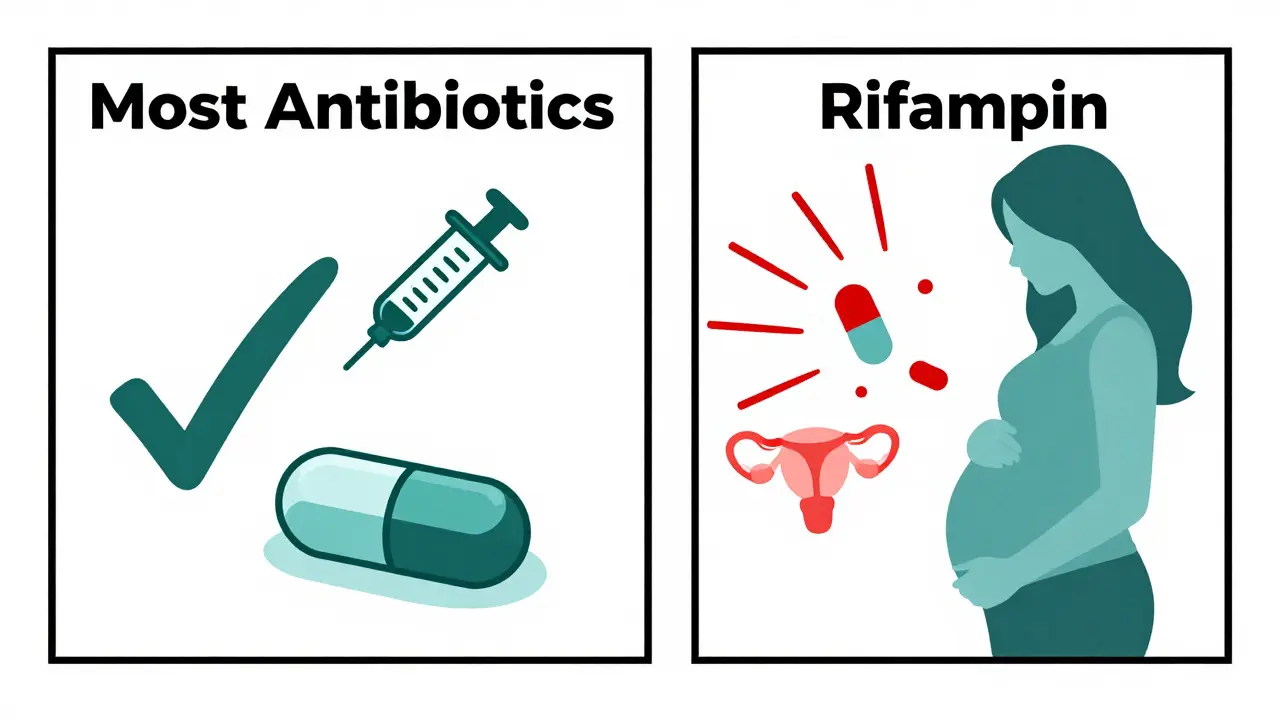
Most people assume that if an antibiotic messes with birth control, it’s probably all of them. But here’s the truth: rifampin is the only antibiotic with solid, proven evidence of making hormonal birth control fail. Not penicillin. Not azithromycin. Not even tetracycline. Just rifampin.
Why Rifampin Is Different
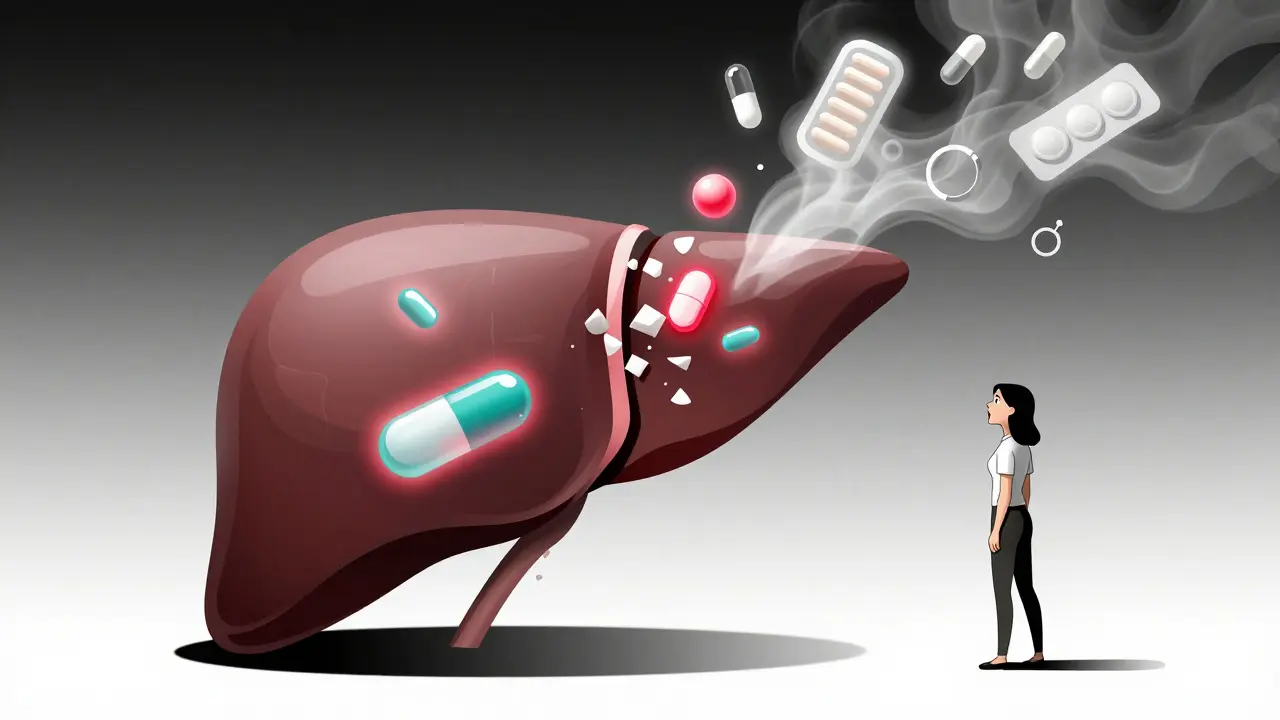
Rifampin is an antibiotic used mainly to treat tuberculosis and some staph infections. It’s powerful, but it doesn’t just kill bacteria-it rewires your liver. Specifically, it turns on enzymes called CYP3A4 that break down hormones faster than normal. That includes estrogen and progestin, the two key ingredients in most birth control pills, patches, and rings.When these hormones get broken down too quickly, your body never reaches the level needed to stop ovulation. The result? You could get pregnant even if you’ve been taking your pill every day without missing one.
Studies show rifampin can slash estrogen levels by up to 67% and progestin by over 50%. In one study, half the women taking rifampin started ovulating again-even while on birth control. That’s not a small risk. That’s a major one.
How Long Does the Risk Last?
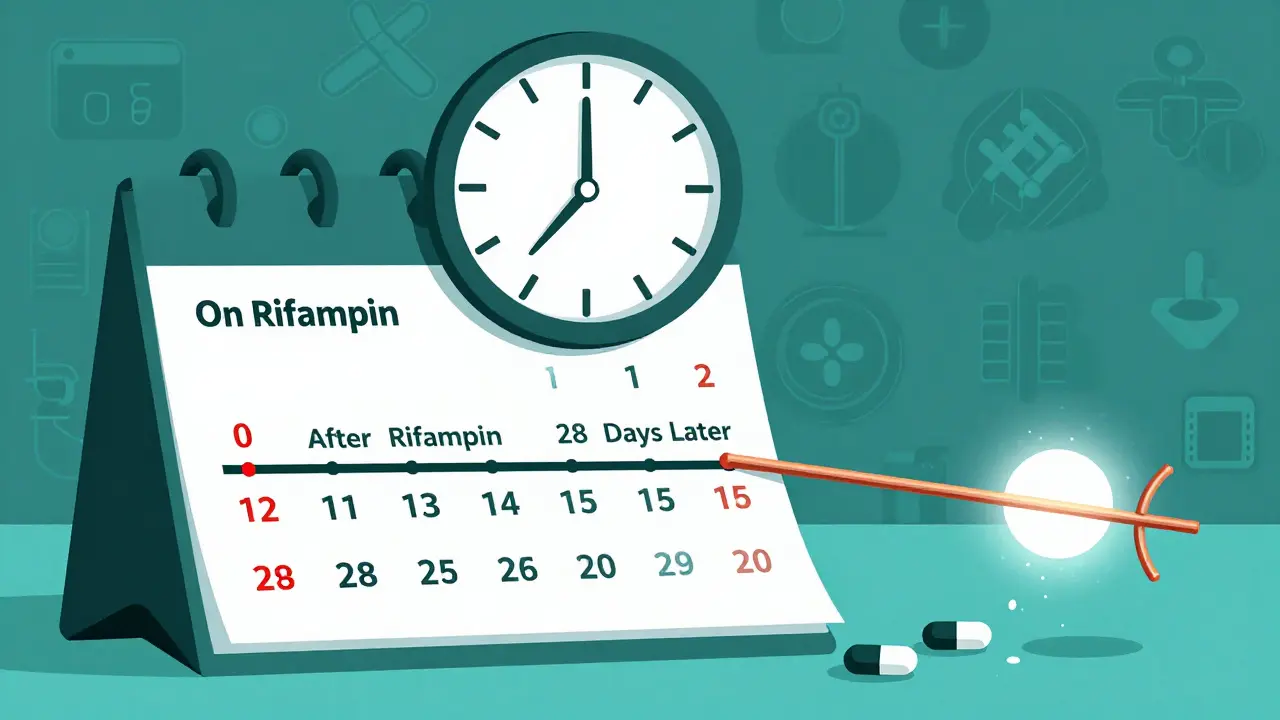
You might think: “I’m only on rifampin for two weeks. I’ll just skip the pill during that time.” But the danger doesn’t disappear when you stop taking it.Rifampin keeps your liver enzymes revved up for weeks after your last dose. That means your birth control stays ineffective for at least 28 days after you finish the antibiotic. The drug itself leaves your system in hours, but the enzyme surge sticks around. That’s why guidelines say: use backup contraception for the entire time you’re on rifampin and for a full month after.
Missing that window is how many unintended pregnancies happen. Women think they’re safe once the antibiotic is done. They’re not.
What About Other Antibiotics?
Let’s clear up a big myth: most antibiotics don’t affect birth control. Not even close.For years, doctors warned patients about penicillin, tetracycline, and erythromycin because of scattered case reports. But when researchers looked at real data-actual hormone levels, ovulation tests, pregnancy outcomes-none of those antibiotics showed any real impact. A 2018 review of over 50 studies found no evidence that common antibiotics interfere with hormonal birth control.
The only other antibiotic with any kind of interaction is rifabutin, a cousin of rifampin used for certain immune-compromised patients. It’s weaker, though. It cuts hormone levels by about 20-30%, not 50-60%. Some doctors still recommend backup contraception with rifabutin, but the risk is far lower.
So if you’re on amoxicillin for a sinus infection or doxycycline for acne? You’re fine. No need to switch to condoms. Just keep taking your pill.
What Should You Do If You’re Prescribed Rifampin?
If you’re on rifampin and using hormonal birth control, here’s what you need to do right now:- Stop relying on the pill, patch, or ring as your only method.
- Use a non-hormonal backup method for the entire time you’re on rifampin and for 28 days after your last dose.
- Best options: copper IUD or condoms. The copper IUD is the gold standard-it’s 99% effective, lasts for years, and isn’t affected by any drug.
- If you don’t want an IUD, use condoms every time you have sex. No exceptions.
Don’t switch to another hormonal method like the shot or implant unless you talk to your doctor first. Some newer implants (like Nexplanon) may hold up better, but we don’t have enough data yet to say they’re safe with rifampin. Play it safe.
Why Do So Many Doctors Get This Wrong?
A 2017 survey found that only 42% of primary care doctors consistently warn patients about rifampin’s interaction with birth control. Almost a third told patients to use backup contraception for all antibiotics.That’s not just misinformation-it’s dangerous. It makes people think all antibiotics are risky, so they stop trusting their birth control entirely. Others don’t get warned at all and end up pregnant.
The problem isn’t lack of evidence. It’s lack of communication. The American College of Obstetricians and Gynecologists (ACOG) and the CDC have clear guidelines: rifampin = category 4 (unacceptable risk) with combined hormonal contraceptives. But those guidelines aren’t reaching every patient.
What If You’re Already Pregnant on Rifampin?
If you find out you’re pregnant while taking rifampin, don’t panic. There’s no evidence that rifampin causes birth defects. The real concern is whether you were getting proper TB treatment during early pregnancy. Untreated tuberculosis is far more dangerous to a fetus than rifampin.Call your doctor right away. You’ll need to continue TB treatment-rifampin is still the best option for most cases. Your provider will monitor you closely and may switch your birth control plan for future pregnancies.
What’s New in 2025?
Researchers are working on shorter TB treatments that avoid rifampin altogether. One promising trial tested a 4-month combo of rifapentine and moxifloxacin. Results are expected soon. If it works, fewer women will face this dilemma.Also, newer hormonal implants like Nexplanon are being studied more closely. A 2023 study of 47 women using Nexplanon while on rifampin showed no pregnancies. That’s encouraging, but the sample was small. Until more data comes in, experts still recommend non-hormonal backup.
The FDA and EMA now require all new birth control products to be tested against rifampin before approval. That’s good. But it doesn’t help women already on older pills.
Bottom Line
Rifampin is the only antibiotic that reliably breaks birth control. If you’re taking it, your pill won’t protect you. Not even close. The risk isn’t theoretical-it’s documented in real pregnancies, real cases, and real studies.Use a copper IUD or condoms. For the full 28 days after your last dose. Don’t guess. Don’t assume. Don’t rely on myths about other antibiotics.
This isn’t about being overly cautious. It’s about knowing exactly what works-and what doesn’t. And when it comes to birth control and rifampin, the only safe choice is a backup that doesn’t depend on your liver’s chemistry.

Josh josh
January 26, 2026 at 03:21so like... if you're on amoxicillin for a sinus infection just keep taking your pill lmao
bella nash
January 27, 2026 at 08:44The pharmacokinetic implications of CYP3A4 induction by rifampin represent a clinically significant pharmacodynamic alteration in hormonal contraceptive efficacy, necessitating non-hormonal contraceptive modalities during and following exposure.
SWAPNIL SIDAM
January 27, 2026 at 19:35bro this is life or death info. i told my sister and she cried. thank you for writing this
Conor Flannelly
January 28, 2026 at 20:58It's fascinating how a single enzyme cascade can unravel the entire architecture of reproductive autonomy. The liver doesn't care about your birth control plan-it just metabolizes. We treat medicine like it's a switch, but biology is a tide. And rifampin? It's the moon pulling the ocean. We built systems on the assumption that hormones would stay put. They don't. They never did. The pill was always a compromise. Rifampin just exposes the fracture. And yet, we still blame the user when it fails. Not the system. Not the drug. Always the woman.
Geoff Miskinis
January 29, 2026 at 09:22Ah yes, the classic ‘rational woman’ narrative-blaming the patient for not reading the 47-page FDA insert. Meanwhile, her GP told her ‘all antibiotics mess with birth control’ because they’re too lazy to update their 2008 handout. This isn’t patient ignorance. It’s systemic negligence dressed up as caution.
Sally Dalton
January 31, 2026 at 06:22i had no idea about the 28 day thing 😭 i thought once i finished the antibiotics i was fine... i'm so glad i read this before my next rx. also copper iud sounds like a dream. anyone have a good doc who puts them in??
Betty Bomber
February 1, 2026 at 11:11i took rifampin for like 3 weeks and didn't think twice. i'm lucky i didn't get pregnant tbh. this is wild
Mohammed Rizvi
February 2, 2026 at 21:08so let me get this straight - the only antibiotic that breaks birth control is the one that also cures TB? and the one we barely ever prescribe? so basically the risk is real but like... you're probably not gonna need this info unless you're in a TB ward or have a weird staph infection? still good to know but also kinda niche lol
Renia Pyles
February 3, 2026 at 19:55so you're telling me the entire medical community has been lying to women for decades about antibiotics? and now you're acting like you're the hero who finally told the truth? where were you when my friend got pregnant on penicillin in 2015? this is performative education.
Nicholas Miter
February 4, 2026 at 07:15i work in pharmacy and i can tell you most people don't even know rifampin is an antibiotic. they think it's a TB pill. the label doesn't say 'this will wreck your birth control' so yeah, people miss it. also side note: if you're on rifampin and your doc doesn't mention birth control, ask. don't wait.
Conor Murphy
February 4, 2026 at 19:11this made me think about how much we rely on our bodies to be predictable. like... we take a pill every day and assume it’s working. but our liver? it’s got its own agenda. and when you add a drug like rifampin? it’s like inviting a demolition crew into your hormonal mansion. no wonder so many women feel betrayed when it fails. it’s not their fault. it’s just biology being weird.
Marian Gilan
February 6, 2026 at 02:29sooo... is this all just a pharma scam? i mean who benefits from making women use condoms or iuds? big pharma. they make more money off condoms and iuds than pills. and why is rifampin the only one? because they tested the others and found nothing... or did they just not want to admit it? 🤔
Patrick Merrell
February 7, 2026 at 08:06I've been taking the pill for 8 years and never missed a day. I got pregnant on amoxicillin. The doctor said it was impossible. I said 'prove it.' I still don't trust medicine.
Conor Flannelly
February 8, 2026 at 15:42You're not alone. The myth that 'all antibiotics interfere' was weaponized to make people feel paranoid - and therefore less likely to question the system. But the truth? The system failed you. Not your body. Not your discipline. The guidelines weren't communicated. The science wasn't taught. And now you're left wondering if your body betrayed you. It didn't. The system did.