

The U.S. Food and Drug Administration doesn’t just approve generic drugs - it ensures they’re as safe and effective as brand-name medicines, every single time. You might think a generic pill is just a cheaper copy. But here’s the truth: if it’s FDA-approved, it has to match the brand-name drug in active ingredient, strength, dosage form, and how your body absorbs it. And the process to get there? It’s far more rigorous than most people realize.
Quality Isn’t Tested at the End - It’s Built In
For decades, drug makers relied on testing finished pills to check quality. But after testing over 4,600 drugs in the 1960s, the FDA found that about 8% of them didn’t deliver the right dose - too much or too little. That wasn’t just a flaw. It was a public health risk.
The solution? Stop waiting until the end to check quality. Start building it into every step of manufacturing. That’s where Current Good Manufacturing Practices, or cGMP, came in. These aren’t suggestions. They’re federal law under Title 21 of the Code of Federal Regulations. And they apply to every single generic drug made for the U.S. market - whether it’s made in Indiana or India.
The Five Pillars of FDA’s Quality System
There are five non-negotiable parts of cGMP that every generic drug manufacturer must follow - and the FDA checks them all.
- Control of Materials: Every raw ingredient, from the active drug to the dye in the pill coating, must be tested, tracked, and stored properly. If a supplier changes, the FDA needs to know. If a batch of powder is stored in a damp warehouse, that batch gets rejected.
- Production and Process Controls: Every step - mixing, granulating, compressing, coating - has a written procedure. Machines are calibrated. Temperatures are monitored. If a parameter goes out of range, the line stops. No exceptions.
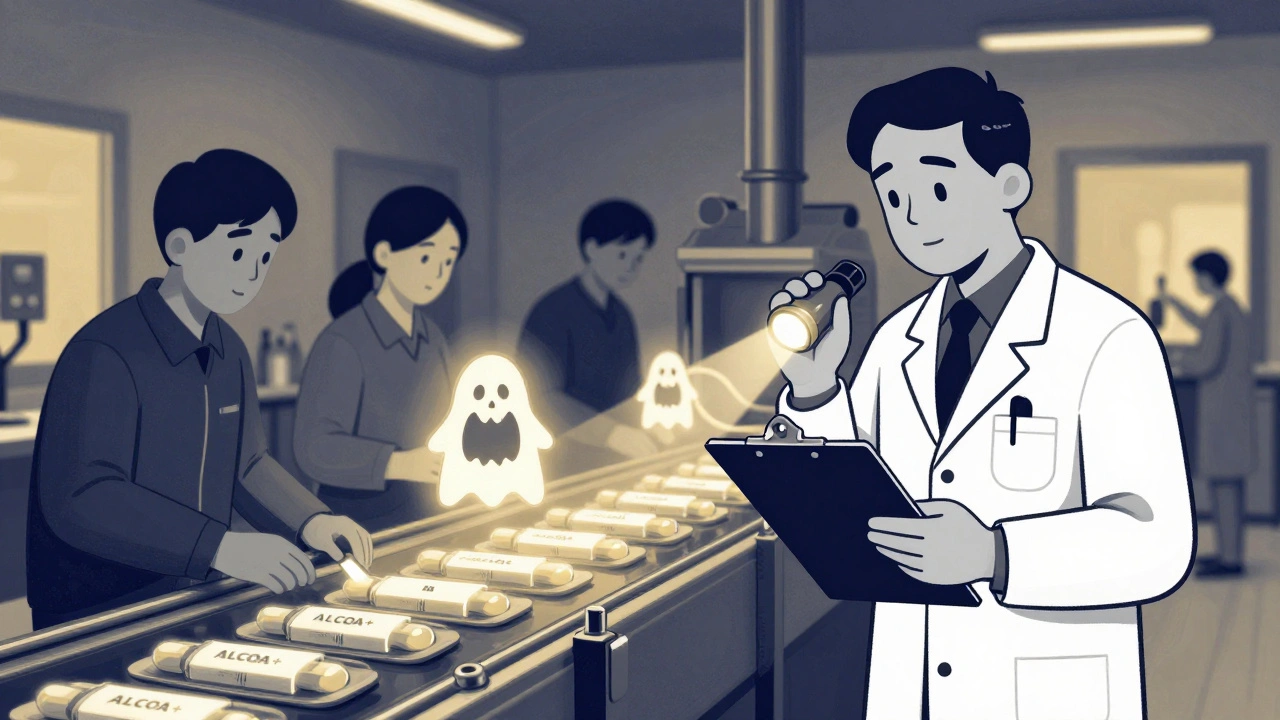
- Quality Control and Laboratory Testing: Every batch is tested for identity, strength, purity, and dissolution. The FDA requires testing methods to be validated and records to follow ALCOA+ standards: Attributable, Legible, Contemporaneous, Original, Accurate, Complete, Consistent, Enduring, and Available. That means no back-dated logs, no erased data, no guessing.
- Packaging and Labeling: A pill labeled as 50mg can’t be 45mg or 55mg. Labels must match the drug exactly - no typos, no missing warnings. The FDA inspects packaging lines to make sure the right bottle goes with the right label.
- Documentation and Record Keeping: Everything is written down. And kept for years. Not just for audits - so if a problem shows up years later, the FDA can trace it back to the exact batch, shift, and operator.
Unannounced Inspections - No Warning, No Exceptions
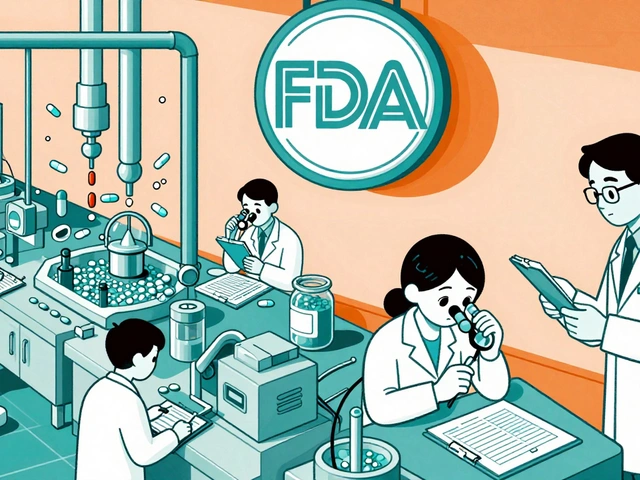
The FDA doesn’t call ahead. Not ever. Inspectors show up at manufacturing sites - 1,200 times a year - with no notice. They can stay for days, even weeks, if they need to. They review records, watch operations, interview staff, and take samples. Their goal? To see if quality is built into the process - not just reported on paper.
Foreign facilities? They’re inspected just as often as U.S. ones. In 2022, 17% of foreign sites had cGMP violations compared to 8% of domestic sites. But the FDA doesn’t let geography excuse poor quality. If a plant fails, the FDA can block imports - even if the drug is already on shelves.
Three Batches, One Rule
When a company applies to make a generic drug, they don’t just submit one batch. They submit three. One for the middle strength. One for the lowest. One for the highest. All three come from the same production line. Why? To prove that the process works consistently across all doses - not just one.
That’s not standard practice in every country. In the U.S., it’s mandatory. And it’s one reason why generic drugs in America are more reliable than in many other places.
Real-World Impact: How This Keeps You Safe
Over 90% of prescriptions filled in the U.S. are for generic drugs. That’s 6.8 billion pills a year. And they cost 80-85% less than brand names. But cost savings shouldn’t mean quality loss.
During the pandemic, when supply chains broke down, the FDA’s Office of Manufacturing Quality stepped in. They reviewed manufacturing changes in real time - like switching suppliers or adjusting equipment - to prevent shortages of critical drugs like antibiotics and heart medications. That proactive approach kept life-saving drugs on the shelves.
And the data backs it up: 98-99% of generic drugs are therapeutically equivalent to their brand-name counterparts. That’s not luck. It’s the result of a system designed to catch problems before they reach you.

Challenges and Criticisms
It’s not perfect. Smaller manufacturers say the paperwork alone can take up 30-40% of their development time. One company spent $4 million just to set up a quality system before submitting their first application.
And inspections aren’t always frequent enough. The Government Accountability Office found that resource limits mean some facilities go years between visits. The FDA admits it’s a challenge - but they’re investing $650 million over five years under GDUFA III to hire more inspectors and use remote evaluations.
Some experts worry about over-reliance on self-reported data. But the FDA doesn’t just take manufacturers’ word for it. They test products on the market. In 2022, over 40% of inspection findings were about data integrity - meaning companies tried to hide mistakes. The FDA caught them.
What’s Next? Smarter, Faster, Stronger
The FDA is moving beyond traditional methods. They’re testing continuous manufacturing - where drugs are made in one steady flow instead of in batches. That reduces variability and cuts waste.
They’re also pushing for real-time release testing. Imagine a machine that checks a pill’s quality as it’s made - and only lets it leave the line if it passes. No waiting for lab results. No delays. That’s the future.
By 2025, manufacturers will need to disclose where their active ingredients come from - down to the factory level. No more hidden suppliers. No more blind spots.
These aren’t just upgrades. They’re necessary steps to keep up with global supply chains and growing demand.
Why This Matters to You
You don’t need to understand cGMP to take your medication. But you should know this: the pill in your hand didn’t just pass a test. It survived a gauntlet of controls, inspections, and documentation designed to protect you.
The FDA doesn’t guarantee perfection. But it guarantees that every generic drug on the shelf had to meet the same standard as the brand-name version - and then some. That’s why you can trust your generic prescriptions. Not because they’re cheap. But because they’re built to last - and the FDA won’t let anything less through.
Are generic drugs really as good as brand-name drugs?
Yes. FDA requires generic drugs to have the same active ingredient, strength, dosage form, and route of administration as the brand-name drug. They must also be bioequivalent - meaning your body absorbs them at the same rate and extent. Studies show 98-99% of generics are therapeutically equivalent to their brand-name counterparts.
How often does the FDA inspect generic drug factories?
The FDA conducts about 1,200 inspections annually across roughly 1,700 manufacturing facilities worldwide. Inspections are unannounced, and inspectors can stay for days if needed. Foreign facilities are inspected just as often as U.S. ones.
Why do generic drug manufacturers have to submit three batches for approval?
Submitting three batches - one for each strength (low, medium, high) - proves the manufacturing process is consistent across all doses. It ensures that changing the pill size doesn’t affect how the drug works. This requirement helps prevent quality issues that could happen if only one batch were tested.
What is ALCOA+ and why does it matter?
ALCOA+ stands for Attributable, Legible, Contemporaneous, Original, Accurate, Complete, Consistent, Enduring, and Available. It’s the FDA’s standard for data integrity. Every record - from lab results to machine logs - must meet these criteria. This prevents falsified or lost data, which could hide quality problems. Over 40% of FDA inspection findings in 2022 were about ALCOA+ violations.
Can the FDA stop a generic drug from being sold if there’s a quality issue?
Yes. If the FDA finds serious cGMP violations, it can issue a warning letter, block imports, or even withdraw approval. In extreme cases, the agency can order a recall. The FDA also uses its Drug Quality Reporting System (DQRS) to track adverse events and quality complaints in real time - allowing quick action before patients are harmed.
Do generic drugs cost less because they’re lower quality?
No. Generic drugs cost 80-85% less because manufacturers don’t have to repeat expensive clinical trials. The FDA already confirmed the brand-name drug’s safety and effectiveness. Generic makers only prove their version works the same way - which is far cheaper. But the manufacturing standards are identical.
How long does it take for the FDA to approve a generic drug?
The review process typically takes 12 to 24 months and involves multiple review cycles. Each cycle can last several months. The timeline depends on how complete the application is and whether the FDA has questions or needs more data. The process is slower than in some countries, but it’s designed to catch issues before approval.
Are all generic drug manufacturers held to the same standards?
Yes. Whether it’s a small startup or a giant like Teva or Mylan, every manufacturer must meet the same cGMP standards. The FDA doesn’t give special treatment based on size or reputation. All facilities - domestic or foreign - are subject to the same inspections and requirements.

Katherine Gianelli
December 3, 2025 at 20:15So many people think generic = cheap and therefore sketchy but this is the exact opposite. The FDA doesn’t cut corners - they build walls around quality. I take generics for my blood pressure and anxiety meds and I sleep better knowing someone’s checking every single pill like it’s their own kid’s medicine. No fluff. No shortcuts. Just pure, unrelenting science. 🙌
Rashi Taliyan
December 5, 2025 at 06:17From India to the US - I’ve seen both sides. Our factories here? We make over 40% of all generic drugs for America. And yes, we sweat the details. The FDA doesn’t trust us because we’re Indian - they trust us because we passed their inspection with flying colors. My cousin works at a plant in Gujarat - he says the inspectors sometimes cry when they see how clean and precise our lines are. That’s pride. That’s power.
Kara Bysterbusch
December 5, 2025 at 11:14It’s worth noting that the ALCOA+ framework is not merely bureaucratic - it is a philosophical commitment to epistemic integrity in pharmaceutical manufacturing. The requirement for contemporaneous, attributable, and enduring records transforms raw data into evidentiary truth. This is not just regulatory compliance; it is the institutionalization of scientific accountability. In an era of misinformation, this system is a bulwark against deception. We should celebrate, not scoff, at its rigor.
Rashmin Patel
December 6, 2025 at 00:36Guys, I work in pharma QA in Hyderabad and let me tell you - the pressure is insane. We have 30+ audits a year, every single batch gets tested for dissolution, purity, AND stability. We’ve had to rework entire runs because a humidity sensor was off by 0.5%. But here’s the thing - I’ve seen patients in rural India get their diabetes meds for $0.10 a pill. That’s life-changing. And yeah, the FDA’s system isn’t perfect - but it’s the only one that actually keeps people alive. No cap. 🙏
sagar bhute
December 7, 2025 at 03:17Don’t be fooled. The FDA is a joke. They inspect once every 3-5 years for most foreign plants. They rely on self-reported data. They approve drugs based on paperwork, not real-world performance. And now they want us to believe this is ‘rigorous’? Wake up. If you think your $2 pill is as good as a $100 brand, you’re either naive or brainwashed. This is corporate propaganda dressed up as science.
James Kerr
December 8, 2025 at 14:14My grandma takes 7 generics a day. She’s 84 and still gardening. She doesn’t know what cGMP means, but she knows her pills work. And that’s all that matters. The system ain’t flashy, but it’s solid. Like a good pair of work boots - no brand name, but they don’t fall apart.
shalini vaishnav
December 9, 2025 at 11:11India? You think your factories are clean? Please. The FDA finds violations in 17% of your plants. Meanwhile, the US has 8%. That’s not ‘global standards’ - that’s a third-world export problem. You get to sell your cheap meds to America because we’re too nice. But don’t act like you’re the hero. You’re the backup plan. And the FDA knows it.
vinoth kumar
December 9, 2025 at 16:11I just want to say - thank you to every inspector, lab tech, and quality engineer who works behind the scenes. I’ve been in the industry 15 years. I’ve seen people cut corners. But I’ve also seen teams pull all-nighters to fix a single batch because they knew someone’s life depended on it. This isn’t about profit. It’s about promise. And that promise? It’s kept - every single day.
bobby chandra
December 10, 2025 at 13:06Let’s be crystal clear: The FDA’s system is the gold standard - not because it’s perfect, but because it’s relentless. It doesn’t sleep. It doesn’t take holidays. It doesn’t care if you’re in Mumbai or Milwaukee. If your data’s sloppy, your batch is trash. And that’s why America’s generic drug supply is the most trustworthy on Earth. This isn’t luck. It’s legacy. And we should treat it like the miracle it is.