
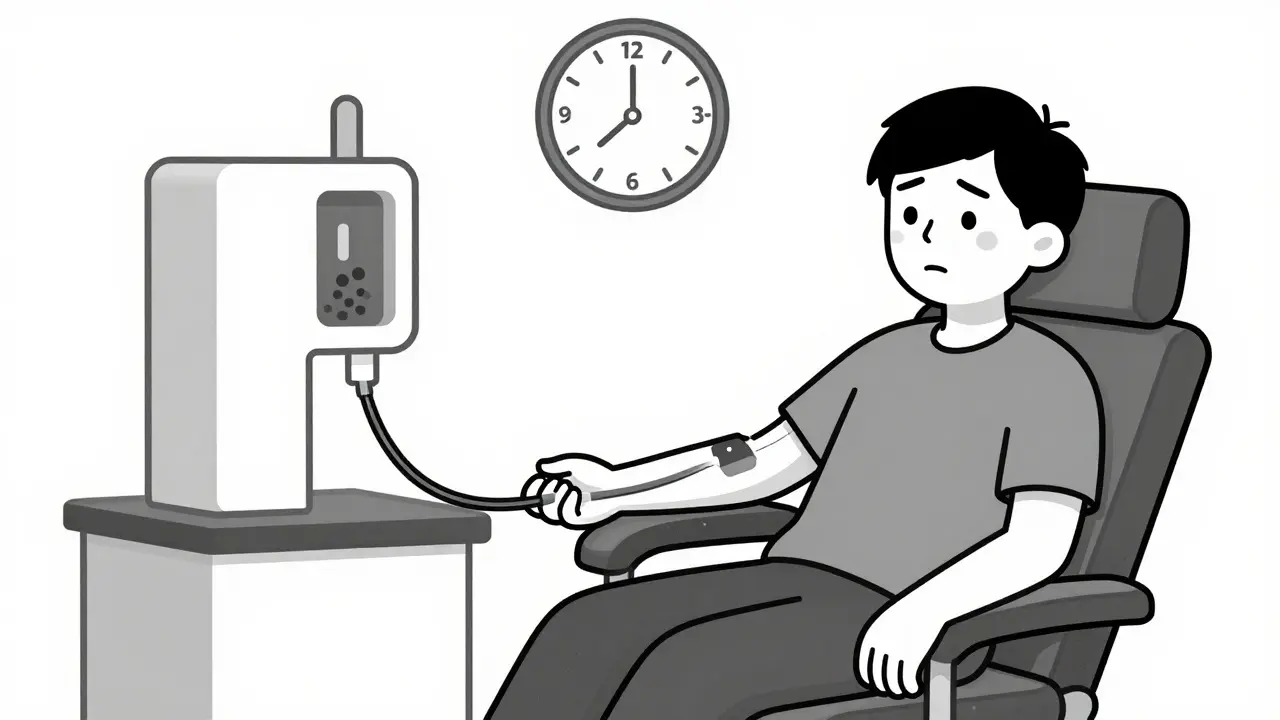
When your kidneys fail, your body can't clean your blood or balance fluids on its own. That’s when dialysis becomes necessary. Two main options exist: hemodialysis and peritoneal dialysis. Both do the same job-removing waste and extra fluid-but they work in completely different ways. Choosing between them isn’t just about medical facts; it’s about your lifestyle, health, and daily reality.
How Hemodialysis Works
How Peritoneal Dialysis Works
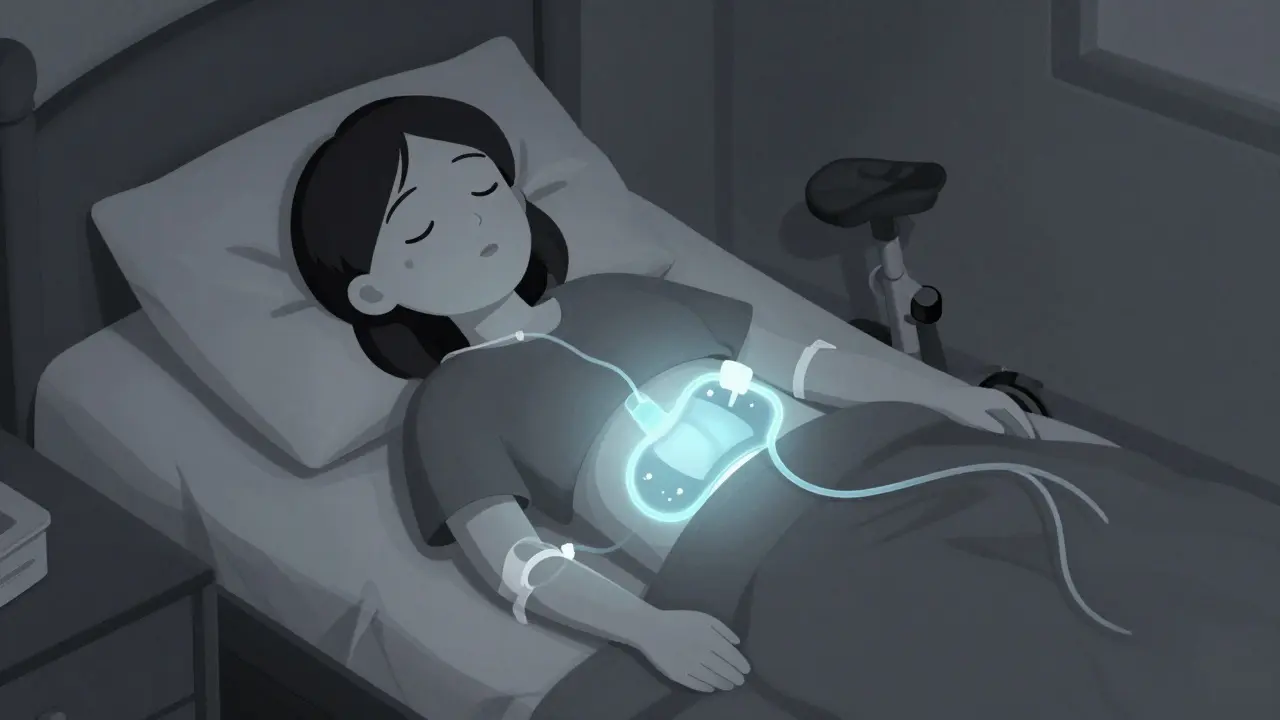
Peritoneal dialysis (PD) uses your own abdominal lining-the peritoneum-as a natural filter. A soft, flexible catheter is surgically placed in your abdomen. Through this, a special fluid called dialysate is introduced. It sits in your belly for 4 to 6 hours, pulling out toxins and excess water through tiny blood vessels in the peritoneal membrane. Then, the fluid drains out naturally. This process repeats several times a day.
There are two types of PD. Continuous Ambulatory Peritoneal Dialysis (CAPD) means you do exchanges manually, usually 3 to 5 times a day. Each exchange takes about 30 minutes. Automated Peritoneal Dialysis (APD) uses a machine, called a cycler, that does the exchanges while you sleep. This lets you go about your day without interruptions.
PD doesn’t need a machine during the day. You just need storage space for dialysate bags and a clean area to work. No needles. No blood outside your body. Many patients appreciate the freedom this gives them.
Clearance and Efficiency
Hemodialysis removes waste quickly. In a single 4-hour session, it clears a lot of toxins. The standard measure, Kt/V, shows HD delivers a value of 1.2 to 1.4 per session. That’s high, but it’s all done in short bursts.
Peritoneal dialysis works slower. Each exchange removes less waste than one HD session. But because PD runs 24/7, the total weekly clearance (Kt/V) often hits 1.7 to 2.1-sometimes even higher than HD. This continuous cleaning means fewer spikes in toxins, less fluid buildup, and more stable blood pressure.
A 2023 study from the National Center for Biotechnology Information (PMC10626077) found PD patients had better control of blood pressure and less strain on the heart. Their levels of intact parathyroid hormone (iPTH), a marker of bone and mineral imbalance, also dropped more than in HD patients. This matters because heart problems are the leading cause of death in dialysis patients.
Side Effects and Risks
Hemodialysis can cause sudden drops in blood pressure during treatment. This leads to dizziness, nausea, or cramping. It also stresses the heart because your body is trying to adjust to rapid fluid removal. Vascular access is another big issue. An AV fistula (a connection between an artery and vein) is the best option, but it takes 6 to 8 weeks to heal. If that’s not possible, a central line is used-but it carries a high risk of infection and clotting.
Peritoneal dialysis has its own risks. The biggest is peritonitis, an infection of the abdominal lining. It happens when bacteria get into the catheter or during fluid exchanges. The rate is 0.3 to 0.7 episodes per patient per year. That sounds low, but it’s serious. It can mean hospitalization, temporary switch to HD, or even catheter removal.
PD also requires strict hygiene. You need to wash your hands, wear a mask, and keep the area clean every time you connect or disconnect fluid. Patients with arthritis, tremors, or poor eyesight may struggle with these steps. Obesity (BMI over 35) or past abdominal surgeries can also make PD unsafe.
Lifestyle Impact
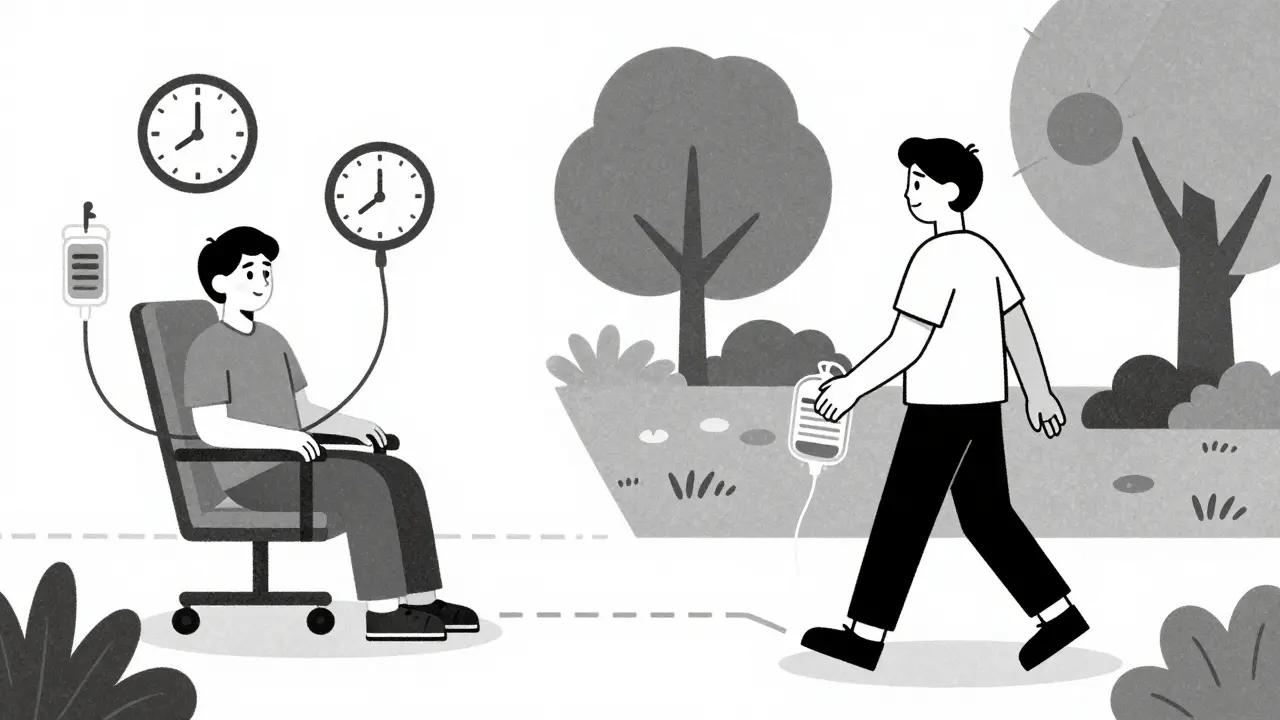
Think about your daily life. Hemodialysis usually means going to a clinic three times a week, for 3 to 5 hours each time. That’s 12 to 15 hours a week just sitting in a chair. Many patients say they feel wiped out for hours afterward. Scheduling vacations, work, or family time becomes harder.
PD offers flexibility. You can do exchanges at home, at work, or even while traveling. APD lets you sleep through treatment. A 2022 National Kidney Foundation survey found 68% of PD users reported higher satisfaction with treatment flexibility than only 32% of HD users. That’s a huge difference in quality of life.
But PD demands responsibility. You’re in charge of every exchange. No one else does it for you. If you forget a cycle, or do it wrong, toxins build up. There’s no nurse nearby to help. This isn’t for everyone.
Cost and Accessibility
Peritoneal dialysis is cheaper overall. It doesn’t require expensive machines, dialysis centers, or staff for every session. A 2023 study in the Journal of Peritoneal Therapy and Clinical Practice found PD offers better value for money. It also reduces hospital stays related to fluid overload or cardiovascular events.
Still, HD dominates in the U.S. About 70% of dialysis patients use in-center hemodialysis. Only 10-15% use PD. Why? Infrastructure. Most clinics are built for HD. Nephrologists are trained mostly in HD. Many patients are never even told about PD as an option.
But things are changing. The Centers for Medicare & Medicaid Services now push home dialysis. By 2025, they want 80% of new patients to be educated about home options. In places like Hong Kong, 77% of dialysis patients use PD. In the U.K., it’s 22%. The U.S. is catching up slowly.
Who’s a Good Candidate for Each?
Choose hemodialysis if:
- You have unstable blood pressure or heart disease that makes continuous filtration risky
- You’re older or have trouble managing complex routines
- You have severe abdominal scarring, hernias, or obesity (BMI > 35)
- You prefer having professionals handle most of your care
Choose peritoneal dialysis if:
- You want more control over your schedule
- You have stable heart function and good blood pressure
- You’re motivated to learn and follow strict hygiene rules
- You have healthy abdominal tissue and no history of major abdominal surgery
- You’re looking for better long-term kidney protection and fewer hospital visits
There’s no one-size-fits-all. The best choice depends on your body, your life, and your goals.
What’s Changing in 2026?
New dialysate solutions, like icodextrin, are helping PD work better for longer. These reduce sugar exposure, which protects the peritoneal membrane over time. New cycler machines are quieter, smarter, and easier to use.
More nephrology training programs are now including PD. The American Society of Nephrology reports that only 34% of fellows got proper PD training in 2022-but that number is rising. Patients are asking for it. And insurers are starting to cover home dialysis better.
By 2027, experts predict PD will rise to 18-22% of U.S. dialysis patients. That’s still less than half of HD, but it’s a big shift from 12% just a few years ago.
Final Thoughts
Hemodialysis isn’t better. Peritoneal dialysis isn’t better. They’re just different. One is fast, scheduled, and managed by staff. The other is slow, continuous, and managed by you.
If you’re newly diagnosed, ask about both. Don’t assume HD is the default. Ask: “Which option gives me the best chance to live longer, feel better, and keep doing the things I love?”
There’s no rush to decide. Talk to your nephrologist. Ask for a PD nurse to explain the process. Watch videos. Talk to other patients. Your kidneys are failing-but your life doesn’t have to stop.

jared baker
March 17, 2026 at 09:30I've been on PD for 3 years now. No needles, no clinic trips. Just clean hands, a quiet space, and my cycler doing its thing while I sleep. It's not perfect, but it lets me work full-time and take my dog on road trips. The biggest win? No more feeling like a zombie after dialysis. I sleep better, eat better, and actually have energy to play with my kids. If you're new to this, give PD a real look. It's not for everyone, but it's way more doable than people think.
Michelle Jackson
March 18, 2026 at 04:21People act like peritoneal dialysis is some kind of miracle cure but let's be real - you're basically living with a permanent belly catheter and praying you don't get peritonitis. One infection and you're back in the hospital. And don't get me started on the hygiene. Wash your hands? Wear a mask? It's like being a surgeon every single day. Hemodialysis is cleaner. Safer. Simpler. Why make your life harder?
Suchi G.
March 18, 2026 at 11:45I read this whole thing and I just felt so deeply for everyone going through this. It’s not just about medical stats or Kt/V numbers - it’s about the quiet moments. The way a mother has to teach herself to change fluid bags with shaky hands because her arthritis is worse than the dialysis. The way a man in his 50s cries because he can’t go fishing anymore and his wife says, 'But you’re alive.' PD gives you back small freedoms - the ability to shower without planning, to wake up and not feel like you’ve been run over by a truck. But it also asks you to be your own nurse, your own advocate, your own hero. And that’s a heavy weight. I wish more people understood how much courage it takes just to show up and do the exchange.
becca roberts
March 19, 2026 at 03:59So let me get this straight - the U.S. still pushes hemodialysis like it’s the only option because ‘that’s how we’ve always done it’? Meanwhile, Hong Kong has 77% of patients on PD and the U.K. is at 22%. We’re literally behind a country with less than half our GDP per capita in healthcare innovation. Who decided we’re too busy to let people live better lives? And why are nephrologists still acting like PD is some weird alternative instead of a mainstream choice? I’m not mad, I’m just disappointed.
Andrew Muchmore
March 20, 2026 at 20:36PD isn't for everyone. But if you're healthy enough to manage it, why wouldn't you? No clinic means no commute, no schedule, no waiting. You control your time. That's priceless. Stop letting fear of infection stop you. Clean technique works. And yes, it's your responsibility. But so is your life.
Paul Ratliff
March 21, 2026 at 19:49I did HD for 2 years. Then switched to APD. Best decision ever. No more 4-hour sessions three times a week. Now I just sleep. Wake up. Go. My boss doesn't even know I'm on dialysis. And yeah, I wash my hands. I wear a mask. It's not hard. It's just different. Stop making it scarier than it is.
SNEHA GUPTA
March 23, 2026 at 11:26There's something deeply human about the idea of using your own body as a filter. The peritoneum - a membrane you never thought about - becomes your lifeline. It's poetic, really. We've turned the body into a machine, but PD reminds us that biology itself can be the cure. We don't need to conquer our bodies. We just need to listen to them. The fluid doesn't need to be perfect. The catheter doesn't need to be invisible. What matters is that you're still here, still choosing, still doing it yourself. That's not just treatment. That's dignity.
Gaurav Kumar
March 24, 2026 at 07:47In India, PD is the standard. Why? Because we know how to make do with less. We don't have fancy clinics everywhere. We don't wait for permission. We adapt. The U.S. is stuck in a system built for profit, not patients. PD works. It's cheaper. It's better. But Americans are too scared to take responsibility. They want someone else to do it for them. That's not healthcare. That's dependency. We should be proud of how we manage this - not ashamed.
jared baker
March 25, 2026 at 04:10To the person who said PD is 'too risky' - I had two peritonitis episodes in three years. Both were caught early. Both were treated in 48 hours. I didn't lose my catheter. I didn't go back to HD. I just changed my technique. You're not helpless. You're learning. And every time you do an exchange, you're proving you can still control your life.