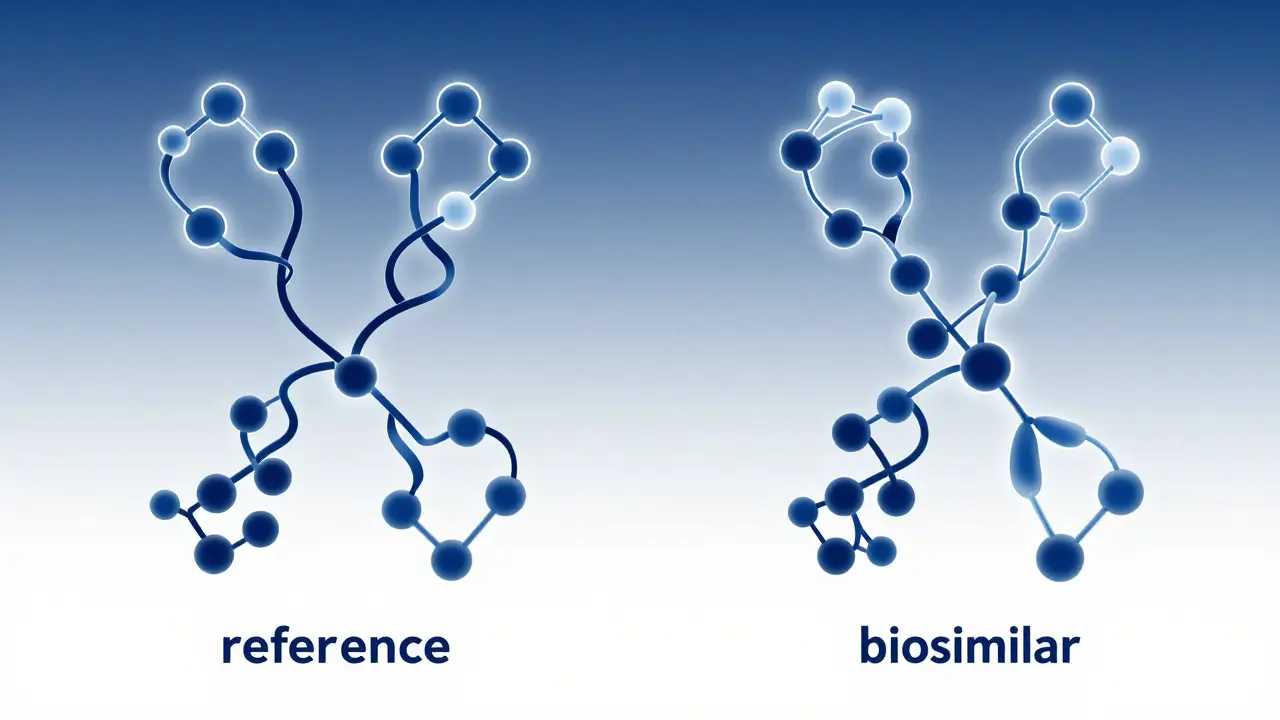
When you're dealing with a chronic condition like rheumatoid arthritis or certain types of cancer, the medication you use isn't just a pill-it's a complex biological machine. For years, these "reference biologics" were the only option, but now you'll often hear your doctor mention a biosimilar. The big question is always the same: does the cheaper version actually work as well, or are you sacrificing quality for cost?
The short answer is yes. To understand why, we first need to clear up a common misconception. A biosimilar is a biologic medical product that is highly similar to an already approved reference biologic drug, with no clinically meaningful differences in safety, purity, and potency. Unlike a generic version of a simple chemical drug (like aspirin), which is an exact chemical copy, biosimilars are nearly identical but not perfect clones because they are grown in living cells. However, that tiny difference doesn't mean they perform differently in your body.
The Proof in the Numbers: Clinical Performance
If you're worried that a biosimilar might be "watered down," the data says otherwise. In oncology, for example, a massive 2022 meta-analysis of over 1,700 patients across six different disease settings-including lung, breast, and colorectal cancers-found that biosimilars were statistically comparable to the reference drugs. The overall response rates were nearly identical. When comparing a bevacizumab biosimilar to the original, the ratio was 1.02 for non-small cell lung cancer, meaning the outcome was effectively the same.
It's not just about the big trials, either. Real-world evidence from the National Health Service (NHS) in the UK, where biosimilar use is incredibly high, showed no increase in adverse events after switching 12,000 patients to a rituximab biosimilar for non-Hodgkin's lymphoma. Whether it's a controlled study or a hospital system with thousands of patients, the trend is clear: the clinical outcomes don't budge when you switch to a biosimilar.
How They Are Tested (And Why It's So Strict)
You might wonder how regulators can be so sure. The approval process for a biosimilar is actually more rigorous in some ways than the original drug's path. To get a biosimilar approved, manufacturers must perform 200 to 300 different analytical tests across multiple batches to prove the structure and function are the same. They also conduct pharmacokinetic (PK) studies to ensure the drug moves through the body at the same speed and concentration.
Interestingly, biosimilar trials are often designed better than the original trials. About 84% of biosimilar trials are double-blinded, compared to only 17% of the original reference drug trials. This means there's actually less bias in the data we have for biosimilars than we do for some of the "gold standard" drugs they are mimicking.
| Feature | Reference Biologic | Biosimilar |
|---|---|---|
| Composition | Complex protein from living cells | Highly similar complex protein |
| Approval Path | Full clinical trials for safety/efficacy | Comparative analytical & clinical similarity |
| Cost | Higher (Original Patent) | Typically 15-85% lower |
| Clinical Outcome | Established benchmark | Comparable (No meaningful difference) |

Real-World Experience: What Patients Are Saying
Numbers are great, but how does it feel in real life? On patient communities like PatientsLikeMe, the feedback is overwhelmingly positive. In one analysis of over 1,200 patients using an adalimumab biosimilar, 87% reported equivalent symptom control compared to 89% using the reference product, Humira. The difference is negligible.
The Arthritis Foundation found that 92% of patients who switched from reference infliximab to the biosimilar Inflectra saw no change in their disease control. In fact, 6% actually felt an improvement. While some people on forums like Reddit report flares after a switch, doctors often point out that these are likely coincidences-natural disease fluctuations-rather than a failure of the drug itself.
The Cost Benefit: Why Switch?
If the outcomes are the same, why not just use biosimilars for everyone? The answer is simple: money. Biologics are incredibly expensive to produce and buy. In the U.S., biosimilars are typically 15-30% cheaper, while in Europe, they can be 25-85% cheaper. This isn't just about corporate profits; it's about patient access. When drugs are cheaper, more people can afford the therapy they need to stay in remission.
The Congressional Budget Office estimates that biosimilar competition could save the U.S. healthcare system a staggering $169 billion over the next decade. For a patient on a tight budget, this is the difference between sticking to a treatment plan and skipping doses.
Addressing the Risks: Immunogenicity and Switching
One valid concern that experts like Dr. Paul Kim from UCLA mention is immunogenicity. Because biologics are proteins, your immune system could theoretically recognize a biosimilar as a "foreign" object and create antibodies against it. While this is a theoretical risk, real-world evidence hasn't shown a significant increase in these reactions compared to the original drugs.
There is also the question of switching. Some patients worry that moving from one brand to another mid-treatment will cause a flare. However, the FDA has a specific category called "interchangeable biosimilars," which requires extra data to prove that switching back and forth doesn't increase risk or lower efficacy. Even for non-interchangeable biosimilars, studies in clinical rheumatology show that switching between different adalimumab biosimilars doesn't negatively affect drug retention rates.
Common Hurdles to Adoption
Despite the evidence, some doctors remain hesitant. A survey by the Alliance for Safe Biologic Medicines found that 38% of U.S. physicians were concerned about efficacy. This usually comes down to a lack of familiarity or misinformation rather than clinical data. Many providers are simply used to the original brand and are wary of changing a winning formula.
Pharmacy benefit managers (PBMs) also create hurdles by restricting which biosimilars are on their formularies. This can make it frustrating for a doctor to prescribe the most cost-effective option if the insurance company doesn't cover it. Despite this, adoption is growing, especially in rheumatology and gastroenterology, where the need for long-term, sustainable therapy is highest.
Are biosimilars just generic versions of biologics?
Not exactly. While they serve the same purpose as generics, they aren't identical copies. Because biologics are made from living cells, there are always slight variations. A biosimilar is "highly similar" and has no clinically meaningful difference in how it works compared to the original.
Will switching to a biosimilar cause my symptoms to return?
Clinical data from thousands of patients suggest that switching is safe. Most patients report no change in disease control. If a flare occurs, it is usually attributed to the natural progression of the disease rather than the switch itself.
Why are biosimilars cheaper if they are just as good?
The original manufacturer spent billions on the initial research and development (R&D) and held a patent. Biosimilar manufacturers don't have to repeat the original discovery phase; they only need to prove the product is similar to the existing one, which significantly lowers development costs.
How do I know if a biosimilar is approved in the U.S.?
The FDA maintains the "Purple Book," which is a comprehensive list of all approved biological products and their biosimilar counterparts. It is updated monthly and is the gold standard for checking approval status.
Can I switch between different biosimilars?
Yes, and studies show that switching between different biosimilars of the same reference product (like different versions of adalimumab) does not significantly impact the long-term success of the treatment.