
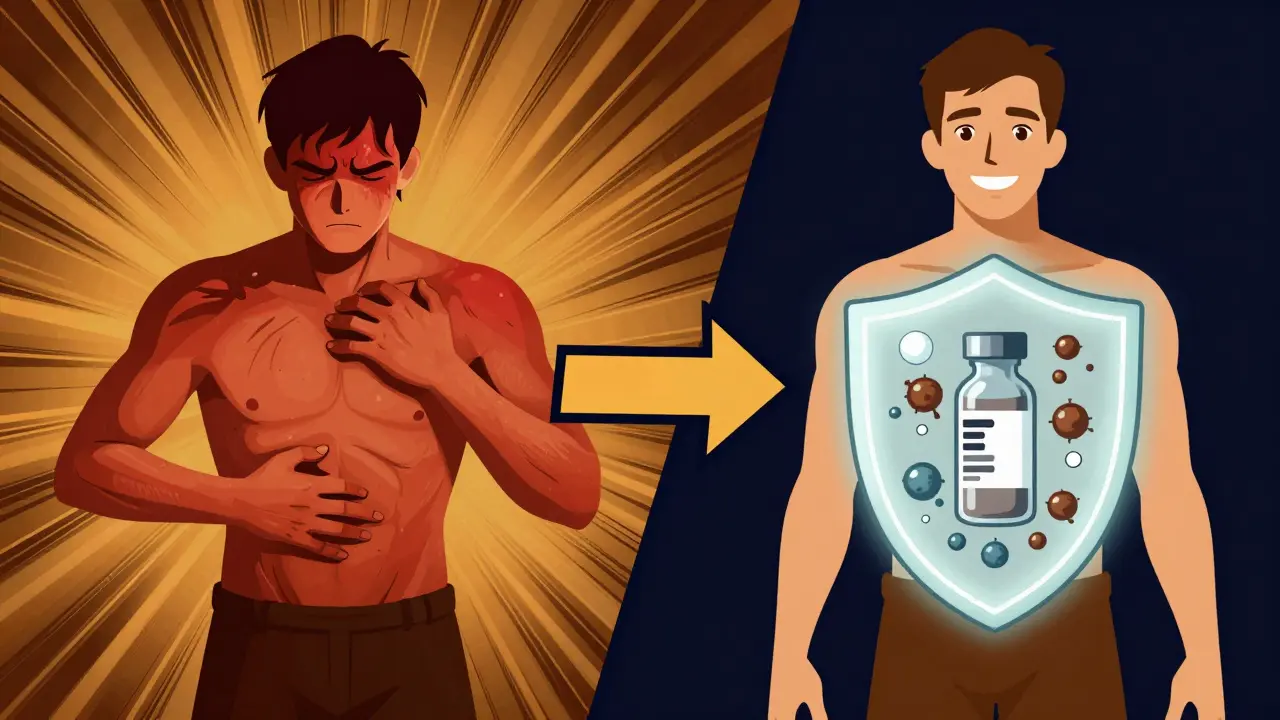
Shingles isn’t just a rash. For many, it’s months of burning pain that won’t go away-even after the blisters heal. That lingering pain is called postherpetic neuralgia, and it affects nearly 1 in 5 people who get shingles. The good news? There’s a vaccine that works better than anything we’ve had before. It’s called Shingrix, and it’s the only shingles vaccine available in the U.S. right now. But who needs it? And when should you get it? The answers aren’t as simple as ‘over 60’ anymore.
Who Needs the Shingles Vaccine?
You don’t have to be old to get shingles. The virus that causes it-varicella zoster-is the same one that gives you chickenpox. After you recover, it hides in your nerves. Years later, maybe when you’re stressed, sick, or just aging, it wakes up. That’s shingles.
The CDC recommends Shingrix for everyone 50 and older, no matter if you’ve had shingles before or not. Even if you got the old vaccine (Zostavax), you still need Shingrix. Zostavax was pulled from the market in 2020 because it wasn’t strong enough. Shingrix cuts your risk of shingles by over 90% if you’re 50 to 69. For those 70 and up, it still works at 91% effectiveness.
Here’s the key change: You don’t have to wait until you’re 60 or 65. Starting at age 50 is now the standard. The American Geriatrics Society says doctors should bring it up with patients as soon as they hit 50. Why? Because your risk goes up every year after 50. By 85, one in four people will get shingles.
And if you’re immunocompromised? That’s even more important. People with diabetes, cancer, HIV, or those on steroids or biologics are at higher risk for severe shingles. Shingrix is safe for them-unlike the old vaccine, which used a live virus and could be dangerous. The CDC now says adults 19 and older with weakened immune systems should get Shingrix too.
When Should You Get It?
Shingrix isn’t a one-shot deal. It’s two doses. The second shot should be given 2 to 6 months after the first. That’s the sweet spot. If you wait longer than 6 months, you don’t need to start over. Just get the second dose as soon as you can.
But there’s a twist for certain people. If you’re about to start chemotherapy, an organ transplant, or another treatment that weakens your immune system, you can get the second dose as early as 1 month after the first. That’s a big deal. It means you can still protect yourself even if you’re heading into a high-risk period.
Don’t wait until you’re in the middle of a flare-up. If you’ve had shingles recently, wait at least until the rash is completely gone. Most doctors suggest waiting at least a year before getting vaccinated, just to be safe. But if you’re immunocompromised, talk to your doctor-some may recommend it sooner.
One of the biggest problems? People don’t come back for the second shot. Studies show about 1 in 3 people skip it. That cuts the protection in half. If you get the first dose, make a note. Set a reminder. Ask your pharmacist to call you. Kaiser Permanente used automated texts and got 89% of people to return for the second shot. You can do the same.
What Are the Side Effects?
Let’s be honest: Shingrix hurts-more than most vaccines. About 78% of people feel pain at the injection site. Nearly half get muscle aches. One in three feels tired. One in three gets a headache. Some even get a fever or nausea for a day or two.
It’s not dangerous. It’s just intense. And it’s temporary. Most side effects fade in 2 to 3 days. But here’s the catch: If you’ve got a big event coming up-a wedding, a trip, a job interview-don’t schedule your shot within 48 hours. A lot of people regret it when they’re stuck in bed after the second dose.
And here’s something surprising: People with weakened immune systems often report milder side effects than those with healthy immune systems. Why? Because Shingrix works by turning up your body’s alarm system. If your alarm is already quiet, the vaccine doesn’t trigger as big a response.
The rarest risk? A severe allergic reaction. That’s why you’re asked to wait 15 minutes after the shot. If you’ve ever had a serious reaction to any vaccine ingredient-like polysorbate 80 or any component of Shingrix-you shouldn’t get it. Talk to your doctor first.
How Much Does It Cost?
Shingrix isn’t cheap. Each dose costs around $185 to $220 out-of-pocket in 2024. But most people pay nothing. Medicare Part D covers it fully. Private insurance usually does too. If you’re on Medicaid or have no insurance, many public health clinics offer it for free or at low cost.
Here’s what most people don’t realize: Shingrix is covered under Part D, not Part B. That means you can get it at your pharmacy, not just your doctor’s office. Pharmacists are trained to give it. You don’t need a prescription if your plan covers it. Just walk in.
If you’re being charged more than $50 per dose, ask if your plan has a preferred pharmacy. Some plans have lower copays at certain chains. And if you’re struggling to pay, GlaxoSmithKline offers a patient assistance program. You can apply online.
Why Shingrix Over Anything Else?
There used to be another vaccine: Zostavax. It was a live virus shot. It only worked about half as well. It didn’t protect older adults well. And it was dangerous for people with weak immune systems. It’s gone now.
Shingrix is a different kind of vaccine. It doesn’t use the live virus. Instead, it uses a piece of the virus-glycoprotein E-plus a special booster called AS01B. That’s why it’s so effective. It doesn’t trick your body into thinking it’s infected. It shows your immune system exactly what to fight, and then gives it a powerful nudge to remember.
Studies show it protects against shingles for at least 7 years. Some experts think it could last longer. We don’t know yet. But we do know that even after 7 years, people who got Shingrix are still far less likely to get shingles than those who never got vaccinated.
And it doesn’t just prevent the rash. It cuts the risk of postherpetic neuralgia by over 90%. That’s the real win. Because shingles pain can last years. Some people can’t sleep. Some can’t wear clothes. Some can’t work. Shingrix stops that before it starts.
What’s Next for the Shingles Vaccine?
Science doesn’t stop. GlaxoSmithKline is testing a single-dose version of Shingrix in Phase II trials. If it works, it could change everything. No second shot. No missed appointments. Just one visit. That could push vaccination rates way up.
Merck is also working on a new shingles vaccine, but it’s still years away. For now, Shingrix is the only game in town.
Meanwhile, public health groups are pushing to vaccinate people earlier. The idea isn’t just to protect seniors-it’s to stop shingles before it has a chance to become a problem. If you’re 50 or older, this isn’t a ‘maybe.’ It’s a ‘when.’
What If You’re Still Unsure?
Some people hold off because they think, ‘I never got chickenpox.’ But if you were born before 1980, you almost certainly had it-even if you didn’t know it. Most adults over 50 have the virus in their nerves.
Others worry about side effects. But the fear of a few days of fatigue is nothing compared to the risk of chronic pain that lasts for years. Over 1 million cases of shingles happen in the U.S. every year. Almost all of them are preventable.
If you’re still unsure, talk to your doctor. Or your pharmacist. They’ve seen the data. They’ve seen the patients. They know how much worse shingles gets with age.
Shingrix isn’t perfect. It’s not painless. It’s not free. But it’s the best tool we have to stop a disease that can ruin your life. And if you’re 50 or older, it’s not a luxury. It’s a shield.
Do I need the shingles vaccine if I already had shingles?
Yes. Having shingles once doesn’t protect you from getting it again. The CDC recommends getting Shingrix even if you’ve had shingles before. Wait until the rash is completely gone-usually a few weeks-before getting vaccinated. Most doctors suggest waiting at least a year, but if you’re immunocompromised, ask your provider about getting it sooner.
Can I get Shingrix at the same time as my flu shot or COVID booster?
Yes. Shingrix can be given at the same visit as other vaccines, including flu, pneumonia, or COVID-19 shots. You’ll get them in different arms to avoid confusion about side effects. There’s no evidence that combining them reduces effectiveness or increases risks.
Is Shingrix safe if I have an autoimmune disease?
Yes. Shingrix is non-live, so it’s safe for people with autoimmune conditions like lupus, rheumatoid arthritis, or multiple sclerosis-even if they’re on immunosuppressants. The CDC specifically recommends it for adults 19 and older with these conditions. Talk to your doctor about timing if you’re starting a new treatment.
What if I miss the 2-6 month window for the second dose?
Don’t panic. If you’re more than 6 months late, just get the second dose as soon as you can. You don’t need to restart the series. The protection from the first dose lasts longer than most people think. The CDC says there’s no maximum time limit between doses. Just don’t wait years-get it done.
Can I get Shingrix if I’m under 50?
Only if you’re 19 or older and immunocompromised. For healthy adults under 50, it’s not currently recommended. The risk of shingles is low before 50, and the vaccine’s long-term protection is best studied in older adults. But if you’ve had recurrent shingles or a severe case under 50, talk to your doctor-they may still recommend it off-label.

Adarsh Uttral
January 30, 2026 at 12:23shingrix hurt like a b*tch but worth it. got both shots, felt like i got hit by a truck for two days. no shingles since. my uncle got it at 62 and still got the rash bad. he didnt get the second shot. dumb move.
Niamh Trihy
January 31, 2026 at 00:09Just want to clarify something-Shingrix’s AS01B adjuvant is what makes it so effective in older adults and immunocompromised folks. It’s not just the glycoprotein E; it’s the immune system’s enhanced dendritic cell activation that drives the long-term memory response. Most people don’t realize that’s why it outperforms live-virus vaccines by such a wide margin.
April Allen
February 1, 2026 at 01:25As someone who’s managed autoimmune patients for over a decade, I’ve seen too many avoid this vaccine because they think ‘it’s live’ or ‘it’ll trigger flares.’ Shingrix is subunit, non-replicating, and safe-even on TNF inhibitors. The real risk is *not* getting it. Postherpetic neuralgia isn’t just pain-it’s neuroinflammation that can persist for years. I’ve had patients on disability because they waited. Don’t be one of them.
Eliana Botelho
February 2, 2026 at 06:28Okay but like… why does it have to be TWO shots? I get it, science, but I’m 54 and I already hate going to the doctor. I got the first one, then my cat died, then my knee started acting up, then my sister got diagnosed with cancer, then I forgot, then I felt guilty, then I thought maybe I don’t need it because I’ve never had chickenpox (but I totally had it in 1987 and just didn’t know it), then I saw a meme that said ‘Shingrix is just Big Pharma’s way of making you pay twice for the same thing’ and now I’m confused. Also, I’m not getting it until after my vacation in June. I’ve got a wedding to attend and I’m not spending my honeymoon in bed crying because my arm hurts.
Jason Xin
February 3, 2026 at 07:54My wife got Shingrix last year. Side effects? She was out for 48 hours. But she also didn’t get shingles. Meanwhile, her brother, who skipped it, got it at 68-three months of nerve pain, morphine patches, couldn’t wear a shirt. He’s still on gabapentin. So yeah. The pain isn’t from the shot. It’s from skipping it.
Katie and Nathan Milburn
February 4, 2026 at 09:11It is worth noting that the two-dose regimen, while inconvenient, has demonstrated sustained immunogenicity beyond seven years in longitudinal cohort studies. The durability of the immune response appears to be dose-dependent and adjuvant-mediated, which is why the CDC maintains its recommendation despite logistical challenges in adherence. Public health campaigns should prioritize reminder systems, as demonstrated by Kaiser Permanente’s success.
Shawn Peck
February 4, 2026 at 13:45You people are overcomplicating this. It’s a shot. Two of them. It hurts. You live. If you don’t get it, you might end up screaming in pain for years. That’s it. Stop talking. Go get it. Your future self will thank you. I’m not even joking.
Sheila Garfield
February 4, 2026 at 20:40My dad got Shingrix last year after he had a mild case of shingles at 61. He was terrified of the side effects, but he said the worst part was the guilt of waiting. Now he’s telling everyone at his senior center to get it. I think the real victory isn’t just avoiding the rash-it’s avoiding the fear. That’s the thing nobody talks about.